Venue guide

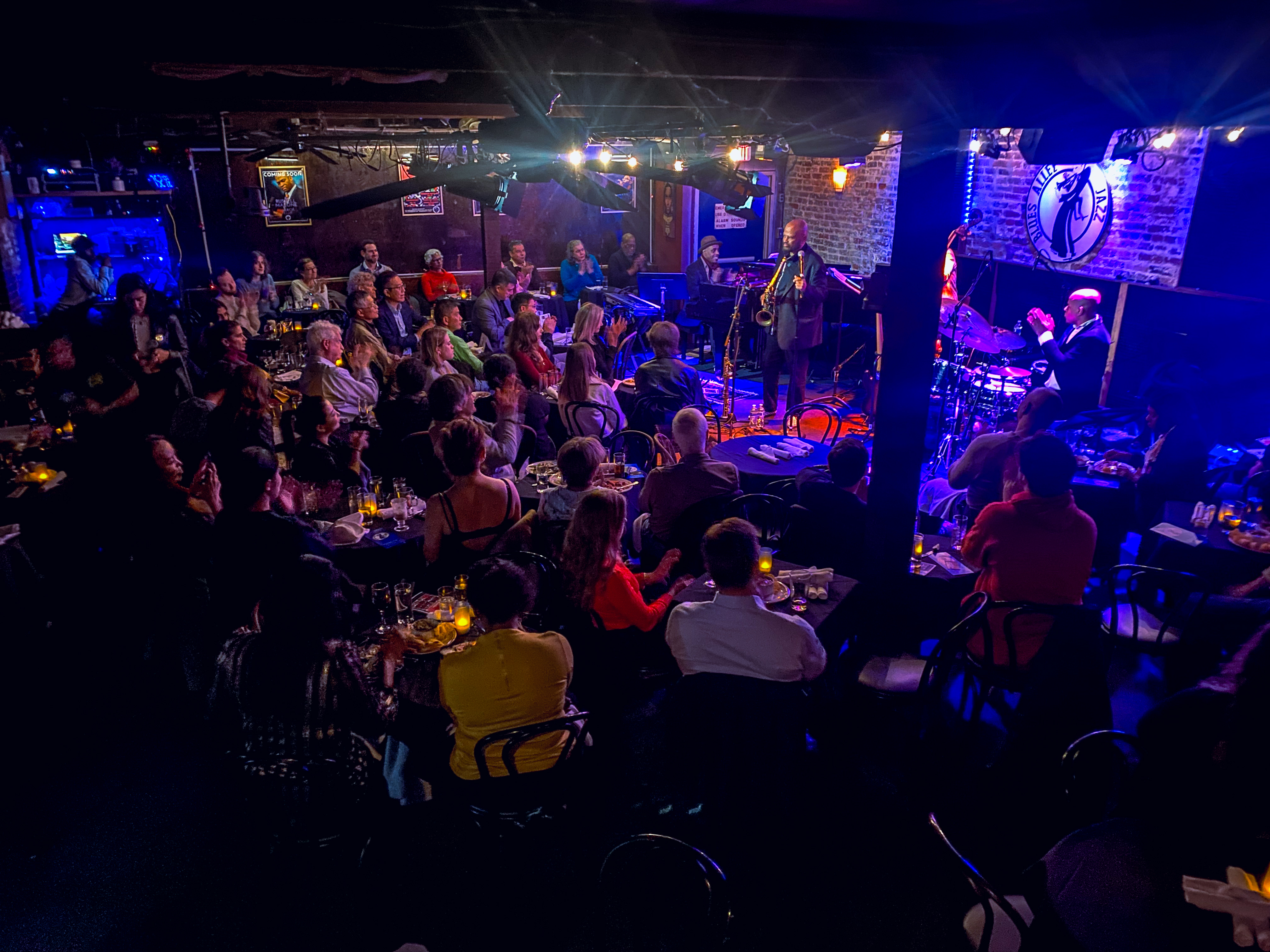
Blues Alley jazz shows

Georgetown · Washington

Blues Alley is a Georgetown jazz supper club with multiple nightly ticketed sets.

The highest-signal direct venue for D.C. launch coverage, especially for touring artists and club-format sets.

Official venue site
Georgetownsupper clubtouring artistsearly and late sets

This Month / 338 shows

Live Jazz in Washington, D.C.

Find what is happening tonight, tomorrow, and this week across D.C. jazz rooms and the wider DMV scene, with ticket status and neighborhood context first.

9

Tonight

17

Tomorrow

84

Week

338

Month

Wed, Jun 10, 7:00 PM

Blues Alley / Georgetown

Now

9 musicians / 5 instruments / 57 venues / 32 neighborhoods

(Blues Alley) Filtered Results: 57Clear Venue Filter

Shows

57 this month

Wed, Jun 10, 7:00 PM

INSTRUMENTS

As Is - the project led by guitarist Al Schulman and vocalist Stacey Schulman debut their 3rd album "Crazy World" - an expansive mix of jazz, pop, Brazilian repertoire, soul, and original material. Building off their trajectory that has widened from intimate duo settings into increasingly flexible ensemble forms, the set will feature a mix of genres, while rooting itself even deeper in the fundamentals of song and human connection. Their name "As Is" reflects the project’s guiding principle: meeting the music — and the moment — exactly where it stands, without nostalgia, novelty, or artifice. Described as “nothing short of enchanting” (All About Jazz), As Is—the musical partnership of jazz guitarist Al Schulman and vocalist Stacey Lynn Schulman—brings a deeply personal, imaginative voice to the jazz canon. Known for reinterpreting 20th-century song classics with both reverence and originality, the duo creates performances that feel at once intimate and expansive. As Jazz Mostly notes, “they find new ways to approach the songs…preserving the origins while making them deeply personal statements.” As Is has toured across the U.S., Europe, and Asia, collaborating with leading contemporary jazz artists including Marcus Baylor, David Binney, Christie Dashiell, Corcoran Holt, Kokayi, and Grégoire Maret. Their performances are marked by a rare musical chemistry—“energetic and contagious” (The Jazz Page)—and a commitment to storytelling that resonates across audiences. Originally from Cincinnati, Ohio, Al Schulman studied with legendary guitarist Cal Collins (Benny Goodman Orchestra) and later became a fixture in the Chicago jazz scene before earning his Master’s degree in Jazz Arranging & Composition from Howard University in Washington, DC. A Thelonious Monk Competition Top-10 finalist, he has performed with artists including Herbie Hancock, Wynton Marsalis, Anita Baker, and Michael Feinstein, and is recognized for his “soft, round tone” (All About Jazz) and a “sparking” guitar presence (DownBeat contributor Dan Ouellette). Stacey Lynn Schulman, a New York native, has been performing professionally since childhood, with credits spanning radio, television, film, and theater. Her “alluring, captivating” voice (DownBeat contributor Dan Ouellette) has been described as “fresh and vibrant” (Jazz Mostly), with the versatility and interpretive depth to “summon delicate lace on one song and a bouncy jam on another” (All About Jazz). The duo’s discography began in Rome with A Love Like Ours (2015), followed by their breakthrough sophomore album, Here’s to Life (2018), produced by Grammy-nominated James McKinney and featuring liner notes by DownBeat contributor Dan Ouellette. Recorded in New York City and embraced by jazz radio, the album debuted at #1 on Amazon Jazz, #6 on iTunes Jazz, and reached #9 on Billboard’s Traditional Jazz Chart. With their third album Crazy World (May 2026), As Is expands its artistic scope—exploring themes of humanity, connection, and authenticity in an increasingly complex cultural landscape. The album features liner notes by Keanna Faircloth (WPFW, Washington, DC / WBGO, New York), who notes that “every track carries an emotional charge that feels distinctly human.”

Thu, Jun 11, 7:00 PM

Fareed Haque's trio ventures into new territory, devoloping his classical guitar inspired fingerstyle arrangements of classic jazz, funk and latin standards and unique compositions. Playing music from Bill Evans and McCoy Tyner to Sergio Mendes and The Meters as well as a healthy dose of original music this trio redfines the contrapuntal possibilities of the guitar in a trio setting. Featuring the legendary Mike Clark and incredible Peter Washington on bass. Fareed Haque is a guitar virtuoso known for blending classical and jazz traditions in his music. Born to a Pakistani father and Chilean mother in 1963, he was exposed to various musical styles early on. His talent was honed at North Texas State University and Northwestern University. Haque’s career took off after joining Howard Levy’s Chevere and later, Paquito D’Rivera’s ensemble, with whom he toured and recorded extensively. His versatility led him to work with Sting and record two albums on Pangaea. He also made notable appearances at the Montreux Jazz Festival. At Bluenote Records, Haque released three albums, collaborated with numerous jazz greats, and performed classical recitals, highlighting his diverse range. Joining Joe Zawinul’s Syndicate brought him back to his Jazz/Rock roots. In 2001, he co-founded the jam band Garaj Mahal and later, MathGames, exploring electronic music and the Moog Guitar. His compositions, including a double concerto premiered by The Chicago Sinfonietta, and his Gamelan Concerto, showcase his compositional talent. Haque has received multiple accolades, including ‘Best World Guitarist’ by Guitar Player Magazine in 2009. His recent work includes performances with jazz and classical ensembles and the release of several albums like “Out of Nowhere” and “Trance Hypothesis.” He continues to direct jazz festivals, perform worldwide, and teach, with recent projects featuring global artists and a renewed partnership with Goran Ivanovic. After a long tenure at Northern Illinois University, Haque is focusing on touring and recording, reflecting his enduring passion for music.

Thu, Jun 11, 9:30 PM

Fareed Haque's trio ventures into new territory, devoloping his classical guitar inspired fingerstyle arrangements of classic jazz, funk and latin standards and unique compositions. Playing music from Bill Evans and McCoy Tyner to Sergio Mendes and The Meters as well as a healthy dose of original music this trio redfines the contrapuntal possibilities of the guitar in a trio setting. Featuring the legendary Mike Clark and incredible Peter Washington on bass. Fareed Haque is a guitar virtuoso known for blending classical and jazz traditions in his music. Born to a Pakistani father and Chilean mother in 1963, he was exposed to various musical styles early on. His talent was honed at North Texas State University and Northwestern University. Haque’s career took off after joining Howard Levy’s Chevere and later, Paquito D’Rivera’s ensemble, with whom he toured and recorded extensively. His versatility led him to work with Sting and record two albums on Pangaea. He also made notable appearances at the Montreux Jazz Festival. At Bluenote Records, Haque released three albums, collaborated with numerous jazz greats, and performed classical recitals, highlighting his diverse range. Joining Joe Zawinul’s Syndicate brought him back to his Jazz/Rock roots. In 2001, he co-founded the jam band Garaj Mahal and later, MathGames, exploring electronic music and the Moog Guitar. His compositions, including a double concerto premiered by The Chicago Sinfonietta, and his Gamelan Concerto, showcase his compositional talent. Haque has received multiple accolades, including ‘Best World Guitarist’ by Guitar Player Magazine in 2009. His recent work includes performances with jazz and classical ensembles and the release of several albums like “Out of Nowhere” and “Trance Hypothesis.” He continues to direct jazz festivals, perform worldwide, and teach, with recent projects featuring global artists and a renewed partnership with Goran Ivanovic. After a long tenure at Northern Illinois University, Haque is focusing on touring and recording, reflecting his enduring passion for music.

Fri, Jun 12, 7:00 PM

with Lorin Cohen, Bass and Jason Brown, drums Born on June 6, 1944, Monty Alexander belongs to a generation of modern jazz piano heroes. From a multicultural, multi-ethnic universe, somewhere between jazz and reggae, he’s a true champion of the Great American Song Book and the world’s finest avatar of Jamaican jazz. Monty’s music combines the rhythms of his native West Indian Caribbean land with North-American harmonies and forms. At 16, he was already expert in all the dance musics of the day: cha-cha, merengue, calypso... “It was music with a beat, and depending how you attack the rhythm, how fierce the rhythm would get, people would want to dance and clap their hands. The music came up with that certain identifiably Jamaican accent or rhythm, the way people talk walk or drive,” he remembers. Exposed to all types of music at dances, he also developed a passion for rhythm’ n blues as well as for Nat King Cole or the inventors of bebop, who he heard on the radio and sought to play be ear. Monty also took part in the early days of ska in the Kingston studios that arranged his first engagements. At 17, he moved to the United States, where he didn’t take long to be noticed by a certain Frank Sinatra, who eased his rip-roaring entry into the big league of the jazzmen of the day. Monty accompanied the great figures of be-bop including Milt Jackson, Dizzy Gillespie, Johnny Griffin and Benny Golson. To this day he carries on the tradition of the full orchestral swinging pianists started by Nat King Cole (in his turn influenced by Earl Fatha Hines), and continued on by Erroll Garner, Oscar Peterson, Ahmad Jamal and Wynton Kelly, all of whom he forged close friendships with in the early 60’s. He recorded for Pacific Jazz for the first time under his name at the age of 20. Alexander The Great was and is a supercharged album that introduced the world to the young prodigy. Critics spoke of “accessible jazz, joyous swing, effusive, without histrionics”. These early years left Alexander with an indelible impression of a wide-open window onto an eclectic world. Armed with an intransigent spirit, a total commitment to his art and incredible musical intuition, he has since developed an instantly recognizable style and has recorded over 75 albums to date. As with many jazz giants, Europe in the sixties, seventies and eighties was a fundamental haven for Alexander and it was also where his international stature grew. A documentary about his life is currently in the works. After a career spanning over 60 years, he’s still writing musical history today.

Fri, Jun 12, 9:30 PM

with Lorin Cohen, Bass and Jason Brown, drums Born on June 6, 1944, Monty Alexander belongs to a generation of modern jazz piano heroes. From a multicultural, multi-ethnic universe, somewhere between jazz and reggae, he’s a true champion of the Great American Song Book and the world’s finest avatar of Jamaican jazz. Monty’s music combines the rhythms of his native West Indian Caribbean land with North-American harmonies and forms. At 16, he was already expert in all the dance musics of the day: cha-cha, merengue, calypso... “It was music with a beat, and depending how you attack the rhythm, how fierce the rhythm would get, people would want to dance and clap their hands. The music came up with that certain identifiably Jamaican accent or rhythm, the way people talk walk or drive,” he remembers. Exposed to all types of music at dances, he also developed a passion for rhythm’ n blues as well as for Nat King Cole or the inventors of bebop, who he heard on the radio and sought to play be ear. Monty also took part in the early days of ska in the Kingston studios that arranged his first engagements. At 17, he moved to the United States, where he didn’t take long to be noticed by a certain Frank Sinatra, who eased his rip-roaring entry into the big league of the jazzmen of the day. Monty accompanied the great figures of be-bop including Milt Jackson, Dizzy Gillespie, Johnny Griffin and Benny Golson. To this day he carries on the tradition of the full orchestral swinging pianists started by Nat King Cole (in his turn influenced by Earl Fatha Hines), and continued on by Erroll Garner, Oscar Peterson, Ahmad Jamal and Wynton Kelly, all of whom he forged close friendships with in the early 60’s. He recorded for Pacific Jazz for the first time under his name at the age of 20. Alexander The Great was and is a supercharged album that introduced the world to the young prodigy. Critics spoke of “accessible jazz, joyous swing, effusive, without histrionics”. These early years left Alexander with an indelible impression of a wide-open window onto an eclectic world. Armed with an intransigent spirit, a total commitment to his art and incredible musical intuition, he has since developed an instantly recognizable style and has recorded over 75 albums to date. As with many jazz giants, Europe in the sixties, seventies and eighties was a fundamental haven for Alexander and it was also where his international stature grew. A documentary about his life is currently in the works. After a career spanning over 60 years, he’s still writing musical history today.

Sat, Jun 13, 7:00 PM

with Lorin Cohen, Bass and Jason Brown, drums Born on June 6, 1944, Monty Alexander belongs to a generation of modern jazz piano heroes. From a multicultural, multi-ethnic universe, somewhere between jazz and reggae, he’s a true champion of the Great American Song Book and the world’s finest avatar of Jamaican jazz. Monty’s music combines the rhythms of his native West Indian Caribbean land with North-American harmonies and forms. At 16, he was already expert in all the dance musics of the day: cha-cha, merengue, calypso... “It was music with a beat, and depending how you attack the rhythm, how fierce the rhythm would get, people would want to dance and clap their hands. The music came up with that certain identifiably Jamaican accent or rhythm, the way people talk walk or drive,” he remembers. Exposed to all types of music at dances, he also developed a passion for rhythm’ n blues as well as for Nat King Cole or the inventors of bebop, who he heard on the radio and sought to play be ear. Monty also took part in the early days of ska in the Kingston studios that arranged his first engagements. At 17, he moved to the United States, where he didn’t take long to be noticed by a certain Frank Sinatra, who eased his rip-roaring entry into the big league of the jazzmen of the day. Monty accompanied the great figures of be-bop including Milt Jackson, Dizzy Gillespie, Johnny Griffin and Benny Golson. To this day he carries on the tradition of the full orchestral swinging pianists started by Nat King Cole (in his turn influenced by Earl Fatha Hines), and continued on by Erroll Garner, Oscar Peterson, Ahmad Jamal and Wynton Kelly, all of whom he forged close friendships with in the early 60’s. He recorded for Pacific Jazz for the first time under his name at the age of 20. Alexander The Great was and is a supercharged album that introduced the world to the young prodigy. Critics spoke of “accessible jazz, joyous swing, effusive, without histrionics”. These early years left Alexander with an indelible impression of a wide-open window onto an eclectic world. Armed with an intransigent spirit, a total commitment to his art and incredible musical intuition, he has since developed an instantly recognizable style and has recorded over 75 albums to date. As with many jazz giants, Europe in the sixties, seventies and eighties was a fundamental haven for Alexander and it was also where his international stature grew. A documentary about his life is currently in the works. After a career spanning over 60 years, he’s still writing musical history today.

Sat, Jun 13, 9:30 PM

with Lorin Cohen, Bass and Jason Brown, drums Born on June 6, 1944, Monty Alexander belongs to a generation of modern jazz piano heroes. From a multicultural, multi-ethnic universe, somewhere between jazz and reggae, he’s a true champion of the Great American Song Book and the world’s finest avatar of Jamaican jazz. Monty’s music combines the rhythms of his native West Indian Caribbean land with North-American harmonies and forms. At 16, he was already expert in all the dance musics of the day: cha-cha, merengue, calypso... “It was music with a beat, and depending how you attack the rhythm, how fierce the rhythm would get, people would want to dance and clap their hands. The music came up with that certain identifiably Jamaican accent or rhythm, the way people talk walk or drive,” he remembers. Exposed to all types of music at dances, he also developed a passion for rhythm’ n blues as well as for Nat King Cole or the inventors of bebop, who he heard on the radio and sought to play be ear. Monty also took part in the early days of ska in the Kingston studios that arranged his first engagements. At 17, he moved to the United States, where he didn’t take long to be noticed by a certain Frank Sinatra, who eased his rip-roaring entry into the big league of the jazzmen of the day. Monty accompanied the great figures of be-bop including Milt Jackson, Dizzy Gillespie, Johnny Griffin and Benny Golson. To this day he carries on the tradition of the full orchestral swinging pianists started by Nat King Cole (in his turn influenced by Earl Fatha Hines), and continued on by Erroll Garner, Oscar Peterson, Ahmad Jamal and Wynton Kelly, all of whom he forged close friendships with in the early 60’s. He recorded for Pacific Jazz for the first time under his name at the age of 20. Alexander The Great was and is a supercharged album that introduced the world to the young prodigy. Critics spoke of “accessible jazz, joyous swing, effusive, without histrionics”. These early years left Alexander with an indelible impression of a wide-open window onto an eclectic world. Armed with an intransigent spirit, a total commitment to his art and incredible musical intuition, he has since developed an instantly recognizable style and has recorded over 75 albums to date. As with many jazz giants, Europe in the sixties, seventies and eighties was a fundamental haven for Alexander and it was also where his international stature grew. A documentary about his life is currently in the works. After a career spanning over 60 years, he’s still writing musical history today.

Sun, Jun 14, 5:30 PM

with Lorin Cohen, Bass and Jason Brown, drums Born on June 6, 1944, Monty Alexander belongs to a generation of modern jazz piano heroes. From a multicultural, multi-ethnic universe, somewhere between jazz and reggae, he’s a true champion of the Great American Song Book and the world’s finest avatar of Jamaican jazz. Monty’s music combines the rhythms of his native West Indian Caribbean land with North-American harmonies and forms. At 16, he was already expert in all the dance musics of the day: cha-cha, merengue, calypso... “It was music with a beat, and depending how you attack the rhythm, how fierce the rhythm would get, people would want to dance and clap their hands. The music came up with that certain identifiably Jamaican accent or rhythm, the way people talk walk or drive,” he remembers. Exposed to all types of music at dances, he also developed a passion for rhythm’ n blues as well as for Nat King Cole or the inventors of bebop, who he heard on the radio and sought to play be ear. Monty also took part in the early days of ska in the Kingston studios that arranged his first engagements. At 17, he moved to the United States, where he didn’t take long to be noticed by a certain Frank Sinatra, who eased his rip-roaring entry into the big league of the jazzmen of the day. Monty accompanied the great figures of be-bop including Milt Jackson, Dizzy Gillespie, Johnny Griffin and Benny Golson. To this day he carries on the tradition of the full orchestral swinging pianists started by Nat King Cole (in his turn influenced by Earl Fatha Hines), and continued on by Erroll Garner, Oscar Peterson, Ahmad Jamal and Wynton Kelly, all of whom he forged close friendships with in the early 60’s. He recorded for Pacific Jazz for the first time under his name at the age of 20. Alexander The Great was and is a supercharged album that introduced the world to the young prodigy. Critics spoke of “accessible jazz, joyous swing, effusive, without histrionics”. These early years left Alexander with an indelible impression of a wide-open window onto an eclectic world. Armed with an intransigent spirit, a total commitment to his art and incredible musical intuition, he has since developed an instantly recognizable style and has recorded over 75 albums to date. As with many jazz giants, Europe in the sixties, seventies and eighties was a fundamental haven for Alexander and it was also where his international stature grew. A documentary about his life is currently in the works. After a career spanning over 60 years, he’s still writing musical history today.

Showing 8 of 57 shows