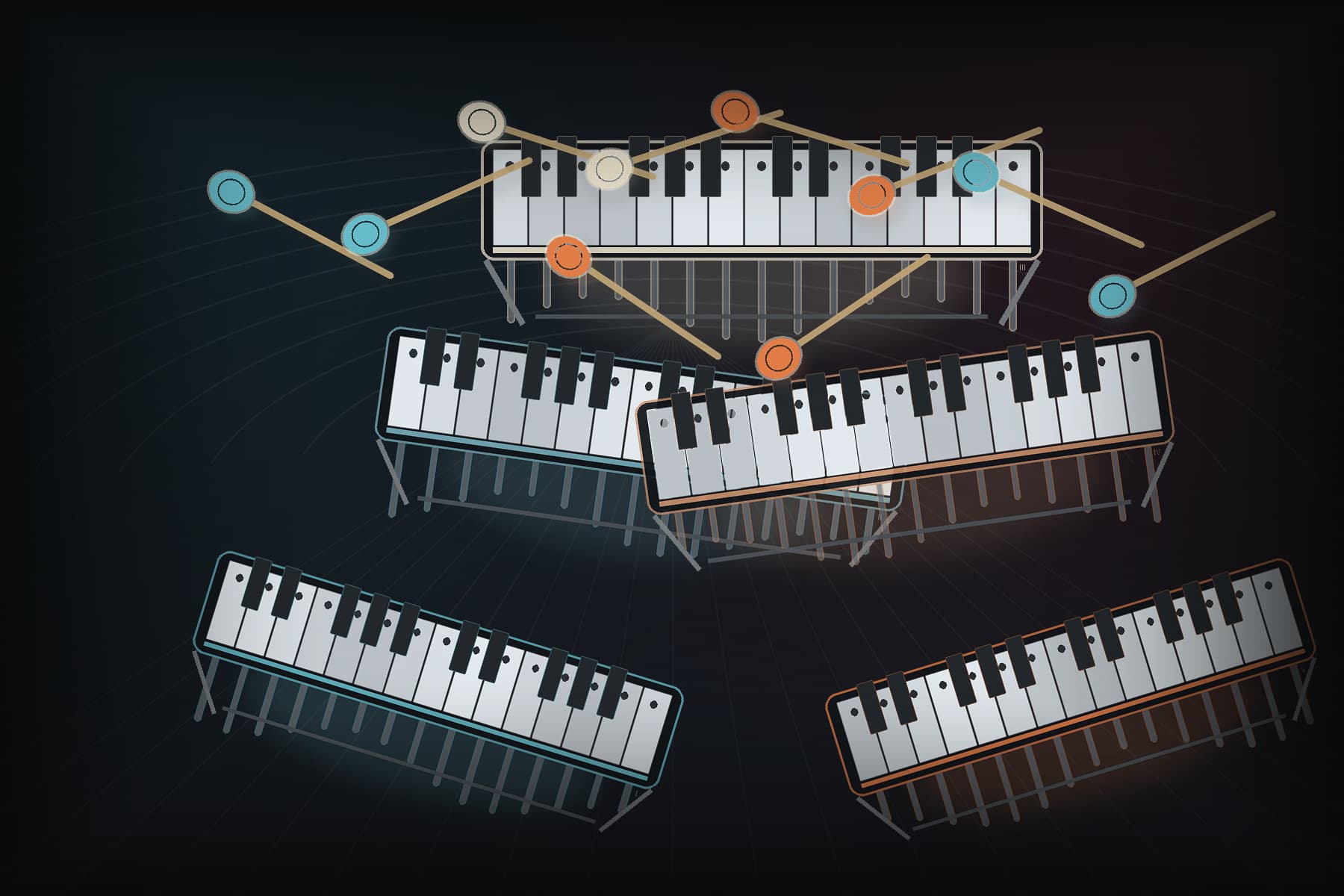
Five vibraphones
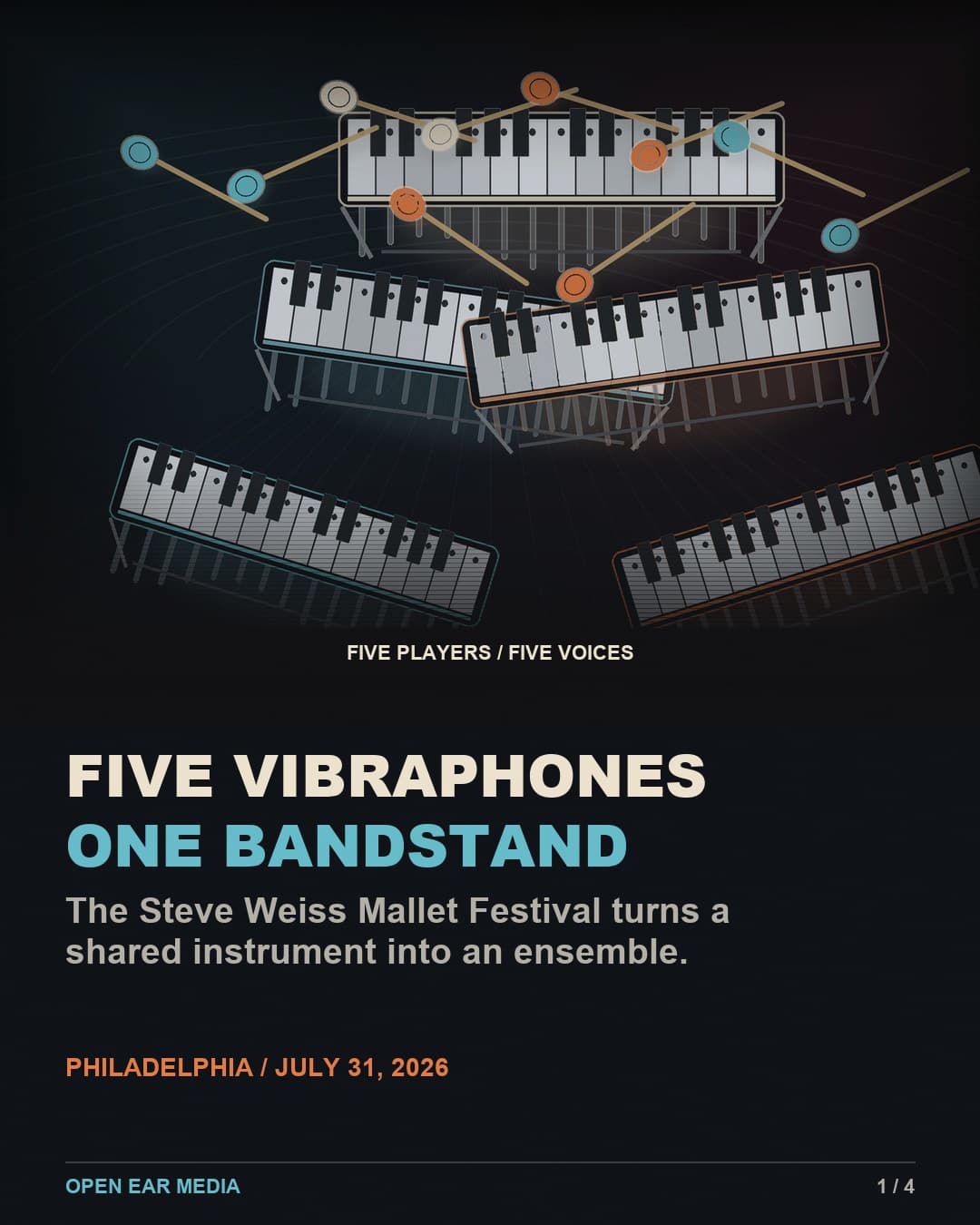
Five vibraphones, one bandstand
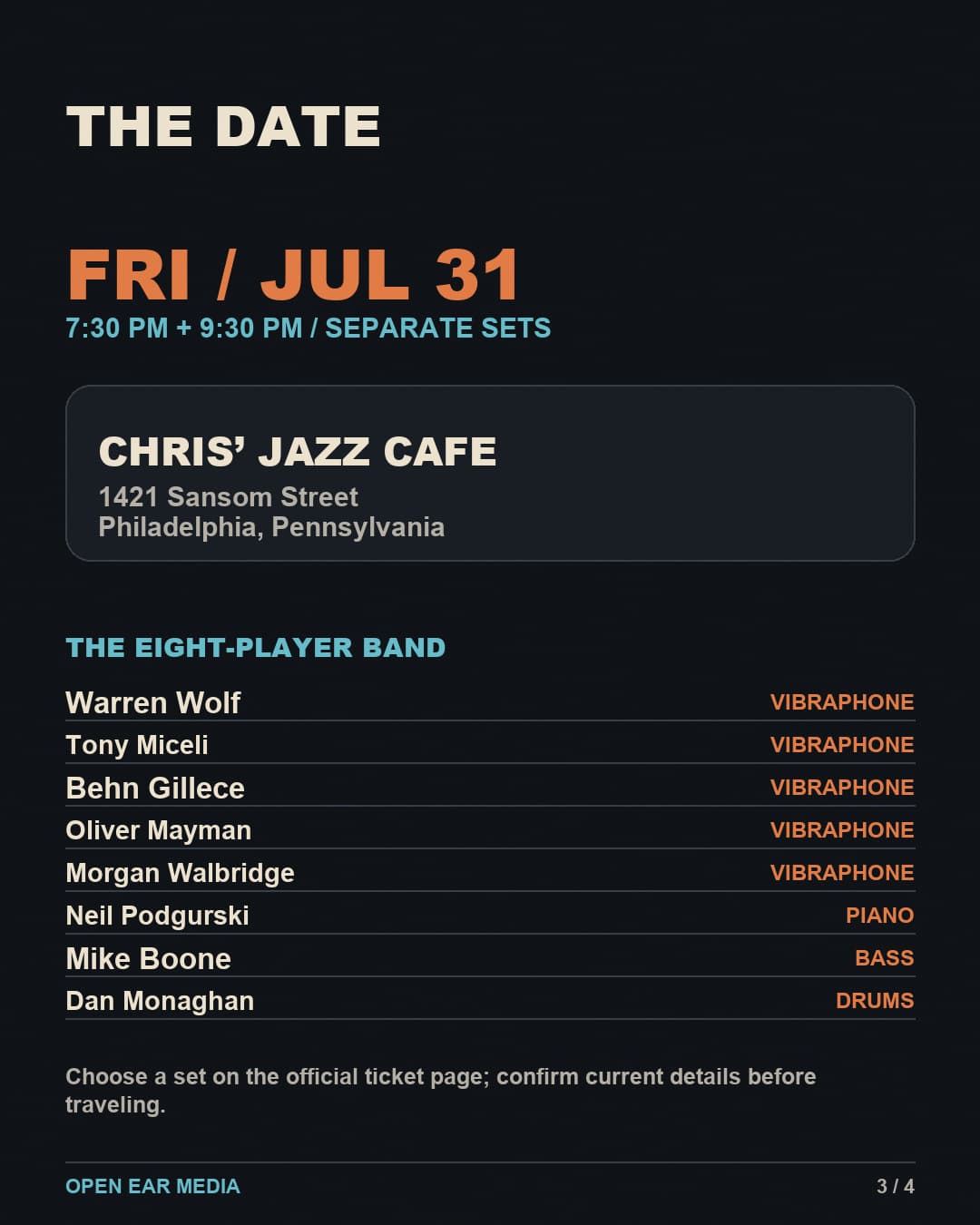
Warren Wolf joins Tony Miceli, Behn Gillece, Oliver Mayman and Morgan Walbridge for a Philadelphia jam where five players on the same instrument must become five distinct voices.
Five vibraphones on one bandstand can sound like abundance or like a traffic problem. Each instrument can state melody, build four-mallet chords, punctuate rhythm and let metal bars ring into the next phrase. Add Neil Podgurski’s piano and the July 31 Steve Weiss Mallet Festival lineup places six harmonic instruments above Mike Boone’s bass and Dan Monaghan’s drums. The reason to hear this gathering is not simply that the number five looks impressive on a poster. It is to hear how five players with access to the same materials make room for five identities. [1][9][14]
The concert is the public face of a week organized around that exact problem. Tony Miceli’s official festival schedule describes daily classes, individual practice, sight-reading, a mallet quartet and sessions with piano, bass and drums before the Friday all-star jam at Chris’ Jazz Cafe. The same week continues with a Lionel Hampton tribute and a youth percussion program at the Barnes Foundation. Teaching, repertory, ensemble design and performance are not separate tracks here; they feed one another. [2][3]
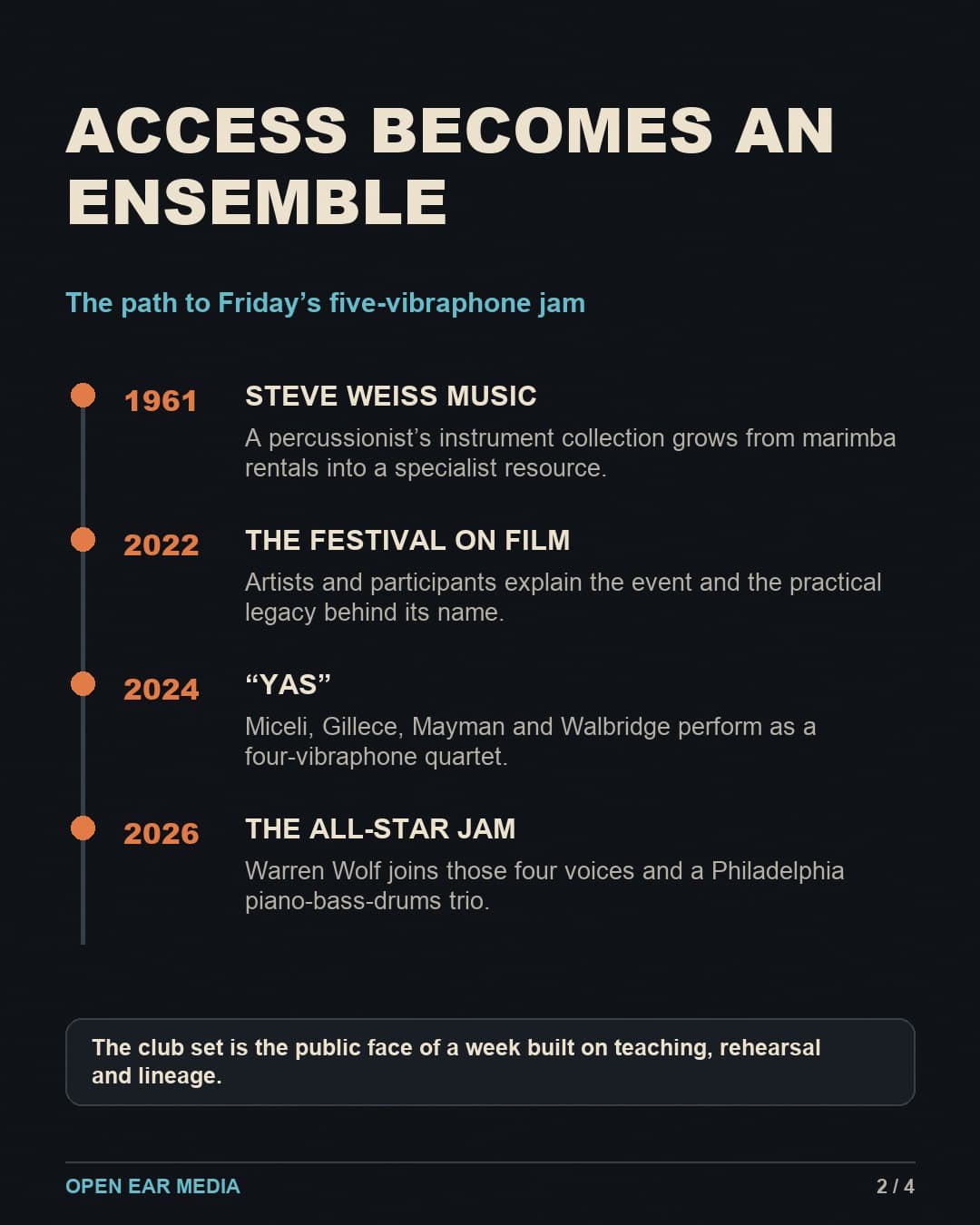
There is already a useful piece of evidence. Steve Weiss Music filmed Miceli, Behn Gillece, Oliver Mayman and Morgan Walbridge playing Miceli’s “YAS” as a four-vibraphone ensemble at the 2024 festival. All four return to the 2026 bill, now joined by Warren Wolf and a full Philadelphia rhythm section. Watch that official performance below: it turns an unusual instrumentation into an audible question, then gives this year’s expanded lineup somewhere concrete to begin. [6][7][1][2]
The musical problem
Five vibraphones have to become an arrangement
A vibraphone’s metal bars are only the beginning of its sound. Resonators extend and color the tone; a pedal controls how freely notes sustain; dampening can end one pitch while another continues. That combination gives a player something close to a pianist’s harmonic reach with a percussionist’s control of attack. It also explains the danger in this lineup. If five players occupy the same register, strike with similar weight and hold the pedal through the same harmonic turn, detail can disappear into accumulated resonance. [9][14]
Mayman has made that control of resonance central to his work. His official biography describes an approach built on novel dampening techniques, pianistic ideas and four-mallet concepts, and his book Dampening Studies treats pedaling and selective note length as compositional resources rather than cleanup. He also writes that the vibraphone can assume the supportive harmonic role normally given to piano. With an actual piano and four other vibraphones present, that ambition becomes an ensemble negotiation: who supplies the chord, who shortens it, who leaves it out, and who turns its upper note into melody? [14]
That is the first listening key for July 31: follow function, not just solos. A player can move from lead voice to inner line, from chordal support to clipped rhythmic answer, without changing instruments. The most revealing passages may arrive when only part of the mallet front line plays, or when one sustained tone is allowed to remain after the others have stopped. Five vibraphones become five voices only when difference is designed in real time. [6][2][14]
More than a concert
The festival is a school before it is a showcase
The 2026 workshop begins July 27 at Settlement Music School in Queen Village. Miceli’s published plan includes two extended classes each day, practice time, a mallet-quartet rehearsal, sight-reading and a closing jam with rhythm section. Students rotate through the quartet parts and play with piano, bass and drums. By the time the all-star concert begins, the festival has spent several days treating ensemble listening as a craft that can be taught, tested and revised. [2]
Miceli has been building infrastructure for that craft well beyond one week. His official biography identifies him as the creator of VibesWorkshop.com and a co-creator of the World Vibes Congress. In a WRTI interview, he explained that an old prediction of the vibraphone’s obsolescence pushed him to learn web publishing and build an online school and discussion space. The festival brings that virtual community into rooms where people can share instruments, read parts together and immediately hear the consequences of a technical choice. [11][12]
The geography reinforces the mission. Settlement houses the workshop; Chris’ Jazz Cafe presents the professional jam; the Barnes Foundation hosts the Sunday youth percussion ensemble and hands-on instrument activities. The Barnes describes the annual festival as honoring Steve Weiss’s legacy while introducing audiences of all ages to mallet percussion. In other words, the week does not only celebrate experts. It creates several doors into the instrument: study it, hear it in a club, or touch one for the first time. [2][3][5]
I was glad I was doing my part to keep this instrument alive.
Watch and listen
“YAS” shows what shared language can do
Steve Weiss Music’s official video of “YAS” credits Tony Miceli, Oliver Mayman, Behn Gillece and Morgan Walbridge—the same four Philadelphia-area vibraphonists on this year’s lineup. The publisher describes Miceli’s composition as a samba-style mallet quartet with strong melodies and spaces for improvisation. There is no conventional rhythm section in the listed personnel. The mallet players must generate ensemble pulse, harmony, contrast and forward motion among themselves. [6]
That personnel credit matters because it demonstrates continuity without promising repetition. The 2026 concert is billed as an all-star jam, not a reprise of “YAS,” and no set list has been published. What the video proves is more useful: Miceli, Gillece, Mayman and Walbridge have already worked inside a piece that requires four related timbres to interlock. The shared experience gives the larger jam a foundation beyond five names assembled for a photograph. [6][2][1]
The change in 2026 is structural. Warren Wolf adds a fifth mallet voice; Podgurski, Boone and Monaghan add a jazz trio capable of carrying time and harmony independently. That can free the vibraphonists to trade short statements, stack arranged lines, set up call-and-response or step away entirely. Those are possibilities, not a predicted program. The point of the old video is to train the ear for allocation: notice who owns each layer, and notice how quickly ownership changes. [1][6][2]
YAS by Tony Miceli | The 2024 Steve Weiss Mallet Festival
Tony Miceli, Oliver Mayman, Behn Gillece and Morgan Walbridge—the four returning Philadelphia vibraphonists on the 2026 bill—perform Miceli’s samba-style mallet quartet at Settlement Music School.
Watch on YouTube · Steve Weiss MusicSpotlight on the 2022 Steve Weiss Music Mallet Festival
Steve Weiss Music’s short official film lets performing artists and participants explain the festival and the practical legacy of percussionist and instrument specialist Steve Weiss.
Watch on YouTube · Steve Weiss MusicPerformers — Tony Miceli, Oliver Mayman, Behn Gillece, Morgan Walbridge.
History in the present tense
Warren Wolf arrives carrying a repertory of vibraphone voices
Wolf’s 2024 album History of the Vibraphone makes his role in this gathering especially clear. In his own notes, he describes choosing music associated with Terry Gibbs, Lionel Hampton, Milt Jackson, Bobby Hutcherson, Cal Tjader, Gary Burton, Roy Ayers, Dave Samuels and Joe Locke. The album is not a chronological lecture. It is a player’s map of how swing, bebop, spacious modernism, Latin rhythm, fusion and groove have each changed what the instrument can say. [9][8]
The details make that map audible. Wolf moves from Gibbs’s compact “Bopstacle Course” to Hampton’s ballad “Midnight Sun,” Hutcherson’s harmonically searching “Herzog,” Tjader’s “Sad Eyes,” Ayers’s “Vibrations” and Samuels’s “Spring High.” A contemporary review in The Jazz Word heard different uses of energy, space and note length across those tributes, while Wolf closes the main program with his own “I See You Baby, Looking at Me.” The history ends not with imitation but with a contemporary voice declaring itself. [9][10]
That is a productive model for the festival jam. Wolf can bring the instrument’s repertory into the room without making the other four players sound like chapters in his survey. He is also a pianist and drummer, according to his official site, so his sense of the vibraphone is informed by the functions surrounding it. Listen for whether he approaches a passage as a lead percussionist, a chordal partner, a drummer shaping attack, or some combination that refuses those categories. [8][9][1]
Four connected voices
Miceli, Gillece, Mayman and Walbridge form a living Philadelphia workshop
Miceli is the organizer and connective tissue. He settled in Philadelphia in 1978, taught at the University of the Arts and now lists Temple, Settlement Music School and other institutions among his teaching work. WRTI’s profile captures the breadth of his musical frame: straight-ahead Philadelphia jazz, Monk, rock repertory and solo vibraphone all belong to the same life. His festival role is therefore not only to take the first solo. It is to create conditions in which several approaches to the instrument can meet. [11][12][2]
Gillece brings a composer-bandleader’s book and a long practice of translating it for students. His official biography traces a run of leader recordings through 2025’s Pivot Point and notes more than 800 lessons prepared for VibesWorkshop.com, alongside his teaching at Rowan University. His music is rooted in post-bop, but the relevant fact for this concert is independence: he is not merely a section player in a mallet choir. He arrives with a developed sense of line, harmony and form that the group must accommodate. [13][2]
Mayman represents a more recent branch of the same teaching network. He began on drums and piano, earned his Temple degree after studying with Miceli and Bruce Barth, and has concentrated on dampening, pedaling and the vibraphone’s capacity to replace piano as a rhythmically active accompanist. He is also one of the 2026 workshop teachers. The technical research and the practical work are linked: the methods in his book are tools for making a dense ensemble speak clearly. [14][2]
Walbridge studied with Miceli at the University of the Arts after moving to Philadelphia in 2016. Her own biography documents solo-vibraphone composition, extensive remote session work and a featured clinician-performer role at the 2024 festival. It also resolves a public spelling conflict: Chris’ current ticket page and headings on Miceli’s festival page add a second “l” to Wallbridge, while her official site, the “YAS” video credits and the biographical text use Morgan Walbridge. Jazz DateBook follows the artist’s own spelling. [15][6][2][1]
The full band
Neil Podgurski, Mike Boone and Dan Monaghan control the air around the metal
Podgurski and Monaghan already appear in the festival’s recent performance record. A free 2024 Chris’ Jazz Cafe video of Behn Gillece playing “Road Song” credits Podgurski on piano and Monaghan on drums with bassist Shane Aaserud. Podgurski’s official biography connects his New School years and Brooklyn work to a return to his native Philadelphia area. None of that tells us what the trio will play in 2026, but it does show two current members supporting a rotating vibraphone lead in the same club and festival context. They understand that the featured voice can change while the band’s continuity cannot. [16][17][1]
Boone is a particularly Philadelphia choice for bass. Jazz Philadelphia’s profile describes a New York-born, Eastman-trained musician who moved to the city in 1983, learned from its club culture, taught at Temple and became a mentor to younger players. His own emphasis in that interview is not novelty but swing, blues connection and making listeners feel something. Beneath five bright, sustaining instruments, that grounded priority can keep the event from becoming a demonstration of equipment. [18][1]
Monaghan adds another layer of local memory. Rowan University identifies him as a Philadelphia-area drummer whose work spans Eric Alexander, Peter Bernstein, Uri Caine and Randy Brecker, with faculty roles at Rowan and Temple. The trio’s task is more delicate than simply driving hard: it must establish enough pulse to unify the jam without filling every opening the mallets leave. When the upper texture grows thick, bass placement, cymbal decay and the piano’s decision to play—or not play—will tell us how the ensemble is hearing itself. [19][1][16]
Why this name and this city
Steve Weiss’s legacy began with access to instruments
The festival name reaches back to a practical act of percussion advocacy. Steve Weiss Music’s company history says Weiss worked for the Reading Railroad, used his travel access to search northeastern music shops and estate sales for hard-to-find percussion, and began renting instruments from a 1960s Plymouth. When Philadelphia Orchestra percussionist and teacher Mickey Bookspan needed a marimba, Weiss could supply one in a market where such rentals were difficult to find. The collection became Philadelphia Music Rental, then a full percussion business operating since 1961. [4]
The story explains why a workshop belongs beside the concerts. Weiss’s contribution was not a theory of vibraphone style; it was access—to instruments, parts, music and informed people. The official 2022 festival film centers artists and participants discussing that legacy, and the Barnes now describes the annual event in the same terms. Putting several vibraphones in student practice rooms, then putting five on a professional bandstand, extends the original idea from finding an instrument to building a community around it. [4][5][3]
Chris’ Jazz Cafe gives the all-star night a fitting public room. The venue dates itself to 1989 and documents a schedule built around hundreds of annual performances, while Miceli has repeatedly called it his Philadelphia home. It also preserves festival performances through its official YouTube channel. The July 31 sets are not detached from the city’s working scene: the organizer, four of the vibraphonists, the rhythm section, the school and the club are connected by years of teaching and playing. [20][12][16][1]
Before the first strike
What to listen for when the mallets begin moving
First, listen to duration. A note can be allowed to bloom, stopped by the pedal, selectively dampened by a mallet, or clipped at the instant another voice enters. In the fastest passages, clarity may come less from how quickly someone can strike than from how precisely the previous note disappears. When a phrase suddenly sounds transparent, ask which player changed register, shortened a chord or stopped playing. [14][6]
Second, follow the handoffs between composition and jam-session protocol. “YAS” is an arranged mallet quartet with designated material and improvising space; the July 31 event is advertised as an all-star jam. The ensemble may rely more heavily on cues, familiar forms or quickly assigned roles. Watch the ends of phrases: eye contact, a repeated rhythmic cell or a bass movement can transfer leadership before any spoken instruction is visible. [6][2][1]
Finally, keep the entire band in the frame. Wolf’s repertory project, Miceli’s teaching network, the four-player “YAS” history and the Philadelphia trio all point toward different ways of organizing the same instrument. The evening succeeds as an ensemble only if those histories remain audible without competing for every measure. Do not wait only for the fastest solo. Listen for the moment five vibraphones stop sounding like a premise and begin sounding like one band. [9][6][18][1]
The social edition
The story in four frames
A concise visual guide for listeners, derived from the researched feature above rather than the other way around.
Research trail
Sources and further listening
Primary artist, presenter, label, and event sources lead this list. Reviews and discographic databases are used for listening context and detailed recording credits. Each source was checked on the date shown in the feature metadata.
- 1Steve Weiss Mallet Festival — July 31, 2026
Chris’ Jazz Cafe · official event
Supports: July 31 date, 7:30 and 9:30 showtimes, Chris’ Jazz Cafe address, complete current lineup, ticket information.
- 22026 Steve Weiss Mallet Festival and Vibes Workshop
Tony Miceli · official event
Supports: festival dates, all-star jam context, workshop schedule, Settlement Music School, Barnes program, featured artists, educational design.
- 3PECO Free First Sunday Family Day: Beats with Heart
Barnes Foundation · official event
Supports: August 2 youth performances, festival mission, Steve Weiss legacy, hands-on percussion activities, Barnes location.
- 4About Steve Weiss Music: Percussion Specialists Since 1961
Steve Weiss Music · publication
Supports: Steve Weiss biography, Reading Railroad travel, early instrument collection, marimba rentals, Philadelphia Music Rental, 1961 company history.
- 5Spotlight on the 2022 Steve Weiss Music Mallet Festival
Steve Weiss Music · media
Supports: official festival film, 2022 program, participant perspective, Steve Weiss legacy, video metadata.
- 6YAS by Tony Miceli | The 2024 Steve Weiss Mallet Festival
Steve Weiss Music · media
Supports: official performance video, Tony Miceli composition, samba-style mallet quartet, Tony Miceli, Oliver Mayman, Behn Gillece, Morgan Walbridge, video metadata.
- 72024 Steve Weiss Mallet Festival and Vibes Workshop
Tony Miceli · official event
Supports: 2024 festival format, workshop faculty, Chris’ Jazz Cafe concerts, Settlement concert, Barnes concert, Warren Wolf feature.
- 8Warren Wolf official website
Warren Wolf · official artist
Supports: official identity, multi-instrumental practice, ensemble affiliations, teaching roles, official Instagram, official listening links.
- 9History of the Vibraphone
Warren Wolf / Cellar Music · official label
Supports: 2024 release, album concept, track list, tribute subjects, personnel, artist statement, instrument definition.
- 10Warren Wolf, History of the Vibraphone Review
The Jazz Word · publication
Supports: album review, track interpretation, Warren Wolf background, vibraphone lineage.
- 11Tony Miceli biography
Tony Miceli · official artist
Supports: official identity, Philadelphia history, teaching roles, VibesWorkshop.com, World Vibes Congress, recording work.
- 12Jazz Philadelphia’s Hometown Heroes: Spotlight on Vibraphonist Tony Miceli
WRTI · publication
Supports: Tony Miceli interview, instrument origin story, VibesWorkshop.com motivation, Philadelphia scene, Chris’ Jazz Cafe relationship, teaching philosophy.
- 13Behn Gillece biography and discography
Behn Gillece · official artist
Supports: official identity, leader discography, Pivot Point, post-bop context, Rowan teaching, VibesWorkshop.com lessons, official Instagram.
- 14Oliver Mayman biography, music and teaching
Oliver Mayman · official artist
Supports: official identity, Philadelphia base, drums and piano background, Tony Miceli studies, dampening practice, Dampening Studies, teaching.
- 15Morgan Walbridge — percussionist, composer and educator
Morgan Walbridge · official artist
Supports: artist-preferred spelling, Philadelphia base, Tony Miceli mentorship, solo work, session work, 2024 festival participation, official Instagram.
- 16Steve Weiss Mallet Festival with Behn Gillece — Road Song
Chris’ Jazz Cafe · media
Supports: official 2024 festival performance, Behn Gillece, Neil Podgurski, Dan Monaghan, Chris’ Jazz Cafe context.
- 17Neil Podgurski official biography
Neil Podgurski · official artist
Supports: official identity, Philadelphia and New York jazz history, piano role, recording work.
- 18Mike Boone — Hometown Hero
Jazz Philadelphia · publication
Supports: Mike Boone biography, 1983 Philadelphia arrival, Eastman studies, Temple teaching, mentoring, musical philosophy.
- 19Dan Monaghan — Jazz Studies, Drums
Rowan University · publication
Supports: Dan Monaghan biography, Philadelphia work, recording and performance credits, Rowan and Temple teaching.
- 20About Chris’ Jazz Cafe
Chris’ Jazz Cafe · publication
Supports: 1989 founding, Philadelphia venue history, performance program, address, club context.