Garden of Klōns — evolving ensemble circuit
Garden of Klōns tests whether a band can change hardware and keep its identity
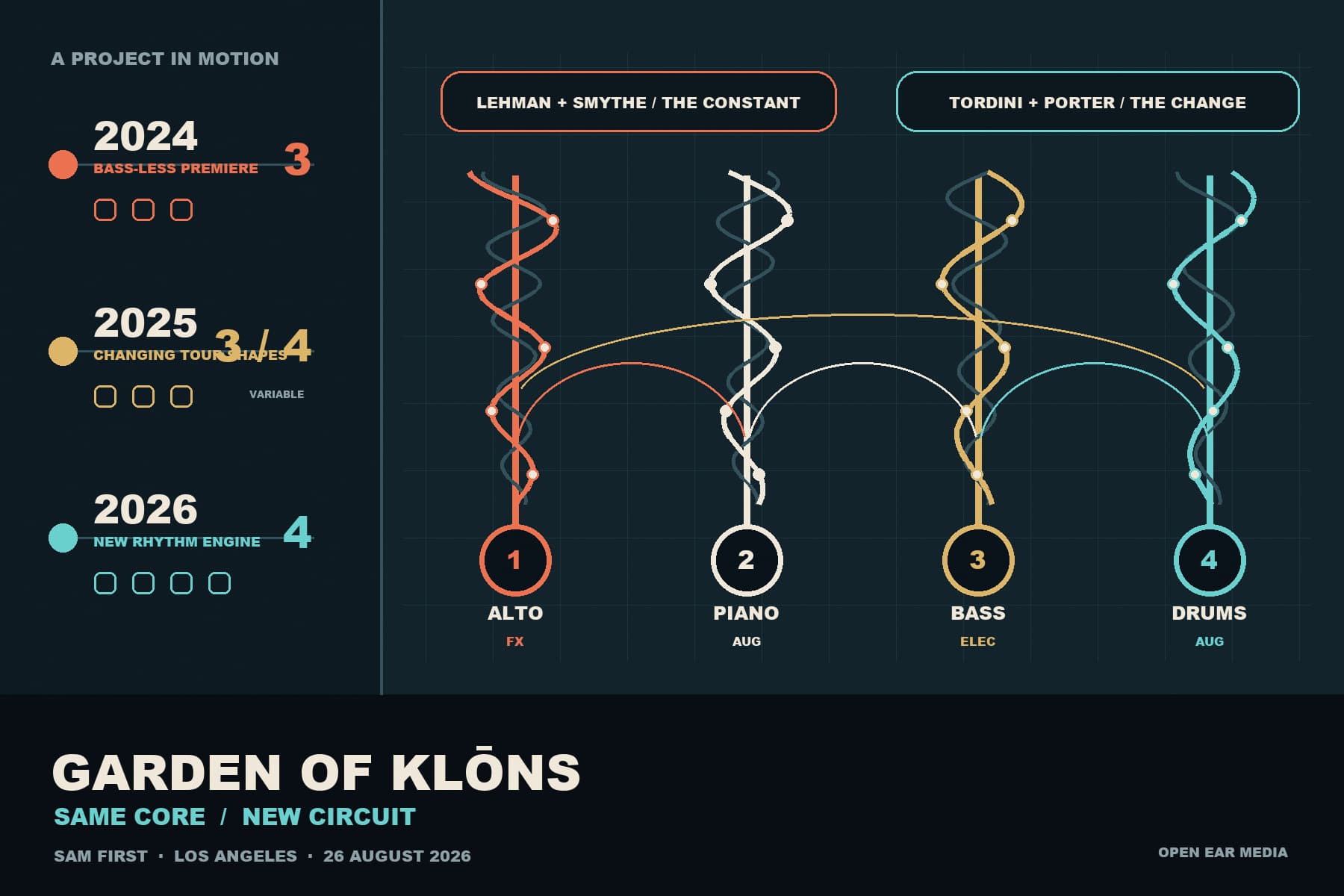
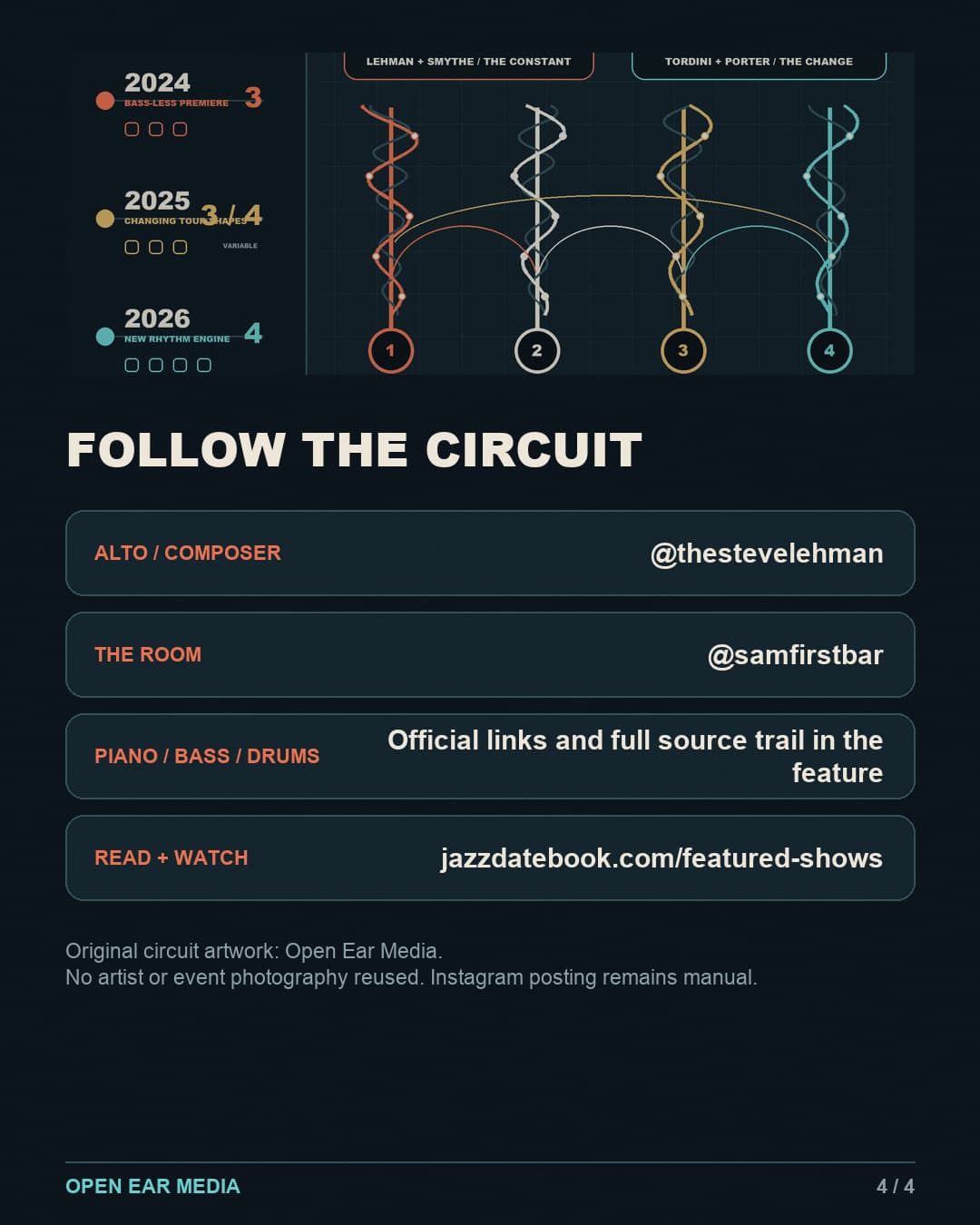
Steve Lehman and Cory Smythe are the constants in a project that has moved from a bass-less 2024 premiere to a 2026 quartet with Chris Tordini and Jacob Porter—making personnel change part of the listening proposition.
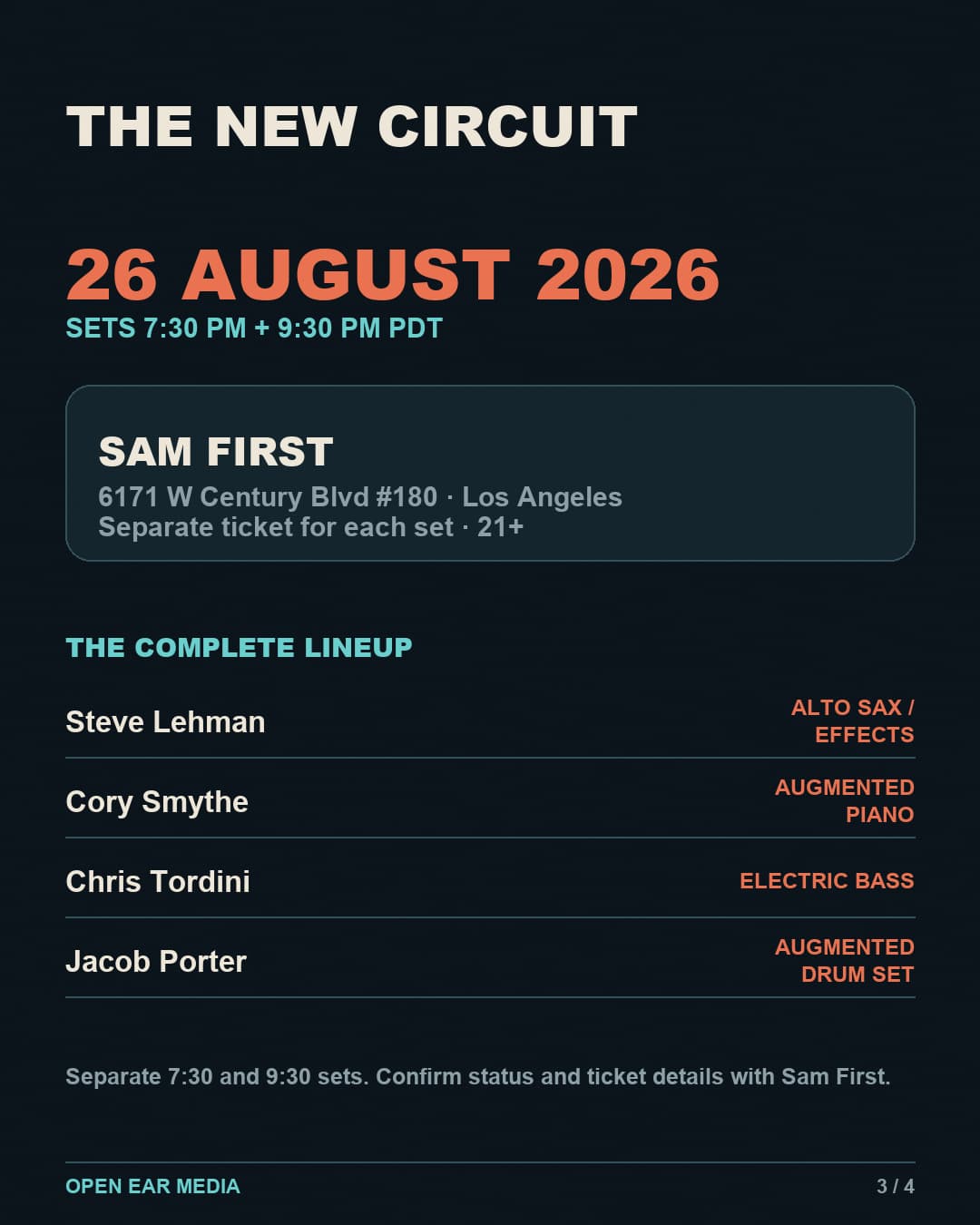
Garden of Klōns arrives at Sam First as four simultaneous definitions of an instrument. Steve Lehman is billed on alto saxophone and effects, Cory Smythe on augmented piano, Chris Tordini on electric bass and Jacob Porter on augmented drum set. The familiar outline of saxophone, keyboard, bass and drums is present, but three of those credits explicitly extend or electrify the physical instrument. The fourth—the electric bass—is already electronic at its source. [1]
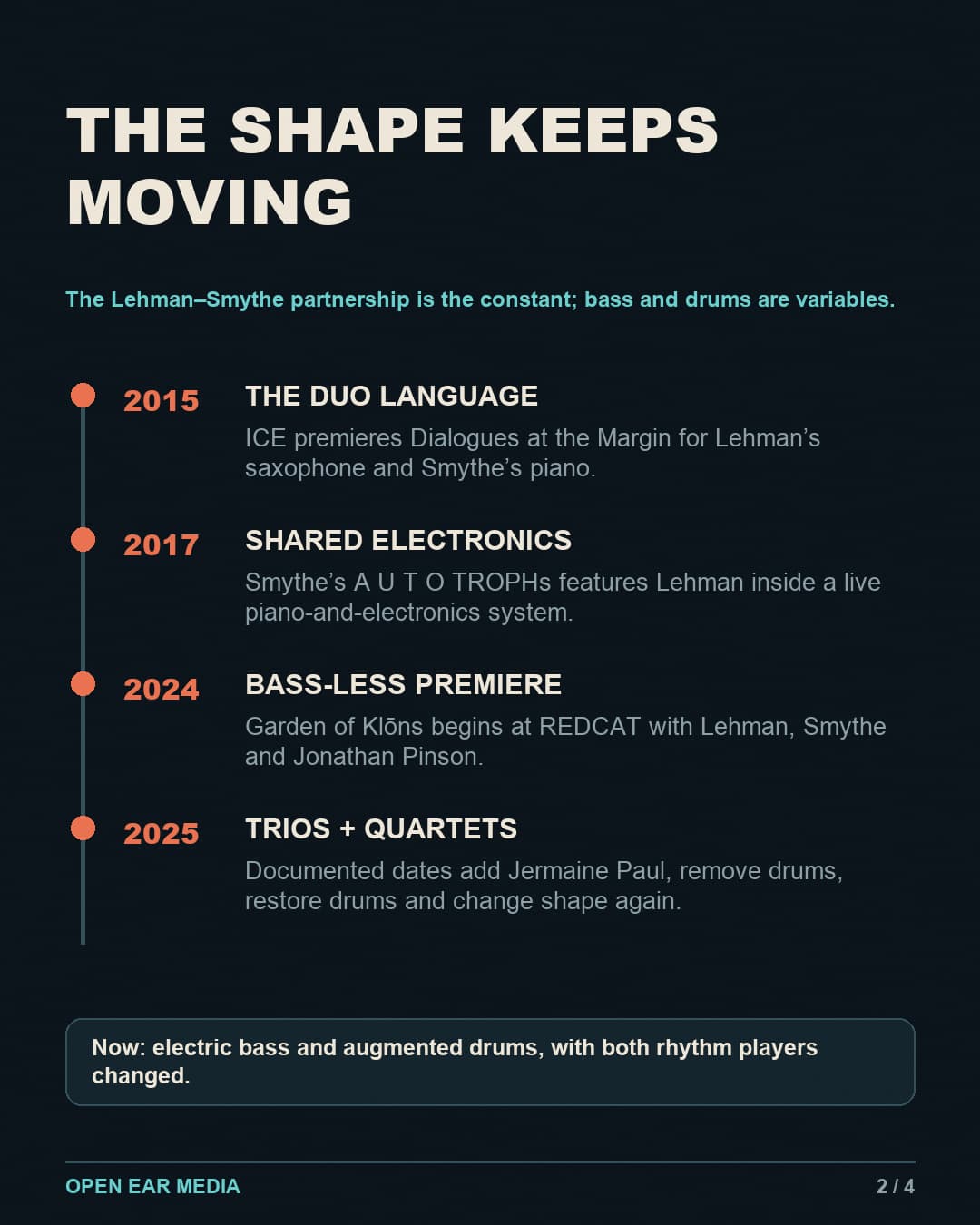
That quartet is not the shape in which the project entered the world. DownBeat identified the October 2024 Angel City Jazz Festival appearance as Garden of Klōns’ world premiere; REDCAT billed a bass-less trio of Lehman, Smythe and Jonathan Pinson. By October 2025, UC San Diego documented a quartet with Jermaine Paul on electric bass and Pinson on drums. The August 2026 bill keeps Lehman and Smythe while changing both rhythm-section players. [3][2][7][1]
The useful question is therefore not whether this lineup can reproduce a fixed original. Publicly documented versions already show that the container moves. The question is what remains recognizably Garden of Klōns when the low register, attack, sustain and electronic response are entrusted to different bodies. At Sam First, personnel is not background information; it is the musical experiment a listener can follow in real time. [2][8][1]
A project with variable architecture
The world premiere was a trio; the public history refuses one permanent lineup
Garden of Klōns premiered at REDCAT on October 12, 2024, on a double bill with the Kris Davis Trio. The official credit was exact: Lehman on alto saxophone and effects pedals, Smythe on augmented piano, and Pinson on drum set and sensory percussion. With no bassist, low frequency, pulse and harmonic weight had to be negotiated among piano, processed alto and drums rather than assigned to a dedicated bass chair. [2][3]
The following year made flexibility visible. Sam First presented Lehman, Smythe and electric bassist Jermaine Paul without a drummer on July 25. Minaret’s September 24 Los Angeles bill restored Pinson alongside Paul for a quartet; three days later, Seattle’s Goodbye Look listed the original bass-less trio. UC San Diego then closed a West Coast tour on October 5 with Lehman, Smythe, Paul and Pinson. These are documented snapshots, not a complete engagement history, but they establish that trio and quartet versions coexisted. [4][5][6][7]
The 2026 Sam First configuration makes another controlled change. Lehman and Smythe remain the compositional and timbral center found in every documented bill reviewed here. Tordini enters the electric-bass role previously occupied by Paul, while Porter takes an augmented drum-set role related in name—but not necessarily in technology—to Pinson’s sensory-percussion chair. The project keeps its four-part spectrum while replacing the entire rhythm team heard in UC San Diego’s archive. [1][7][9]
The project keeps its four-part spectrum while changing the entire rhythm team heard in the official 2025 archive.
The constant pair
Steve Lehman and Cory Smythe had already spent a decade testing the edge of two instruments
Lehman and Smythe’s public collaboration predates Garden of Klōns by nearly ten years. International Contemporary Ensemble’s official film identifies “Dialogues at the Margin I” as a world premiere at Abrons Arts Center on February 28, 2015, with only Lehman on saxophone and Smythe on piano. The 38-minute performance is a valuable baseline: before the current effects labels, their exchange already depended on attack, register, silence and the ability of two linear or percussive gestures to suggest a larger machine. [11][12]
In 2017, Smythe’s A U T O TROPHs made the shared electronic vocabulary explicit. The album credits Smythe with piano, electronics and compositions and places Lehman on “Lucy-A” and “Lucy-B.” In an interview published with the release, Smythe described a live freeze effect triggered through Max and Ableton, and explained that paired sine waves in “Lucy-B” became sources of rhythmic and microtonal information. He named Lehman’s off-kilter rhythm and microtonal spectral harmony as part of the design rather than as a style pasted onto it afterward. [13][14]
That history clarifies why the two names are the project’s constants, but it does not supply a current equipment list. Sam First says “effects” and “augmented piano”; it does not specify software, pedals, preparations, signal routing or whether the 2017 system survives in 2026. The responsible listening stance is to hear the augmentation first and identify the device second, if the musicians choose to explain it at all. [1][14][15]
Not an effects showcase
Lehman’s electronics have learned to compose, answer and reorganize acoustic sound
Lehman’s official Pi Recordings biography connects his recent electro-acoustic work to computer-driven models for improvisation in Max/MSP; it also places that research beside his writing on spectral composition, rhythm cognition and jazz improvisation. Spectral practice begins from sound’s internal frequency content, but in Lehman’s work it has never meant harmony alone. The recurring challenge is to make unfamiliar pitch color coexist with pulse, articulation and improvising musicians. [17][16]
Ex Machina, Lehman’s 2023 album with Frédéric Maurin and the Orchestre National de Jazz, offers the large-ensemble precedent. Pi’s notes describe IRCAM software that reacts to soloists, proposes sonorities and can function as a virtual orchestrator and improvising partner. An official IRCAM film documents the real-time DYCI2 environment; the ONJ’s performance of Lehman’s “Los Angeles Imaginary” lets a listener hear that research inside an acoustic orchestra rather than as a separate electronic track. [18][20][19]
Garden of Klōns relocates that question from orchestra and central software to a compact band whose credits attach processing to individual instruments. The comparison should not be pushed too far: no source says Garden uses Ex Machina’s software. What carries forward is the compositional problem—how transformed sound can participate in timing and orchestration instead of functioning as decorative atmosphere. [18][2][1]
Steve Lehman and Cory Smythe - Dialogues at the Margin I [2015] | International Contemporary Ens...
The official 38-minute film of the February 2015 world premiere provides an acoustic baseline for the Lehman–Smythe partnership that later anchors Garden of Klōns.
Watch on YouTube · International Contemporary EnsembleEx Machina "Los Angeles Imaginary" (Steve Lehman)
The ONJ’s official performance shows Lehman’s Los Angeles-titled composition inside the larger Ex Machina system of spectral orchestration and generative electronics.
Watch on YouTube · Orchestre National de JazzImages d'une œuvre n°29 : « Ex Machina » de Steve Lehman et Frédéric Maurin
IRCAM’s official documentary explains the real-time DYCI2 environment used in Ex Machina and distinguishes that orchestral system from Garden of Klōns’ player-centered billing.
Watch on YouTube · IrcamThe new rhythm engine
Chris Tordini and Jacob Porter alter more than the personnel line
The current roles divide the work cleanly enough to hear consequences. Lehman can project a single alto line and its processed shadow. Smythe can supply harmony, percussion, resonance and electronic sustain from the piano chair. Tordini gives the group a dedicated electric low register that the premiere trio did not have. Porter controls both physical time and whatever additional layer “augmented drum set” creates. Every player can affect density; no player is confined to accompaniment. [1][2]
Tordini is new to this documented Garden lineup, not new to Lehman. Pi Recordings says he has toured and recorded in Lehman-led bands. In a 2023 Jazz Gallery interview, Tordini said he had played in Lehman’s bands “a lot” and called him one of his favorite musicians; he also distinguished rhythmically free writing from later music with more rigorous rhythmic ideas. That history does not predict his Sam First choices, but it means the bass chair is occupied by a musician already familiar with Lehman’s demand for precision and surprise. [21][22]
Porter is the largest documented unknown, and the feature should preserve that fact. Sam First confirms his spelling and augmented drum-set role but publishes no biography or rig diagram on the event page. The original drummer’s importance shows what is at stake: Greg Burk’s REDCAT review heard Pinson’s attack making unusual meters and displaced accents legible while sensory percussion changed drum color. Porter should not be expected to imitate that system; his different solution to the same structural job is one reason this date matters. [1][10]
The closest listening document
UC San Diego’s complete concert is a map, not a promised set list
UC San Diego preserves a 74-minute, 56-second Garden of Klōns concert from October 5, 2025, on its official Vimeo account. Lehman plays alto and electronics, Smythe piano and electronics, Paul electric bass, and Pinson drums and electronics. Because it is the same four-part instrumental design with a different rhythm section, the archive is the most useful public reference for what changes at Sam First—and also the strongest warning against treating personnel as interchangeable. [9][7][8]
The institutional program identifies seven works: Lehman’s “Garden of Klons,” “Orenthal,” “Lest We Forget” and “Meris”; Andrew Hill’s “Siete Ocho”; “House Count,” credited to Lehman and John Coltrane; and Rodgers and Hart’s “You Are Too Beautiful.” That sequence places brand-new project music beside transformed jazz and song sources. It documents one 2025 performance only. Sam First has not published titles for August 26, so none should be promoted as a coming selection. [8][7][1]
Use the archive to separate three variables. First, follow written rhythm before solo order: Burk’s premiere review characterized the early version as composition-forward and heard Pinson clarify asymmetric accents. Second, notice when a sound’s attack belongs to an acoustic gesture but its decay belongs to processing. Third, attend to the electric bass as both pitch and boundary—when it anchors the ensemble, when it doubles a line, and when it leaves harmonic weight to piano or processed alto. Those questions remain valid even when the answers change with Tordini and Porter. [10][9][1]
The room beside the runways
Sam First puts the experiment into two compact, separately ticketed sets
Sam First lists the concert for Wednesday, August 26, with sets at 7:30 and 9:30 p.m.; a separate ticket is required for each. The event is 21+, and the prices observed on August 11 were $39.20 for the first set and $33.60 for the second, including the venue’s stated 12 percent service fee. The site marked both offers available at that check, but inventory and price are dynamic and should be reconfirmed. [1]
The club sits at 6171 W Century Boulevard, Suite 180, near LAX. Sam First describes itself as an intimate modern-jazz room within a seven-to-ten-minute walk of the terminals and says it normally presents two sets Tuesday through Saturday. That location gives “Los Angeles-based” a specific meaning: the band is not appearing in a festival theater or university lab this time, but in a small club embedded in the airport district’s constant movement. [23][1]
The event page also carries a recording notice and says Sam First live-streams and records its concerts. That is not a guarantee that this performance will receive a free stream, a permanent public video or a record release. It does mean the room treats documentation as part of its practice—an apt setting for a project whose identity can only be understood by comparing versions. [1][23]
A three-step listening path
Hear the partnership, the prior quartet and the larger electronic idea—in that order
Start with “Dialogues at the Margin I.” The official International Contemporary Ensemble film strips the partnership to saxophone and piano and shows how long-form attention can emerge without bass or drums. Then watch UC San Diego’s complete Garden archive, concentrating less on whether a passage sounds electronic than on who controls its beginning, duration and ending. The first reveals the durable pair; the second reveals one already superseded rhythm section. [11][9]
Next, use the official “Los Angeles Imaginary” performance and IRCAM film to understand scale. Ex Machina lets software listen and answer inside a large orchestra; Garden offers four player-centered interfaces in a club. At Sam First, listen for dry and processed versions of the same attack, for bass notes that stabilize or destabilize the harmonic field, and for drum gestures whose audible result extends beyond a struck surface. These are observations to test, not a description of an unheard set. [19][20][18][1]
No official source supplies the August set list, the electronics inventory or a claim that this is the first appearance of the four musicians together. What is verified is more interesting than promotional certainty: a project premiered as an augmented, bass-less trio; it later circulated in several shapes; and its two constant voices now meet a rhythm section with old collaborative knowledge on bass and a genuinely open question at the drums. The performance can answer how much identity a composition carries when its hardware changes. [3][2][22][1]
The social edition
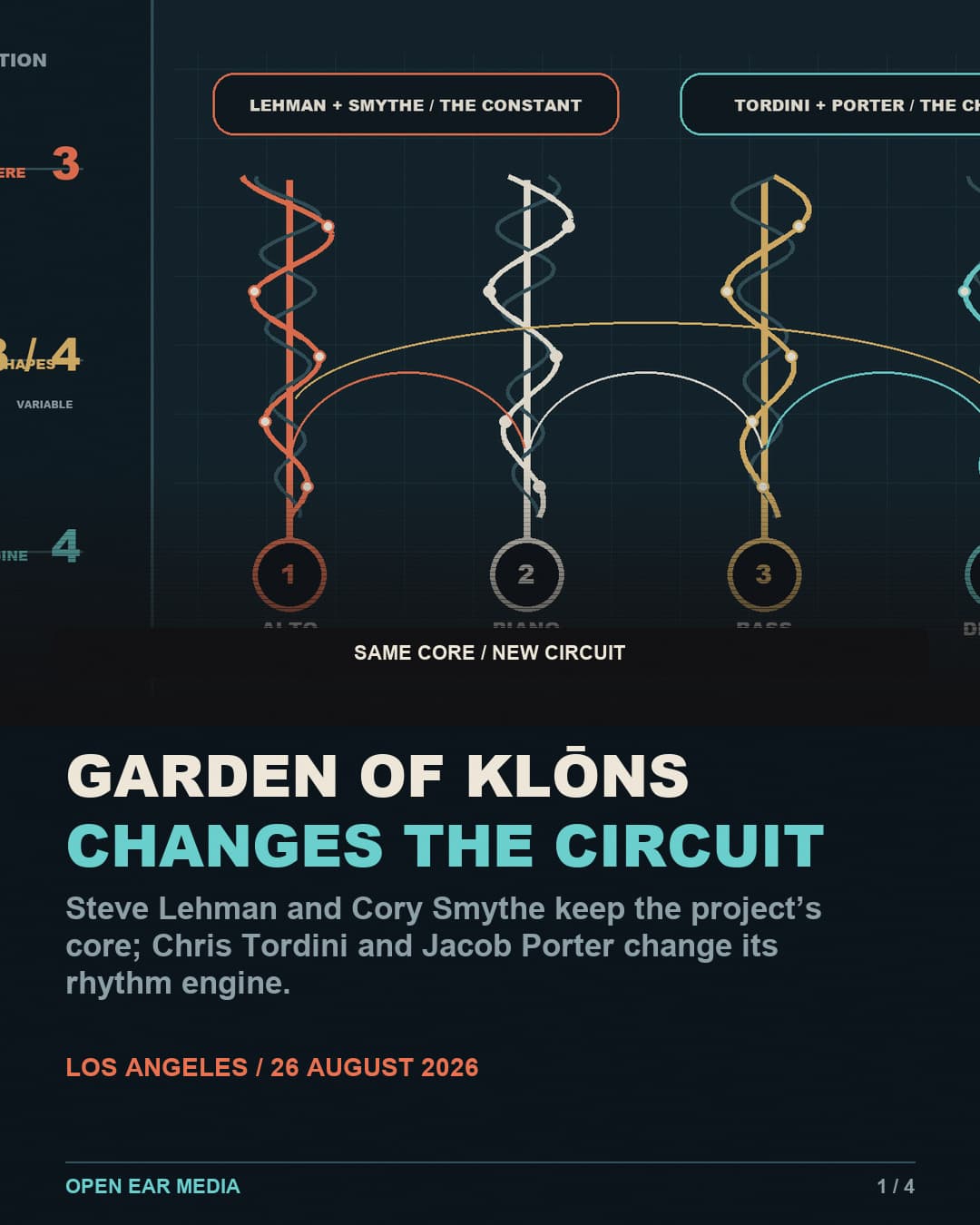
The story in four frames
A concise visual guide for listeners, derived from the researched feature above rather than the other way around.
Research trail
Sources and further listening
Primary artist, presenter, label, and event sources lead this list. Reviews and discographic databases are used for listening context and detailed recording credits. Each source was checked on the date shown in the feature metadata.
- 1Steve Lehman & Garden of Klōns with Cory Smythe, Chris Tordini & Jacob Porter
Sam First · official event
Supports: August 26 date and scheduled status, 7:30 and 9:30 p.m. sets, complete current lineup and instruments, address, 21+ policy, ticket prices observed August 11, recording notice, Sam First Instagram link.
- 2Steve Lehman & Garden of Klōns, Kris Davis Trio
REDCAT · official event
Supports: October 12, 2024 performance, original trio lineup, effects pedals, augmented piano, sensory percussion, Los Angeles-based project description.
- 3Angel City Jazz Fest Announces October Lineup
DownBeat · publication
Supports: world-premiere designation, Angel City Jazz Festival context, Lehman, Smythe and Pinson billing.
- 4Garden of Klōns with Steve Lehman, Cory Smythe & Jermaine Paul
Sam First · official event
Supports: July 25, 2025 trio, Lehman effects, Smythe augmented piano, Paul electric bass, absence of drummer from listed lineup.
- 5Steve Lehman & Garden of Klōns / Slauson Malone 1
Minaret Records · official event
Supports: September 24, 2025 Los Angeles appearance, Smythe, Paul and Pinson ensemble credits, new Los Angeles ensemble description.
- 6Steve Lehman & Garden of Klōns
Goodbye Look · official event
Supports: September 27, 2025 Seattle performance, bass-less Lehman-Smythe-Pinson trio billing, instrument roles.
- 7Garden of Klōns — Featuring Cory Smythe
UC San Diego Department of Music · official event
Supports: October 5, 2025 concert, West Coast tour conclusion, brand-new music mostly by Lehman, Lehman-Smythe-Paul-Pinson quartet, effects and sensory-percussion roles.
- 8Garden of Klōns, Cory Smythe Trio — event detail and program
UC San Diego Department of Music · official event
Supports: 2025 personnel, piano, alto and drum electronics credits, seven-work concert program, composer attributions.
- 9Garden of Klōns, Cory Smythe Trio — October 5th, 2025
UC San Diego Music · media
Supports: official complete concert archive, 74:56 duration, 2025 quartet personnel, program order, listening reference.
- 10Live review: Kris Davis Trio, Steve Lehman’s Garden of Klōns at REDCAT
MetalJazz · publication
Supports: contemporary account of the premiere, Pinson’s rhythmic function, piano preparation, processed alto and drums, composition-forward balance.
- 11Steve Lehman and Cory Smythe — Dialogues at the Margin I [2015]
International Contemporary Ensemble · media
Supports: February 28, 2015 world premiere, Lehman-Smythe duo history, Abrons Arts Center, performer credits, video title, channel, date and 38:23 duration.
- 12Steve Lehman and Cory Smythe — Dialogues at the Margin II [2015]
International Contemporary Ensemble · media
Supports: second official film from the February 28, 2015 Lehman-Smythe performance, duo personnel and venue.
- 13A U T O TROPHs
Cory Smythe · official artist
Supports: March 6, 2017 release, Smythe piano, electronics and compositions, Lehman alto on Lucy-A and Lucy-B, track durations.
- 14AUTOTROPHS: Cory Smythe Speaks
Jazz Speaks / The Jazz Gallery · publication
Supports: Smythe’s live Max and Ableton freeze effect, sine waves as rhythmic and microtonal information, Lehman collaboration, spectral and Lucier connections, live electronics philosophy.
- 15Cory Smythe — biography
Cory Smythe · official artist
Supports: official identity, work across new, classical and improvisatory music, International Contemporary Ensemble membership, composition-improvisation focus.
- 16Steve Lehman — official website
Steve Lehman · official artist
Supports: official biography, Los Angeles and CalArts context, experimental musical practice, official Instagram handle, official Bandcamp.
- 17Steve Lehman
Pi Recordings · official label
Supports: computer-driven Max/MSP improvisation research, spectral music scholarship, rhythm cognition writing, education, discography context.
- 18Ex Machina
Pi Recordings · official label
Supports: September 15, 2023 release, Lehman-Maurin collaboration, IRCAM interactive software, computer as virtual orchestrator and improvising partner, spectral harmony and rhythm, Los Angeles Imaginary context.
- 19Ex Machina ‘Los Angeles Imaginary’ (Steve Lehman)
Orchestre National de Jazz · media
Supports: official performance, Lehman composition, Bimhuis filming date and personnel, electronic collaboration credits, video title, channel, date and 5:59 duration.
- 20Images d’une œuvre n°29: Ex Machina de Steve Lehman et Frédéric Maurin
IRCAM · media
Supports: official project documentary, real-time DYCI2 system, Lehman and Maurin collaboration, video title, channel, date and 23:17 duration.
- 21Christopher Tordini
Pi Recordings · official label
Supports: official bassist identity, touring and recording in Steve Lehman-led bands, creative-music collaborations.
- 22Music with Friends: Chris Tordini Speaks
Jazz Speaks / The Jazz Gallery · publication
Supports: 2023 Tordini-Lehman quartet, Tordini’s prior work in Lehman’s bands, his view of Lehman, remarks on rhythmic freedom and rigor, collaborative process.
- 23About Sam First
Sam First · official event
Supports: intimate club description, proximity to LAX, address, normal two-set schedule, venue context.