Shuhei Mizuno Trio with Strings — editorial interpretation
Shuhei Mizuno brings his strings album to the room inside ‘Starry Eyes’
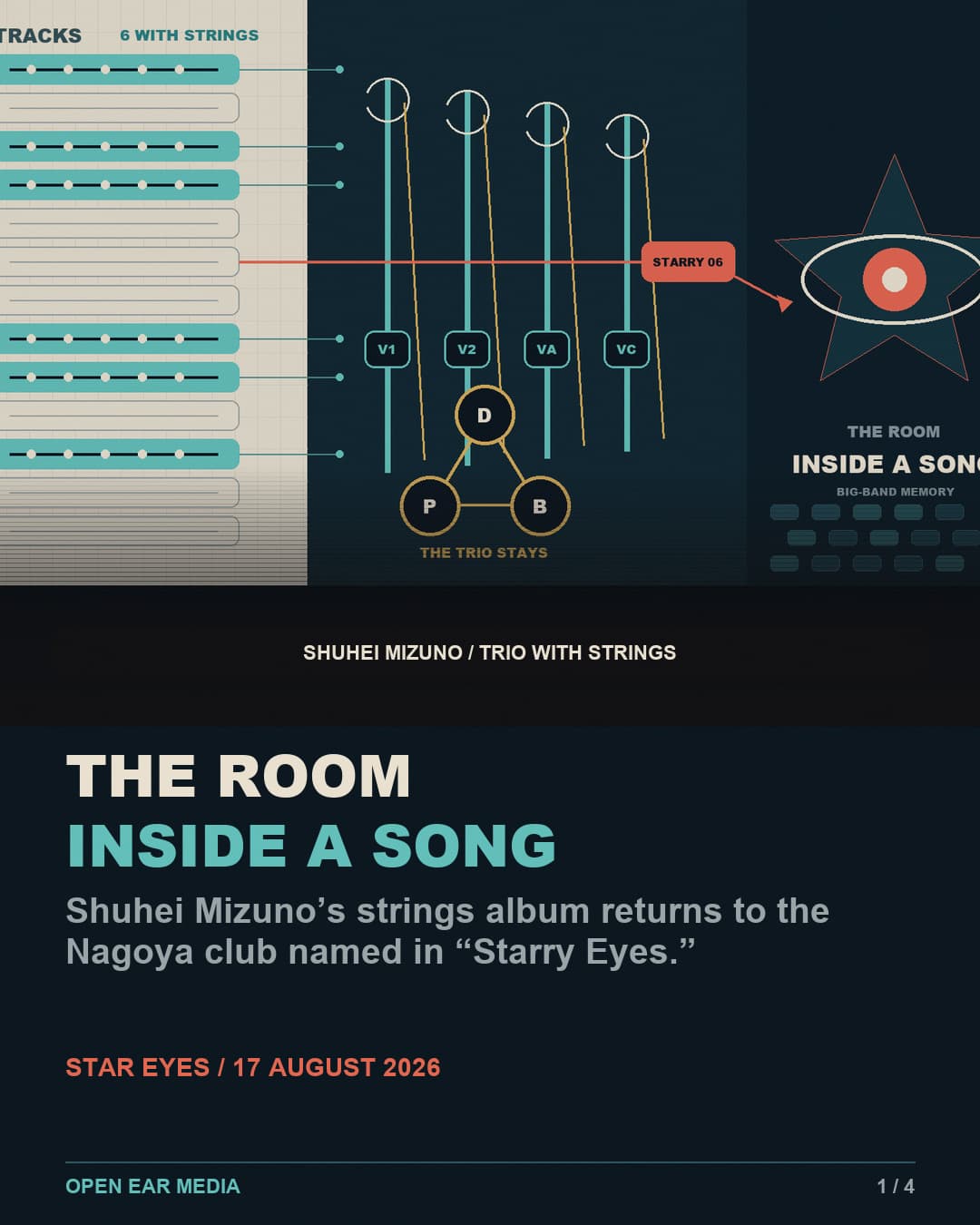
The Nagoya release show keeps the trio behind most of a one-day, 13-track session but hands every string chair to a new player in the club Mizuno salutes by name.
A room has entered Shuhei Mizuno’s new album twice: once as the place where his music has already been played, and once as a title. Track six is “Starry Eyes.” QAZZ Records describes it as an answer to Charlie Parker’s “Star Eyes,” while Mizuno’s artist-owned video adds a direct dedication to “Stareyes, Nagoya.” On August 17, the pianist, composer and arranger brings the album’s seven-player touring format into that same Kakuozan club. [6][25][1]
That symmetry is the invitation, not a promised set list. No official page says which of the record’s 13 tracks will be played. What the billing does establish is a more useful proposition: Mizuno, bassist Yoshimasa Otsuka and drummer Hayato Yamazaki carry the recording’s central trio into four release-tour dates, while a completely different string quartet takes over the live parts. This is a chance to hear whether the writing survives a change of hands, not an attempt to preserve a studio cast under glass. [6][3][2]
The title does not describe every track
“With strings” is a structural choice, not a permanent coating
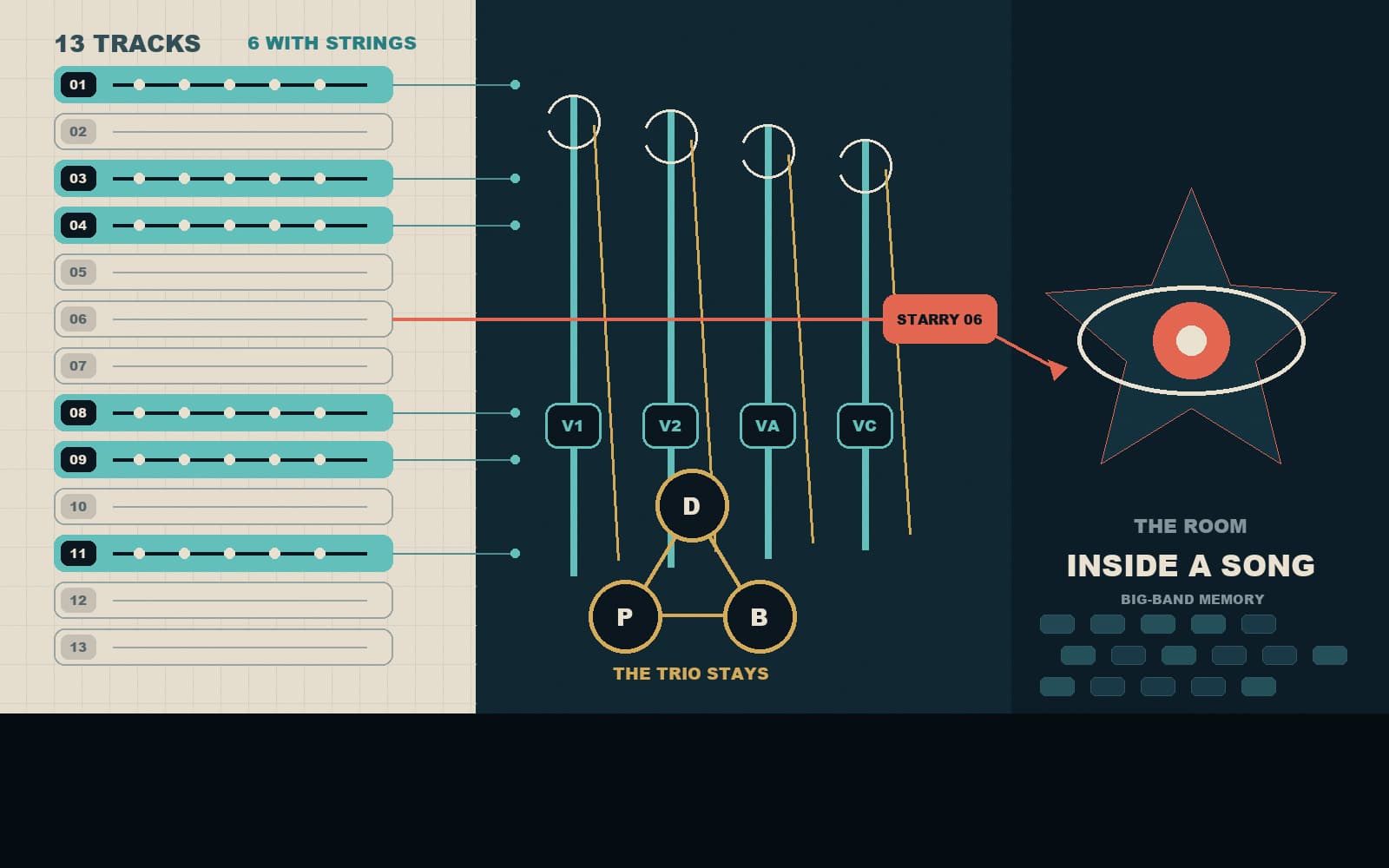
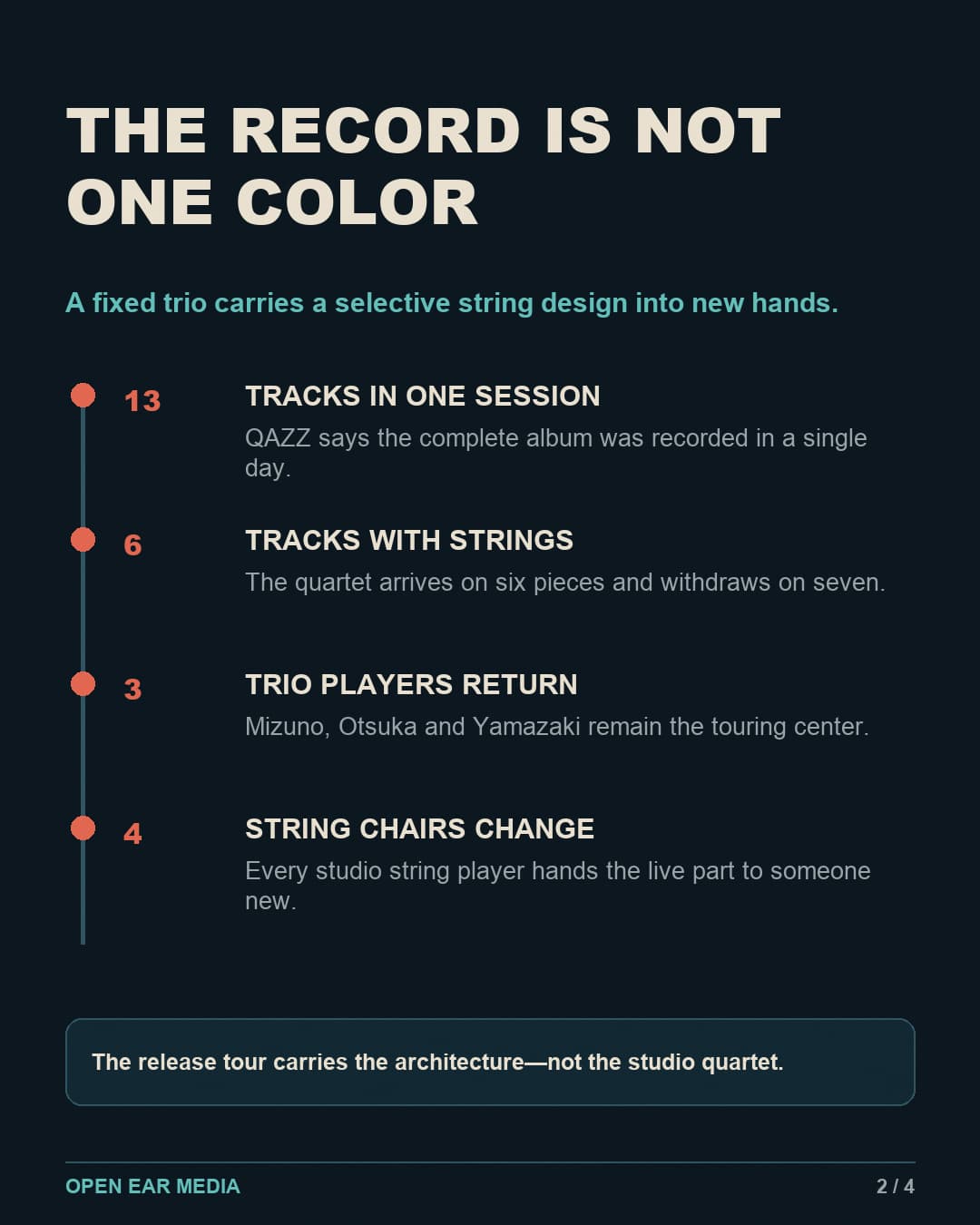
QAZZ marks strings on six pieces: “Pathos Remembered,” “Poinsettia,” “Fukuda’s Waltz,” “Hush A Bye — Reiwa6-10,” “Just One of Those Things — Reiwa6-5” and “Behind the Eight Ball.” Seven other tracks retain a smaller frame. That alternation matters. A listener does not spend the entire album inside one orchestral color; the string quartet can arrive, withdraw and make the trio sound newly exposed when it is left alone. [6]
The 13-track sequence is broad without being miscellaneous. Nine Mizuno compositions sit beside a traditional tune, Cole Porter, Charlie Parker and Oscar Pettiford. The label hears a cinematic opening in “Pathos Remembered,” a 1950s inflection and blues harp in “Poinsettia,” a double-time modulation in “Kiev,” and contemporary reframings in the two standards carrying Reiwa subtitles. The record therefore moves between authored melody, bebop memory and arrangement as revision. [6]
The most revealing concert question is not simply whether the strings sound lush. Listen for function: whether the quartet states a theme, builds inner motion behind the piano, punctuates the rhythm section, or disappears long enough for Otsuka and Yamazaki to reset the scale. Because no public set list has been announced, even the balance between string-arranged album pieces and trio material remains open until the performance. [6][1][3]
The arranger before the album
A trio plan expanded into 13 tracks recorded in one day
Mizuno’s official biography places composition and arrangement beside piano, not behind it. He began playing jazz as a teenager in Aichi, worked in college with the Tomonao Hara–Masahiko Osaka quintet, later toured with Hiroshi Murata’s Bop Band, and wrote for the C.U.G Jazz Orchestra. After solo-piano releases in 2005 and 2015, he formed a big band in 2016 devoted to his own compositions. The new record condenses that long large-ensemble practice rather than introducing arranging as a late ornament. [8][9][10]
QAZZ traces the project to Yamazaki. The label had encountered the drummer through another recording, learned that he shared Mizuno’s home region and played in his trio, and made the offer. What began as a conventional piano-trio idea grew when strings were proposed. The resulting session captured all 13 tracks in a single day—six with the quartet and seven without it. [6][13]
That speed does not mean the rhythm team is anonymous. Otsuka plays bass on most of the album; Yamazaki’s official profile reaches beyond jazz into Latin, Brazilian and percussion work; and Mizuno supplies the compositions and arrangements. On tour, those three retain the center. Their continuity gives four new string players a stable pulse and harmonic map against which details of attack, blend and phrasing can change. [6][13][12]
Seven players, two layers of continuity
The trio stays; every string chair changes
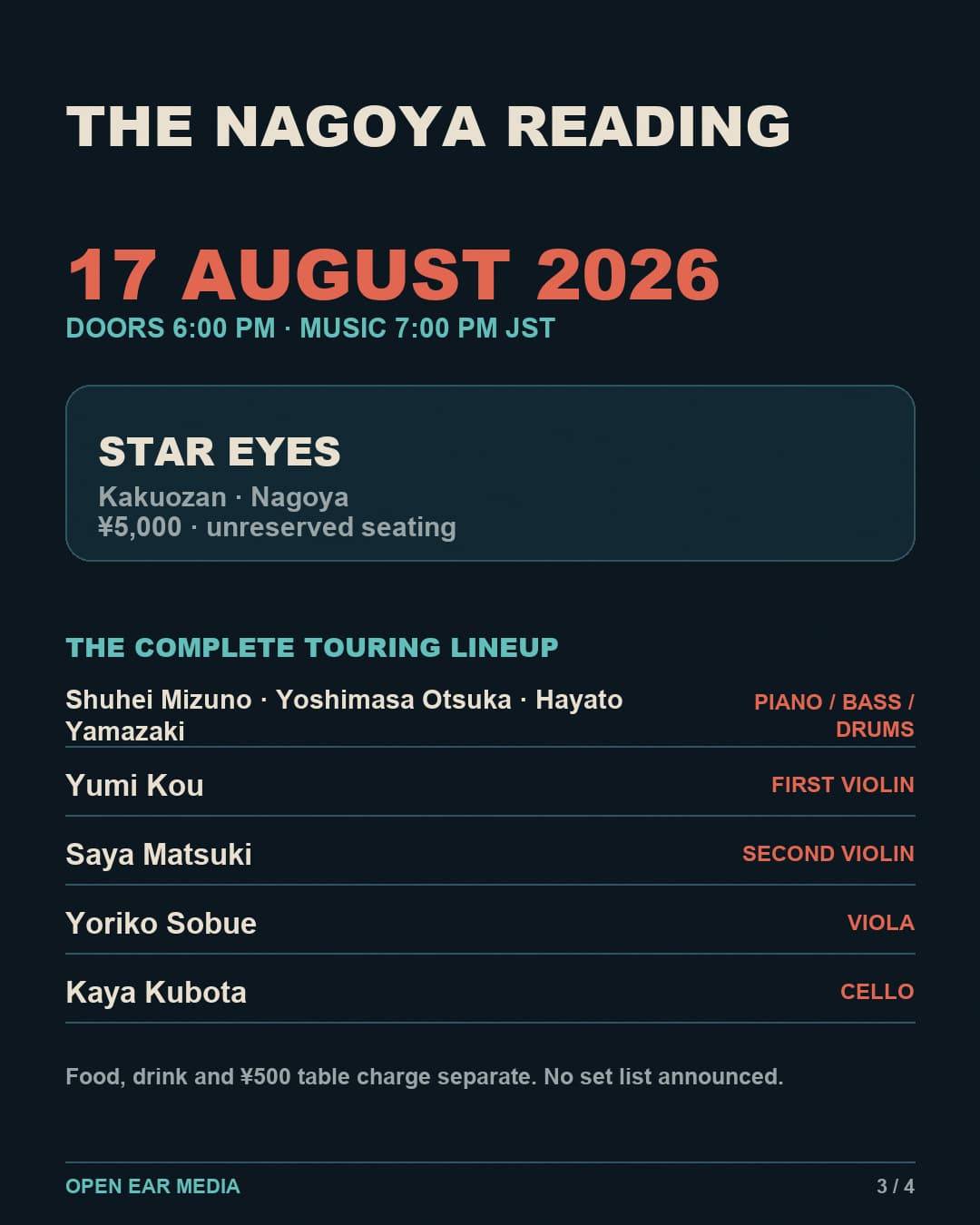
The complete STAR★EYES lineup is Mizuno on piano, Otsuka on bass and Yamazaki on drums, joined by Yumi Kou on first violin, Saya Matsuki on second violin, Yoriko Sobue on viola and Kaya Kubota on cello. QAZZ, Mizuno and Yamazaki all publish the same seven-player bill, and Yamazaki’s tour page specifies the two violin chairs rather than listing an undifferentiated pair. [1][2][3]
The studio quartet was Maiko on first violin, Crusher Kimura on second violin, Shiori Tanaka on viola and Orie Hirayama on cello. None appears in the touring quartet. That is the decisive personnel fact behind the release show: these parts leave the recording ensemble and become live material for four new interpreters, while the main trio remains recognizable. It is a transfer of architecture, not a reunion of everyone heard on the disc. [6][3]
The touring strings also bring different musical histories. Kou’s official site documents classical training, tango study and cross-genre work around Nagoya. QAZZ’s profile sheet describes Matsuki’s chamber-music training; Sobue is listed in the Chubu Philharmonic’s viola section; and Kubota identifies as an Okazaki-born Aichi University of the Arts graduate working as a cellist in the prefecture. Their common ground is regional, but their routes into the quartet are not identical. [14][7][15][21]
The instrumentation creates choices a generic “strings” credit can hide. First violin can carry a top line while second violin and viola determine how much harmonic grain sits in the middle. Cello can join that inner fabric or approach Otsuka’s register, making the seam between quartet and rhythm section audible. The practical listening test is whether seven players become one blended body or preserve several distinct layers—and when Mizuno’s piano chooses to belong to each. [3][6]
The Nagoya address is musical evidence
STAR★EYES is both the release room and part of the record’s map
STAR★EYES describes itself as a jazz bar operating since 1982, four minutes from Kakuozan Station. Its official address is 3-4-1 Kikusaka-cho, Chikusa-ku, Nagoya, on the first floor of G House. That continuity matters for a composer whose public biography is centered on Aichi and Nagoya: this is not a touring package dropping into an interchangeable hall, but a home-region club with a documented place in his working life. [5][8][9]
“Starry Eyes” makes the relationship explicit. QAZZ lists the track as a Mizuno original and a response to Parker’s “Star Eyes”; the official video title adds the dedication to STAR★EYES. Yet the album notation does not mark track six as one of the six string pieces, and it credits Makoto Uemura rather than Otsuka on bass. Even within the album, the room-linked piece is an exception to the headline configuration. [6][25]
Another album piece already has a visual record inside the club. Mizuno’s official “Fukuda’s Waltz” video documents a performance at STAR★EYES on October 5, 2025. The recording is a big-band performance, not the album’s trio-and-strings version; the label marks the waltz as one of the six string-arranged tracks. The same composition can therefore be traced through at least two documented ensemble designs before the release tour begins. [24][6]
That is why the venue belongs to the feature’s thesis without predicting the night’s repertoire. “Starry Eyes” may or may not be called, and the tour pages do not promise an album-in-sequence performance. What is certain is that Mizuno is bringing a project containing a tribute to this room back through its door, with a string section that did not make the record. [1][3][6][25]
Three official views of the same arranging mind
Hear the compositions at big-band scale before the quartet changes them again
The three videos below come from Mizuno’s own big-band channel. They do not show the August touring band, and that distinction is their value. Each description identifies Mizuno as composer and publishes the large ensemble’s personnel. “Pathos Remembered” and “Starry Eyes” come from the big band’s April 12, 2026 tenth-anniversary concert; “Fukuda’s Waltz” comes from STAR★EYES in 2025. [22][23][24][25]
Start with “Pathos Remembered.” QAZZ places it first on the album and describes its string opening in cinematic terms. The video offers a different orchestration—saxes, six trumpets, five trombones, two bassists, drums and Mizuno’s piano. Rather than treating it as a preview, use it to locate the composition’s large shape, then ask how four bows and a piano trio can carry comparable weight with far fewer voices. [6][23]
Next, use “Fukuda’s Waltz” as a room study. The camera preserves the big band inside STAR★EYES, while Mizuno’s note says he wrote the piece during treatment for the ensemble’s original bassist. On the album it becomes a string-arranged track. The comparison is not about deciding which version is definitive; it reveals how personal material can move from brass and reeds toward a smaller chamber balance. [24][6]
Finish with “Starry Eyes.” Its official title names the dedication that makes August 17 more than a convenient date at a familiar club. The video again supplies a big-band version, while QAZZ places a smaller, non-string-marked reading on the album. If the tune appears in Nagoya, its next form is unknown. If it does not, the dedication still explains why this room remains audible around the event. [25][6][1]
Pathos Remembered [Reiwa5-2]
Mizuno’s official big-band performance gives the album-opening composition a brass-and-reeds scale before listeners encounter its string-arranged recording and new touring quartet.
Watch on YouTube · 水野修平 Shuhei Mizuno Big BandFukuda's Waltz
This official October 2025 big-band performance at STAR★EYES connects the room to a composition that receives strings on the new album.
Watch on YouTube · 水野修平 Shuhei Mizuno Big BandStarry Eyes [Dedicated To Stareyes,Nagoya] [Reiwa7-9]
The artist-owned title documents Mizuno’s dedication to the Nagoya club hosting the album-release performance, heard here at big-band scale.
Watch on YouTube · 水野修平 Shuhei Mizuno Big BandThe repertoire beneath the chamber surface
Bebop remains the grammar even when the palette widens
Nagoya College of Music describes bebop as the foundation from which Mizuno develops performance, composition and arrangement. His own and C.U.G. biographies document decades of writing for jazz orchestras alongside piano work. That background clarifies the album’s balance: strings broaden timbre, but the track list keeps Parker, Pettiford, Cole Porter and a traditional tune in conversation with Mizuno’s originals. [9][8][10][6]
Several titles make the conversation unusually legible. QAZZ calls “Clark In Motion” a Sonny Clark homage; “Starry Eyes” answers Parker’s “Star Eyes”; Parker’s “Confirmation” appears under its own name; and Pettiford’s “Blues in the Closet” closes the album. The record does not require strings to certify ambition. Its larger claim is that a composer can keep bebop’s repertoire and forward motion while treating ensemble size as a variable. [6]
The label emphasizes Mizuno’s approachable melodic writing, while his institutional biography emphasizes trial, improvisation and arrangement. Those are not opposing descriptions. Melody gives a listener something to recognize when the same piece changes scale; improvisation prevents the new quartet from becoming a mechanical copy of the session. The release show matters at precisely that intersection between a fixed score and musicians hearing one another in real time. [6][9][3]
What is confirmed before doors open
The Nagoya stop is the third night of a four-date regional tour
The STAR★EYES performance is Monday, August 17, 2026. Doors are listed for 6 p.m. and music for 7 p.m. The touring page sets admission at ¥5,000, with food and drink plus a ¥500 table charge separate; seating is unreserved. It directs Nagoya reservations to the club by telephone at 052-763-2636. Jazz DateBook’s event and venue pages provide the internal calendar path, but the artist and presenter pages remain the source of current practical truth. [3][1][5][26][28]
Nagoya is night three of four: Kasugai on August 15, Hamamatsu on August 16, STAR★EYES on August 17 and Mikawa-Anjo on August 18. The same seven musicians are billed throughout. The itinerary gives the new quartet two scheduled public nights to negotiate Mizuno’s charts with the trio before the group reaches the room behind “Starry Eyes”; the following evening offers the experiment one more setting. [1][2][3][12]
No official source reviewed here publishes a set list, running time or promise to perform all 13 album tracks. Confirm details before traveling, and do not treat “Starry Eyes” as guaranteed repertoire. The documented reason to listen is already enough: a one-day studio project becomes a regional ensemble, every string chair changes, and a Nagoya composer brings that revised design to a club he has written into his musical world. [6][1][3][25]
The social edition
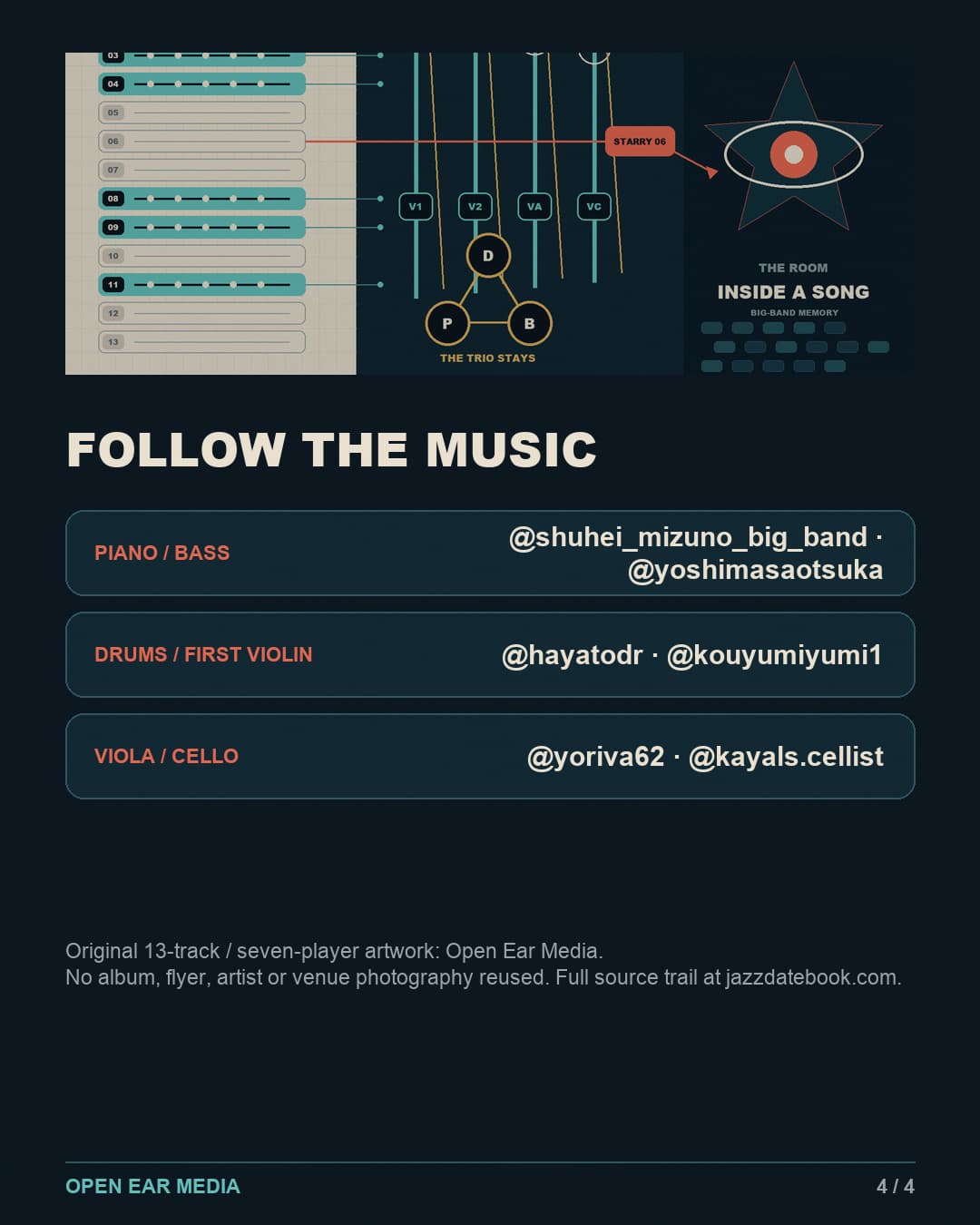
The story in four frames
A concise visual guide for listeners, derived from the researched feature above rather than the other way around.
Research trail
Sources and further listening
Primary artist, presenter, label, and event sources lead this list. Reviews and discographic databases are used for listening context and detailed recording credits. Each source was checked on the date shown in the feature metadata.
- 1Shuhei Mizuno Trio with Strings New Album Release Tour 2026
QAZZ Records · official event
Supports: four-date release tour, Nagoya date, doors and start, price, complete touring lineup.
- 2August 17 at STAR★EYES — Shuhei Mizuno Trio with Strings album release tour
Shuhei Mizuno · official artist
Supports: Nagoya event, complete lineup, price, tour itinerary.
- 3Shuhei Mizuno Trio with Strings release tour
Hayato Yamazaki · official artist
Supports: first and second violin roles, date, doors and start, price and additional charges, reservation phone, address, complete lineup.
- 4Shuhei Mizuno Trio With Strings CD release celebration
STAGLEE / STAR★EYES · official event
Supports: date, doors and start, venue, complete lineup.
- 5Jazz Live STAR★EYES
STAR★EYES · official event
Supports: venue address, 1982 opening history, Kakuozan Station access, room operations and charges.
- 6Shuhei Mizuno Trio with Strings — QAZZ-026
QAZZ Records · official label
Supports: 13-track sequence, six string-arranged tracks, studio personnel, one-day recording, composition and arrangement notes, album price and catalogue number.
- 7Shuhei Mizuno Trio with Strings touring musician profiles
QAZZ Records · official label
Supports: touring musician biographies, regional and ensemble backgrounds, instrument roles.
- 8Biography
Shuhei Mizuno · official artist
Supports: pianist, composer and arranger roles, C.U.G. history, solo albums, 2016 big-band formation, Nagoya base.
- 9Shuhei Mizuno — faculty profile
Nagoya College of Music · official artist
Supports: career chronology, bebop-centered teaching and practice, composition and arranging credits.
- 10Rhythm Section & Vocal — Shuhei Mizuno
C.U.G Jazz Orchestra · official artist
Supports: C.U.G. role, recording history, composer and arranger work, bebop orientation.
- 11Shuhei Mizuno has released Shuhei Mizuno Trio with Strings
Nagoya College of Music · publication
Supports: 2026 album announcement, Mizuno faculty identity, official purchase referral.
- 12August 2026 schedule
Yoshimasa Otsuka · official artist
Supports: release-tour itinerary, touring lineup, Nagoya date and time.
- 13Hayato Yamazaki — official biography
Hayato Yamazaki · official artist
Supports: drummer and percussionist biography, Aichi background, jazz, Latin and Brazilian practice.
- 14Violinist Kou, Yumi — official website
Yumi Kou · official artist
Supports: first-violin billing, tour dates, classical, tango and cross-genre background, official Instagram link.
- 15Orchestra members
Chubu Philharmonic Orchestra · official artist
Supports: Yoriko Sobue name and viola role, orchestra membership.
- 16Shuhei Mizuno Big Band on Instagram
Instagram / Shuhei Mizuno Big Band · official social
Supports: verified social handle, Mizuno pianist, composer and arranger identity.
- 17Yoshimasa Otsuka on Instagram
Instagram / Yoshimasa Otsuka · official social
Supports: verified social handle, bassist identity.
- 18Hayato Yamazaki on Instagram
Instagram / Hayato Yamazaki · official social
Supports: verified social handle, drummer identity.
- 19Yumi Kou on Instagram
Instagram / Yumi Kou · official social
Supports: verified social handle, violinist identity.
- 20Yoriko Sobue on Instagram
Instagram / Yoriko Sobue · official social
Supports: verified social handle, violist identity.
- 21Kubota Kaya on Instagram
Instagram / Kaya Kubota · official social
Supports: verified social handle, cellist identity and name reading, Aichi background.
- 22Shuhei Mizuno Big Band
YouTube / Shuhei Mizuno · media
Supports: artist-owned media channel, official composition videos.
- 23Pathos Remembered [Reiwa5-2]
YouTube / Shuhei Mizuno Big Band · media
Supports: official big-band performance, composition credit, complete video personnel, upload date and duration.
- 24Fukuda's Waltz
YouTube / Shuhei Mizuno Big Band · media
Supports: official performance recorded at STAR★EYES, composition context, complete video personnel, upload date and duration.
- 25Starry Eyes [Dedicated To Stareyes,Nagoya] [Reiwa7-9]
YouTube / Shuhei Mizuno Big Band · media
Supports: official venue dedication, big-band performance, complete video personnel, upload date and duration.
- 26Shuhei Mizuno Trio With Strings CD release celebration
Jazz DateBook · publication
Supports: Jazz DateBook event record, internal event destination.
- 27Live Jazz in Nagoya
Jazz DateBook · publication
Supports: Nagoya jazz calendar, internal city destination.
- 28STAR★EYES schedule and upcoming jazz shows
Jazz DateBook · publication
Supports: venue guide and calendar, internal venue destination.