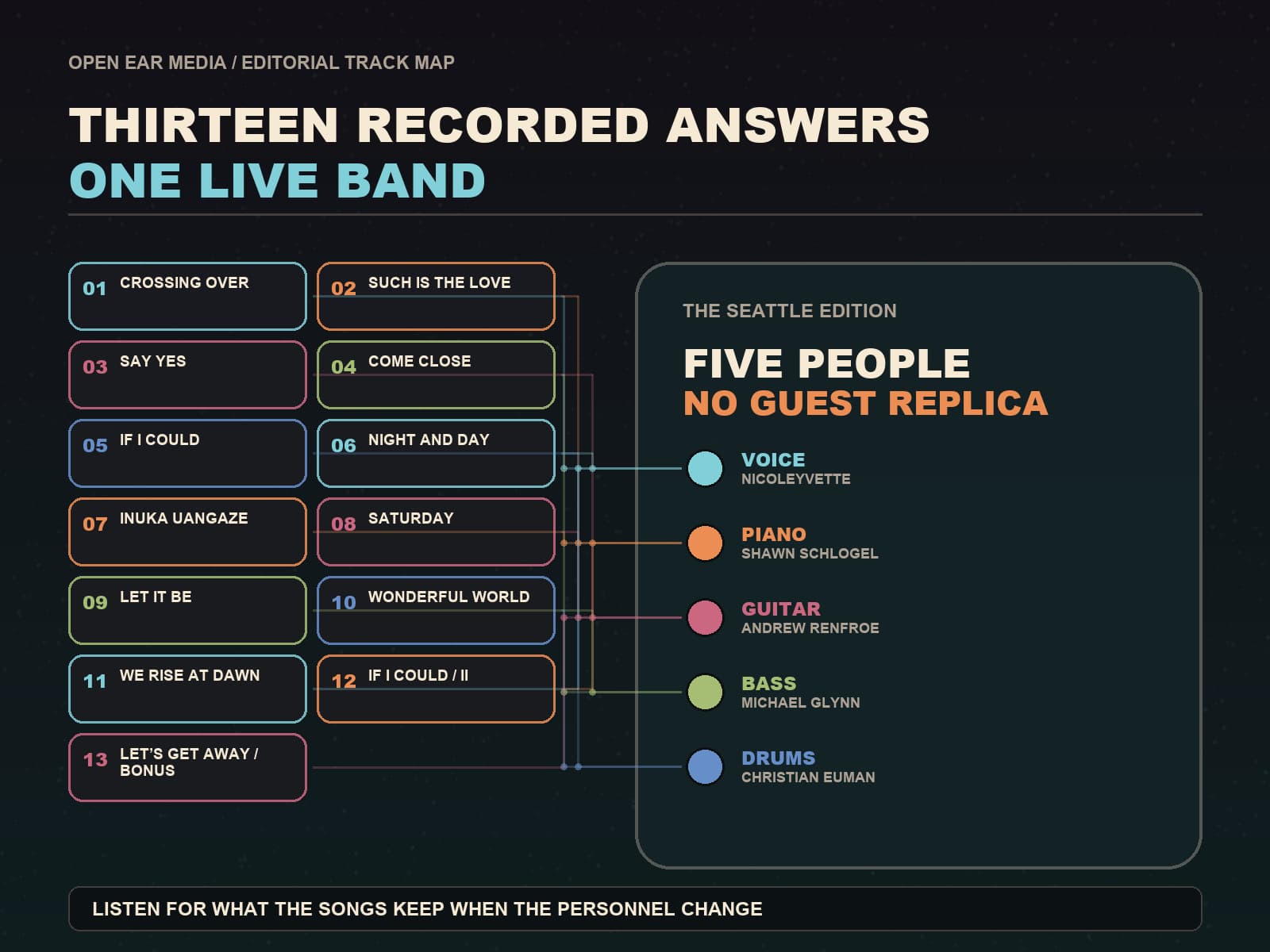
Thirteen recorded answers, one live band
NicoleYvette turns a lifetime of songs into a first album
The Seattle singer’s debut is a 67-minute studio constellation; at the Royal Room, a five-person band has to turn its guests, alternate readings and long personal history back into one live voice.
A debut album normally introduces an artist. Say Yes does something more complicated: it gathers songs NicoleYvette says she has been writing some version of her entire life, after childhood church singing, original music in Denver and more than a decade inside Seattle’s jazz community. The record is new; the life inside it is not. Its August 30 release show at the Royal Room matters because the city that gave her a working musical home now hears that long private timeline returned as a public repertoire. [1][4][3]
The studio version is expansive: thirteen digital tracks and just over 67 minutes, produced by Sara Gazarek, with named appearances by Kurt Elling, Joel Ross, J. Ivy, Keyon Harrold, Terri Lyne Carrington, Lenard Simpson and Paul Cornish; NicoleYvette’s official material also credits Larry Goldings among the album contributors. Yet the Seattle stage billing is deliberately smaller. Shawn Schlogel, Andrew Renfroe, Christian Euman and Michael Glynn form the complete live band around the singer. The show is not advertised as a parade of album guests. [6][7][8][4][1]
That difference is the story. A record can preserve a particular vocalist, vibraphone ring, trumpet answer or drum conversation forever; a release concert has to discover what the songs are when those colors are redistributed among five people in real time. One official video already offers a clue: the album’s bonus track “Let’s Get Away” appears in a Los Angeles club performance with Renfroe on guitar, while Schlogel shares the writing credit. Say Yes reaches Seattle not as a museum copy of its sessions, but as music built to survive a change of room and personnel. [11][1][6]
The long first chapter
A debut is not the same thing as a beginning
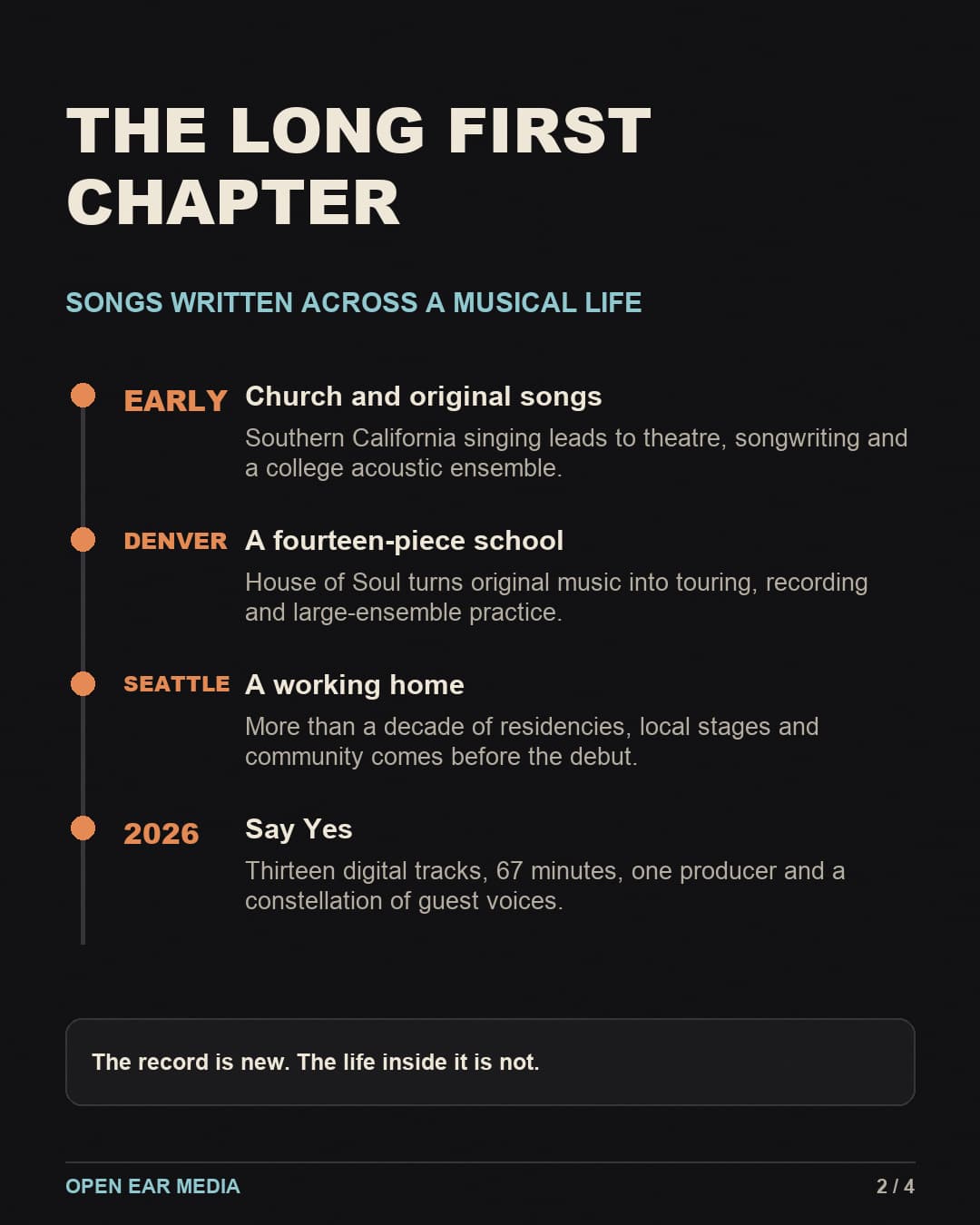
NicoleYvette’s own biography starts in Southern California, singing as a child in church, including her father’s. In high school she moved into musical theatre and songwriting; in college she formed the acoustic original-music group His Beloved. Denver then became a proving ground: she worked as a worship leader, co-founded the 14-piece Dave LeMieux and House of Soul, toured and recorded with that ensemble, and appeared with Denver Brass. Those chapters explain why Say Yes can hold gospel directness, ensemble writing and jazz improvisation without presenting them as new discoveries. [4]
Seattle supplied continuity rather than instant reinvention. Her press biography describes study, regular performance, residencies, sold-out headlining dates and cultural or corporate work after the move; the Royal Room calls her a fixture of the city for more than a decade. That phrasing should not be converted into a claim that this is her first important Seattle concert. The album-release date means almost the opposite: a familiar working singer is asking her city to encounter the authorship that had been accumulating beneath those appearances. [4][1]
Her preferred description—singer, songwriter and “joy cultivator”—is useful because it puts composition beside voice. The official site says the original songs anchor Say Yes, while familiar titles such as “Night and Day,” “Let It Be” and “What a Wonderful World” sit inside the same sequence. The album therefore does not force a choice between writer and interpreter. It lets standards test her sense of language and lets originals show what happens when the language begins with her own experience. [3][4][6]
The record
Thirteen tracks make “yes” a sequence, not a slogan
Public distribution records identify Say Yes as a vocal-jazz album released by Bright Fame, LLC on August 14, 2026. The running order lasts 67 minutes and eight seconds across thirteen digital tracks; the final entry is explicitly marked “Let’s Get Away (Bonus Track).” NicoleYvette’s shop describes the physical program as twelve tracks, which is consistent with treating the bonus as an addition rather than evidence of a factual mismatch. Either way, this is a long-form debut: the pacing has enough room for songs to answer one another rather than compete for a single-release moment. [6][7][8][9]
The guest credits create a map through that sequence. Kurt Elling joins track two, “Such Is the Love.” Joel Ross appears on the title track. J. Ivy and Keyon Harrold share “Come Close”; Terri Lyne Carrington is named on “Inuka Uangaze”; Lenard Simpson on “Saturday”; and Paul Cornish on the second of two entries titled “If I Could.” These are track-level facts, not a promise that any guest will appear in Seattle. The Royal Room’s announced band contains none of those names. [6][7][1]
That design also keeps the album from becoming guest-driven branding. The opening “Crossing Over” carries no featured name. Neither do the first “If I Could,” “Night and Day,” “Let It Be,” “What a Wonderful World” or “We Rise at Dawn.” The guests arrive at selected structural points, while NicoleYvette remains the only artist credited across the complete album. The word yes, in this context, can mean accepting collaboration without surrendering the center of the record. [7][8][3]
The producer’s role
Sara Gazarek heard intention before scale
NicoleYvette’s site quotes Gazarek remembering an immediate clarity not only in the singer’s tone but in her intention. That distinction is central to the production credit. A record with this many recognizable collaborators could easily frame importance as accumulation: more names, more orchestration, more proof. Instead, the artist’s own description calls Say Yes a record that asks to be felt, and presents Gazarek’s task as shaping a full emotional spectrum around words that must remain intelligible. [3][5][4]
Thierry De Clemensat’s Paris-Move review hears restraint as the method: phrasing allowed to settle into rhythm, production that trusts silence, and guest performances treated as parts of a shared dramatic argument rather than detachable attractions. That is criticism, not a session ledger, but it gives a practical listening test. On a 67-minute album, ask not only who enters, but what changes when they do: density, register, rhythmic pressure, the distance around the voice, or the amount of time a lyric is permitted to hang unresolved. [10][8]
The review also attributes arrangements across the project to Dawn Clement, Schlogel and NicoleYvette. That makes Schlogel’s Royal Room piano chair more consequential than the generic phrase “local backing band” would suggest. He is not merely inheriting completed studio objects; published credits place him inside the music’s construction, and the official “Let’s Get Away” description names him as NicoleYvette’s co-writer. The release show brings one of the record’s architects into the smallest possible harmonic instrument onstage: a single piano. [10][11][1]
There was an unmistakable clarity in her sound, not just of tone, but of intention.
How to hear the album
Follow the conversations, then compare the two “If I Could” readings
“Such Is the Love” is the clearest entry point for vocal exchange. Paris-Move describes NicoleYvette and Elling listening across delayed entrances, overlaps and held harmonic tension rather than treating the duet as a contest. The title track changes the conversation from a second voice to Joel Ross’s vibraphone, an instrument that can extend a sung phrase through resonance after its words end. “Come Close” expands again: spoken word and trumpet give the song two different ways to answer a vocalist without becoming another vocalist. [10][6]
The seventh track offers the most reduced guest design. “Inuka Uangaze” names Carrington, and the review characterizes the performance as a near-bare dialogue between voice and drums, where breath, silence and rhythmic response carry the form. Three tracks later, “We Rise at Dawn” returns without a featured credit. Hearing those points in sequence reveals the album’s range more clearly than shuffling celebrity appearances: subtraction can be as important as addition. [10][7]
Tracks five and twelve share the title “If I Could”; only the later one names Cornish. The public metadata does not label them take one and take two, nor does it explain whether their arranging, tempo or instrumentation differs, so those details should be heard rather than guessed. Their durations already establish that they are distinct presentations: 5:56 and 6:38. Treat the first as memory and the second as a return. What has changed in the lyric’s weight after seven intervening songs—and what can a named pianist disclose that the earlier version withholds? [7][8]
The live evidence
“Let’s Get Away” already knows how to change bands
NicoleYvette’s official channel published “Let’s Get Away” from Birds of a Feather Jazz Lounge in Los Angeles on July 29. The three-minute performance is credited to Nicole Walters and Schlogel as writers, with Miro Sprague on piano, Renfroe on guitar, Marlonius on bass and John Davis on drums. The streaming album places the same title last and marks it as a bonus track. The video is therefore both a listening route into Say Yes and documentation that one of its songs had a live identity outside the album session. [11][6][7]
Watch the arrangement as a compact travel song. The first vocal invitation arrives around 0:15; the lyric moves through planes, trains, an open-top drive and a beach, then leaves a central instrumental span before the voice returns near 1:43. The final repetitions become a question-and-answer release rather than a new narrative verse. What matters for Seattle is the division of labor: Renfroe already knows how to place guitar inside this song, while Schlogel knows it from the writing side even though Sprague holds the piano chair in the filmed performance. [11]
Do not use the clip as a predicted Royal Room arrangement. Its bassist and drummer are different, and the event page does not promise the song will be played. Use it to hear portability. A composition can retain its invitation while rhythm players, pianist and room change around it. That is exactly the problem the release show must solve across an album much larger than one bonus track. [11][1]
Let’s Get Away featuring NicoleYvette
An artist-published club performance of the album’s bonus track, co-written by NicoleYvette and Royal Room pianist Shawn Schlogel and featuring release-show guitarist Andrew Renfroe.
Watch on YouTube · NicoleYvette WaltersThe Seattle edition
Five musicians cannot reproduce a studio constellation—and should not try
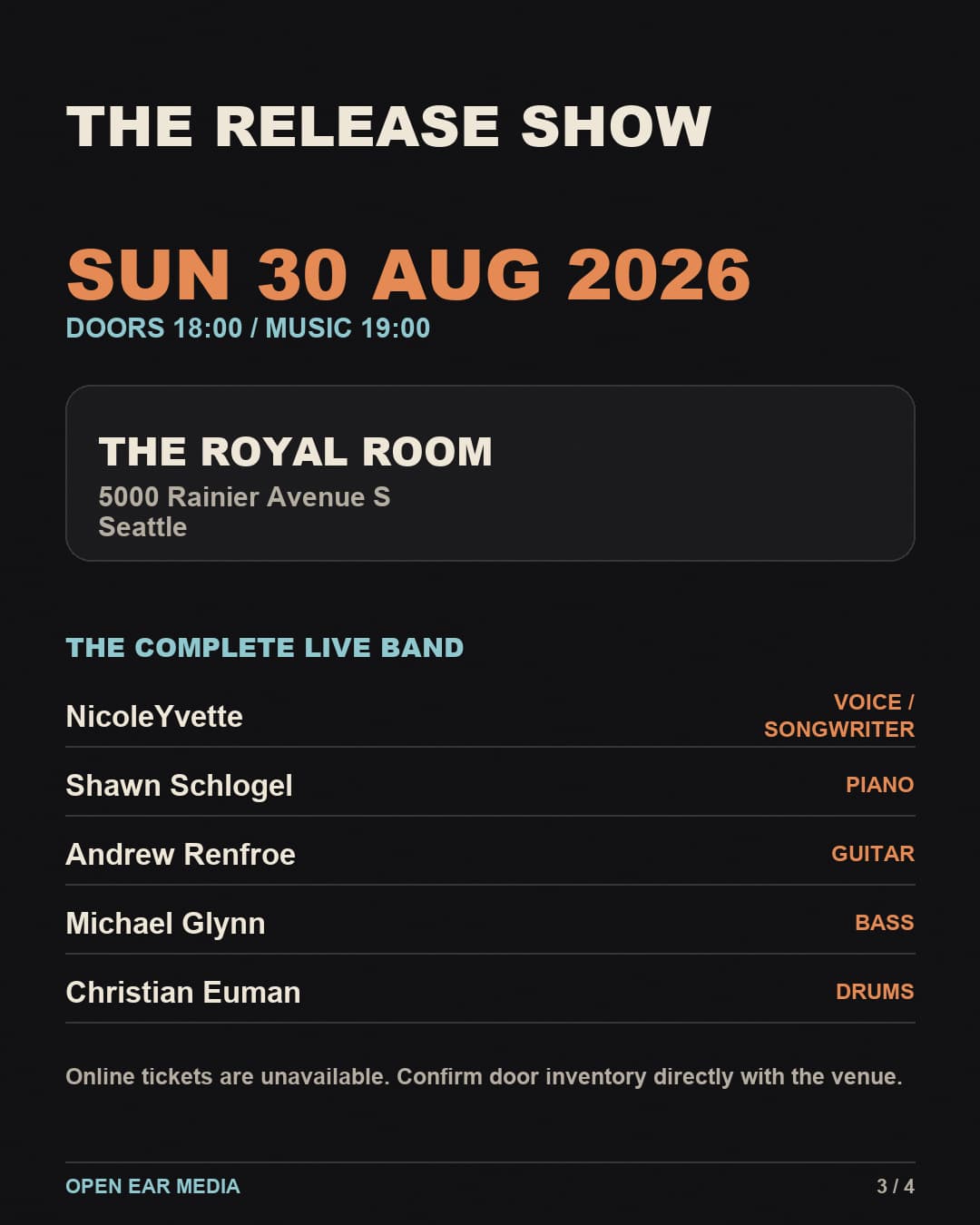
The Royal Room names Schlogel on piano, Renfroe on guitar, Euman on drums and Glynn on bass. Its copy says several members of the studio band will appear but does not identify which individuals that phrase covers, so the safe public claim is the complete current billing—not an invented session-by-session match. The visible instrumentation contains no vibraphone, trumpet or saxophone. Any color associated with Ross, Harrold or Simpson must be omitted, reassigned or transformed if the corresponding songs enter the set. [1][2][6]
Renfroe is the clearest documented bridge because he appears in the official “Let’s Get Away” performance. Euman’s event biography places him in touring work with Elling, Jacob Collier, Billy Childs and Gazarek; that does not mean he will imitate Carrington’s album role. It means the drummer understands vocalist-led settings where time and dynamics answer words. Glynn is presented as the Seattle anchor, with long experience across jazz and other forms. Around NicoleYvette, this quartet can make the record local through working relationships rather than guest replication. [11][1]
Listen for redistribution. Can Renfroe’s guitar carry the sustained afterimage that vibraphone supplies on record? Does Schlogel preserve open space or make the harmony more explicit? How do Glynn and Euman treat songs shaped in the studio by different low-end and drum voices? These are questions, not forecasts. A convincing release show does not prove fidelity by matching timbre; it reveals whether the songs’ emotional and formal identities remain legible after the record’s personnel map is folded into one band. [1][10][11]
The room and the practical truth
The Royal Room was built for projects still becoming themselves
The venue’s history makes it an unusually apt release room. Wayne Horvitz approached operators Tia Matthies and Steve Freeborn about the project in 2009; after two years of development, the Royal Room opened in Columbia City in December 2011. It was designed with a permanent backline, recording and video capability, grand piano and a stage intended to serve working artists. Its stated emphasis on creative programming and development turns an album release from a ceremonial playback into another stage of the project’s life. [14]
The performance is scheduled for Sunday, August 30, with doors at 6 p.m. and music at 7. The venue lists $20 advance admission and $25 at the door, but Stranger Tickets now says online sales are no longer available. Neither source marks the event sold out. Readers should not interpret a closed web checkout as guaranteed door inventory; confirm with the Royal Room before traveling. Tickets do not guarantee seating, and non-dining seats are first come, first served. [1][2]
Dining tables require an advance ticket plus a separate reservation, an important complication now that the online ticket window is closed. The Royal Room says its main entrance has no stairs and most seating is wheelchair accessible. Minors may remain until 10 p.m.; the bar area is always 21+. No stream or public archive is promised on the event page. The durable way to prepare is the album and official live video—and then, if a ticket is actually available, to hear what the Seattle band changes. [1][2][15]
What remains
Say Yes becomes a repertoire after the celebration
Release nights are temporary; debut albums are durable decisions. Say Yes fixes one long, carefully sequenced answer with its producer, guests and alternate readings. The Royal Room show begins the next question: which parts belong to those exact sessions, and which belong to the songs? That question will still matter after August 30 because NicoleYvette has built the record around originals, not only around a one-time gathering of famous contributors. [4][6][1]
For a focused path, hear “Such Is the Love,” the title track, “Inuka Uangaze,” both “If I Could” entries and “Let’s Get Away” in sequence. That route moves from vocal partner to resonant percussion, from voice-and-drums reduction to an explicit alternate return, then out of the studio into a documented club performance. It does not summarize all 67 minutes. It shows how NicoleYvette uses collaboration as a series of different listening relationships. [7][10][11]
At the concert, resist measuring the band by absent names. The more useful test is whether the words retain the clarity Gazarek first heard, whether the arrangements leave enough air for intention to shape time, and whether Seattle’s musicians reveal new seams in songs that the album appears to settle. A first record says yes to permanence. A live band has to decide what that permanence can afford to let go. [3][1][10]
The social edition
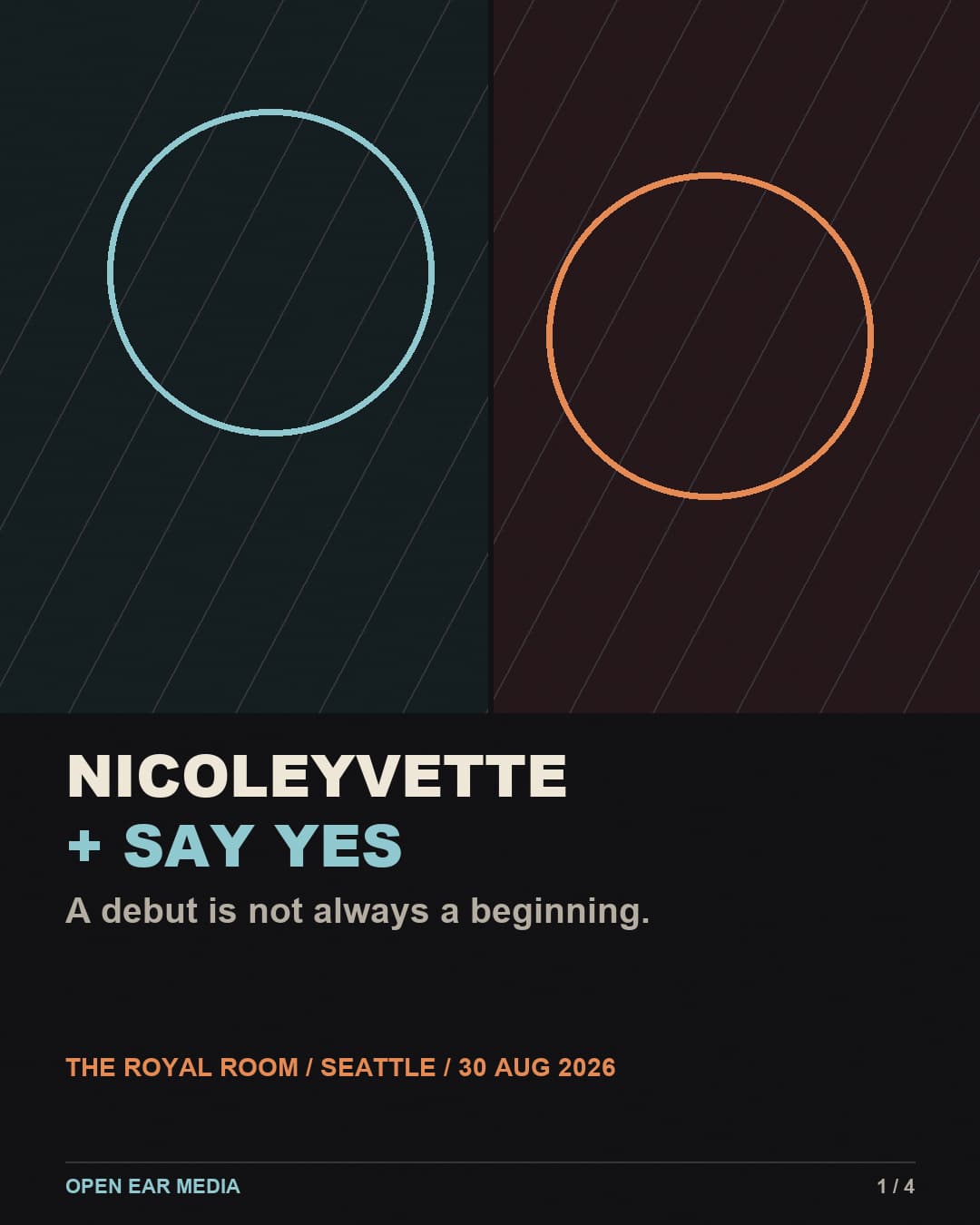
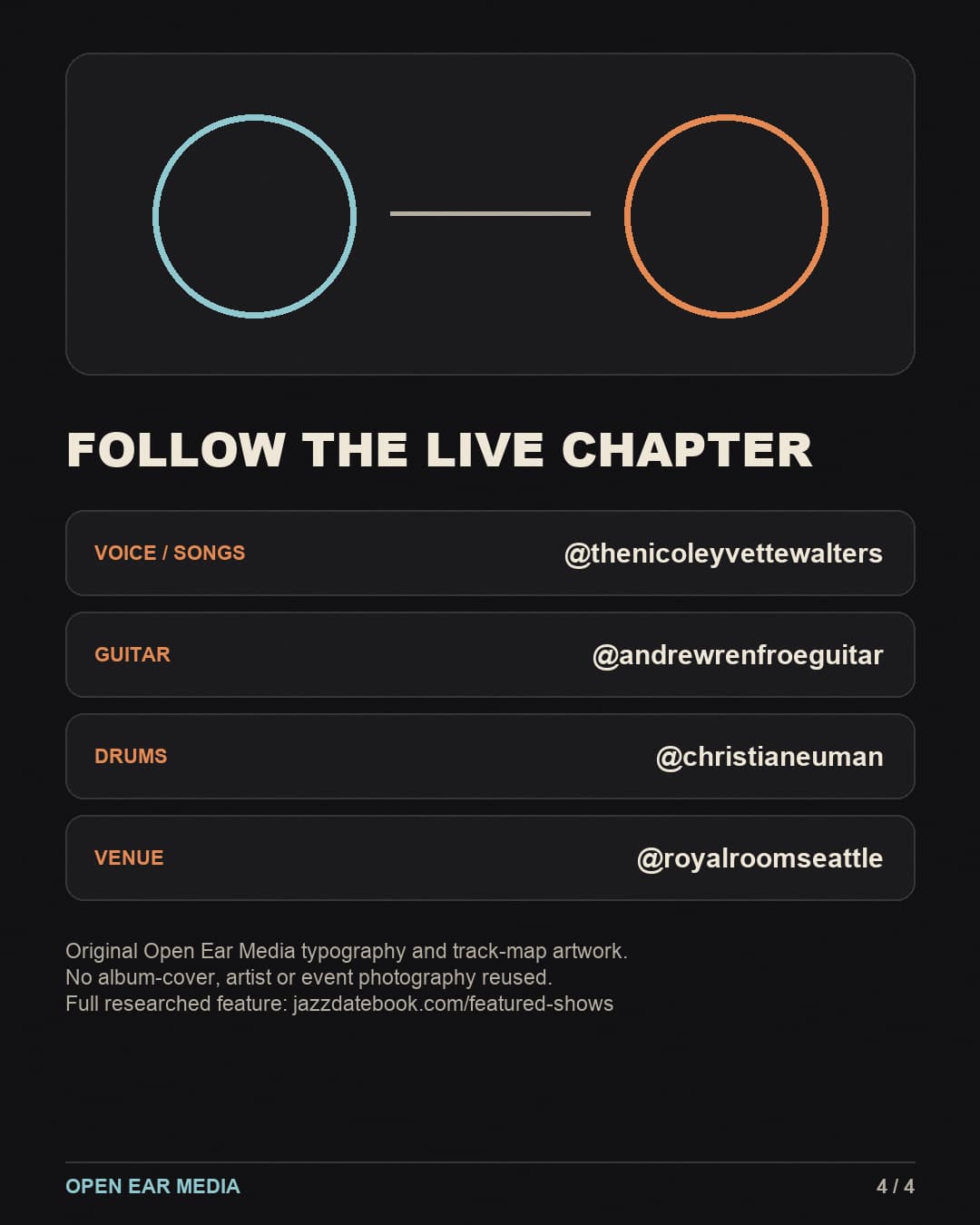
The story in four frames
A concise visual guide for listeners, derived from the researched feature above rather than the other way around.
Research trail
Sources and further listening
Primary artist, presenter, label, and event sources lead this list. Reviews and discographic databases are used for listening context and detailed recording credits. Each source was checked on the date shown in the feature metadata.
- 1Nicole Yvette Debut Album Release Celebration
The Royal Room · official event
Supports: August 30 date, 6 p.m. doors and 7 p.m. show, $20 advance and $25 door prices, complete live lineup, Say Yes album and producer, album contributor list, Seattle history claim, venue address and seating policy, NicoleYvette and Royal Room social links.
- 2Nicole Yvette ‘Say Yes’ Album Release tickets
Stranger Tickets / Bold Type Tickets · official event
Supports: scheduled date, doors and show time, online tickets no longer available notice, door-price language, complete current band, venue address, seat and dining-reservation caveats.
- 3About NicoleYvette
NicoleYvette · official artist
Supports: singer, songwriter and joy-cultivator identity, Sara Gazarek quotation, featured album artists, official website and social links.
- 4NicoleYvette media and biography
NicoleYvette · official artist
Supports: Southern California church background, early songwriting and His Beloved, Denver work and House of Soul, Seattle career context, Say Yes original-song focus, Gazarek production and album contributors, official live video placement.
- 5Say Yes — official music page
NicoleYvette · official artist
Supports: debut status, album available now, Sara Gazarek producer credit, artist’s emotional framing, official smart-link listening path.
- 6NicoleYvette — Say Yes
Bright Fame, LLC / The Orchard · official label
Supports: August 14, 2026 release date, UPC 820233507752, thirteen-track sequence, track-level featured-artist credits, official multi-service listening links.
- 7Say Yes by NicoleYvette
Apple Music · discography
Supports: vocal-jazz classification, August 14, 2026 album release, Bright Fame copyright, thirteen-track order, track durations, featured-artist title credits.
- 8Say Yes by NicoleYvette
Deezer · discography
Supports: Bright Fame label, August 14, 2026 release, thirteen tracks, 67-minute running time, track order and durations, official listening path.
- 9Say Yes CD
NicoleYvette Shop · official artist
Supports: physical CD availability, debut status, Sara Gazarek producer credit, twelve-track physical-program description.
- 10NicoleYvette — Say Yes
Paris-Move · publication
Supports: Thierry De Clemensat’s critical interpretation, production and restraint analysis, selected track listening observations, credited core musicians and guests, Dawn Clement, Shawn Schlogel and Nicole Walters arrangement attribution.
- 11Let’s Get Away featuring NicoleYvette
NicoleYvette Walters · media
Supports: official live performance, Nicole Walters and Shawn Schlogel writing credit, Miro Sprague, Andrew Renfroe, Marlonius and John Davis personnel, Birds of a Feather location, upload date, duration and video metadata, lyric and arrangement listening guide.
- 12Andrew Renfroe
Andrew Renfroe · official artist
Supports: guitarist identity, official website, official Instagram link.
- 13Christian Euman (@christianeuman)
Christian Euman / Instagram · official social
Supports: drummer identity and current Instagram handle.
- 14About The Royal Room
The Royal Room · official event
Supports: Wayne Horvitz, Tia Matthies and Steve Freeborn founding history, December 2011 opening, Columbia City context, grand piano, stage, recording and video facilities, creative-programming and project-development mission, venue address.
- 15The Royal Room frequently asked questions
The Royal Room · official event
Supports: ADA accessibility, dining reservation policy, all-ages-until-10 policy, 21+ bar area, door timing and refund policy.