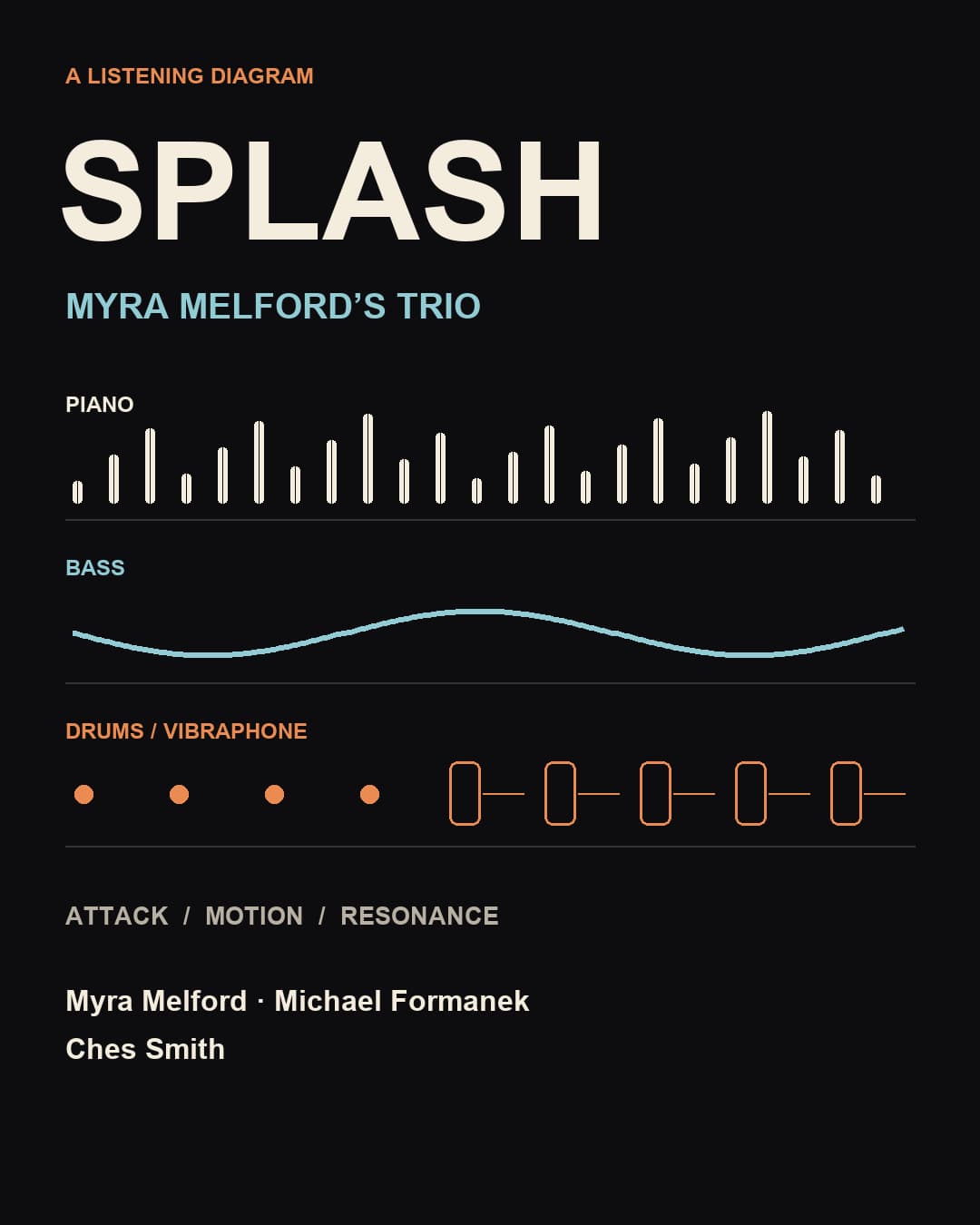
Splash Trio · an original listening diagram
Myra Melford’s Splash Trio: the line comes alive
With Michael Formanek and Ches Smith, Melford brings her Cy Twombly-inspired music to SFJAZZ’s Joe Henderson Lab on September 19–20.
A drawn line can look as if it happened in an instant, even when the image around it has been carefully composed. That tension—between the force of a gesture and the shape that holds it—is the useful way into Myra Melford’s Splash Trio. The pianist does not set out to make musical illustrations of Cy Twombly’s paintings. She borrows ways of working: actions that can start a phrase, redirect a player or give a composition the volatile energy of something being invented on the spot. [2]
At SFJAZZ’s Joe Henderson Lab on September 19–20, Melford will explore that territory with bassist Michael Formanek and drummer and vibraphonist Ches Smith, the musicians on her 2025 Intakt album Splash. The attraction is not simply a pianist with an accomplished rhythm section. It is a compact ensemble whose instruments can change their relationship: bass becomes a sustained voice, percussion becomes pitched harmony, and piano can supply the most physical attack in the room. Four separately ticketed sets offer a chance to hear what happens when the same compositional ideas pass through three independent musical imaginations. [1][3]
The idea
Not a painting translated into sound
Melford traces her encounter with Twombly to his 1994 retrospective at New York’s Museum of Modern Art. What followed was not a single tribute piece but an extended investigation across different ensembles. Her project account describes action words as a way to propel both composition and improvisation, and the problem of preserving an impression of spontaneity within a deliberate form. That is a more specific proposition than saying that music and painting are both abstract. A verb asks a player to do something; a finished picture does not dictate what that action must sound like. [2]
The track titles on Splash make this method unusually legible. Its three interludes carry groups of verbs: “To Dribble, To Smear, To Splash”; “To Erase, To Cover Up, To Utter, To Trace”; and “To Drip, To Draw, To Scribble, To Scrawl.” Treat those words as invitations to notice pressure, duration and interruption, rather than as a code to solve. What might count as erasing in an improvisation—a pause, a new texture, another musician replacing an idea? The titles give the ear productive questions without requiring any specialist knowledge of Twombly. [4][2]
This also explains why the visual connection need not make the music polite or atmospheric. In her biography, Melford says that the physical act of playing matters as much to her as the sound. Her Twombly-inspired Fire and Water Quintet has already produced For the Love of Fire and Water and Hear the Light Singing. Splash continues that inquiry in a different instrumental body. The continuity lies in a compositional question, not in reproducing the earlier band with fewer people. [5][3]
Melford’s language
The piano is also a moving body
Melford’s physical approach has roots beyond the art gallery. Growing up north of Chicago, she absorbed blues and boogie-woogie from her first piano teacher, Erwin Helfer, alongside classical training. Later came studies with Art Lande and Gary Peacock, then, after her move to New York in 1984, work with teachers including Jaki Byard, Don Pullen and Henry Threadgill. Those names do not amount to a recipe for her playing. They help explain why rhythmic propulsion, dense sound and adventurous form need not occupy separate compartments in her music. [5]
The piano trio itself is familiar ground. Her 1990 debut as a leader, Jump, featured bassist Lindsey Horner and drummer Reggie Nicholson; she subsequently explored many other configurations, from chamber-like groups to ensembles involving strings, electronics and harmonium. Splash returns to that compact frame with different collaborators and a vocabulary developed across larger and less conventional groups. After so many different instrumental settings, three players are enough to make the allocation of musical space conspicuous. [5]
Her account of collaboration is equally important: she wants musicians to take compositions somewhere she has not already imagined. Listen for that distinction between a written identity and a predetermined result. A piece can remain recognizably hers while its pacing, density and internal balance depend on someone else’s intervention. The leader’s contribution is partly the material and partly the selection of people capable of changing it. [5][2]
The full ensemble
Why bass and vibraphone change the proposition
Formanek’s contribution is more than a low register beneath the piano. Intakt’s account of his career presents a bassist who also leads and composes, from small groups to the large Ensemble Kolossus. In the Splash liner-note excerpt, Nate Chinen specifically points to his bowed playing as part of the trio’s chamber-like possibilities. A sustained bass sound gives Melford something different to work against than a succession of plucked notes. It can make the space between piano attacks feel occupied rather than empty. [6][3]
Smith’s double credit is just as consequential. His official biography identifies a drummer, percussionist and composer whose collaborators include Tim Berne, Marc Ribot, Mary Halvorson and Kris Davis. In this band, however, the central fact is not the length of that résumé: it is the option of moving between drums and vibraphone. Chinen highlights that pivot alongside Formanek’s bowing. Three musicians can thus suggest a percussion-driven piano trio in one configuration and a more sustained, pitched ensemble in another. [8][3]
A useful listening exercise is to stop identifying the instruments only by their conventional jobs. Ask who is articulating time, who is extending a sound, and who introduces the next change. The answer need not always be drummer, bassist, pianist. The pleasure is in following those responsibilities, rather than deciding in advance which player is meant to carry them. Smith’s vibraphone belongs in the lineup, not in a parenthesis forgotten after the headline. [3][1]
Watch the earlier chapter
“Insertion 1” is context, not a Splash performance
The official SFJAZZ video below shows Melford’s Fire and Water Quintet performing “Insertion 1” in a concert filmed on November 5, 2022. The ensemble is Melford on piano, Ingrid Laubrock on tenor saxophone, Mary Halvorson on guitar, Tomeka Reid on cello and Lesley Mok on drums. Neither Formanek nor Smith appears. SFJAZZ itself places this clip on the Splash event page, but its value here is as an earlier chapter in Melford’s engagement with Twombly—not as footage of the band being booked for September. [9][1]
Watch with a particular question: how does a composed identity survive the presence of several strong, distinct voices? Follow one instrument’s attack and then shift attention to the surrounding ensemble. Notice where you perceive reinforcement, contrast or a change in the music’s direction. Melford’s stated interest in the physical gesture makes the visible work of playing relevant, too. At ten minutes and forty-one seconds, the clip gives that attention room to develop: stay with an interaction rather than looking only for the entrance of a theme. [9][5]
There is a further personnel distinction worth retaining. The studio album For the Love of Fire and Water credits Susie Ibarra on drums and percussion; the filmed SFJAZZ performance features Mok. Even within the earlier project, the album and concert are not interchangeable documents. Use the video to understand the broader artistic inquiry, then turn to Splash for the specific instrumental partnership coming to Joe Henderson Lab. [5][9][3]
SFJAZZ Singles: Myra Melford's Fire and Water Quintet performs "Insertion 1"
Official SFJAZZ footage from November 5, 2022: Melford with Ingrid Laubrock, Mary Halvorson, Tomeka Reid and Lesley Mok. This is the earlier Fire and Water Quintet, not Splash Trio; it illuminates the Twombly-inspired inquiry carried into the new instrumentation.
Watch on YouTube · SFJAZZBefore the concert
Three ways into the record
For a short introduction, the official SFJAZZ event page offers audio players for “Streaming” and “Interlude I.” That is a useful contrast in scale: Melford’s discography lists “Streaming” at 9:21 and the first interlude at 4:22. Start with the shorter piece and its sequence of action words, then give the longer one room to develop. Ask whether your sense of movement comes from a pulse, a recurring idea, a change of texture or the way one player answers another. The contrast is a way to enter the album, whatever the trio chooses to play live. [1][4]
For a fuller encounter, listen to the album in order; Intakt’s release page supplies recording credits and purchase options. “Drift” opens the ten-track program; “Chalk” closes it, with the three interludes distributed between longer pieces. That arrangement encourages attention to proportion as well as individual solos. A brief episode can redirect how the next extended piece is heard. Resist turning the titles into literal scenes: Melford’s own explanation emphasizes processes and actions, rather than translating a canvas into a fixed musical image. [3][4][2]
For a comparison focused on the supporting players, return to Time Like This or As Things Do. Keep Formanek and Smith in the foreground of your attention, while remembering that Davis, Malaby and Formanek’s compositions establish another musical situation. The reward of the comparison is hearing how much an ensemble’s identity depends on its entire membership. Splash is a three-way proposition, and a listening path should treat it that way. [6][7][3]
The Bay Area setting
A local connection in the smaller room
Melford is not simply passing through an unrelated city. She joined UC Berkeley’s music department in 2004, and its faculty page identifies her as a professor of composition and performance. Her official biography describes teaching and curating as active parts of her musical life. The earlier SFJAZZ video also documents a relationship with this presenter. The trio brings the Twombly inquiry back to a presenter that has already given another version of it a stage. [10][5][9]
The physical room matters. SFJAZZ lists this engagement in the 100-seat Joe Henderson Lab, not the larger Miner Auditorium. The center’s own description distinguishes the two spaces, and its visitor guide locates the building at 201 Franklin Street, at Fell Street in Hayes Valley. For music that invites attention to how a sound begins, hangs in the air and meets another sound, the smaller-room setting is part of the appeal. The invitation is to pay attention on the scale of individual gestures, not only to the collective sound. [1][11][12]
Plan the visit
Four sets, with room for the unexpected
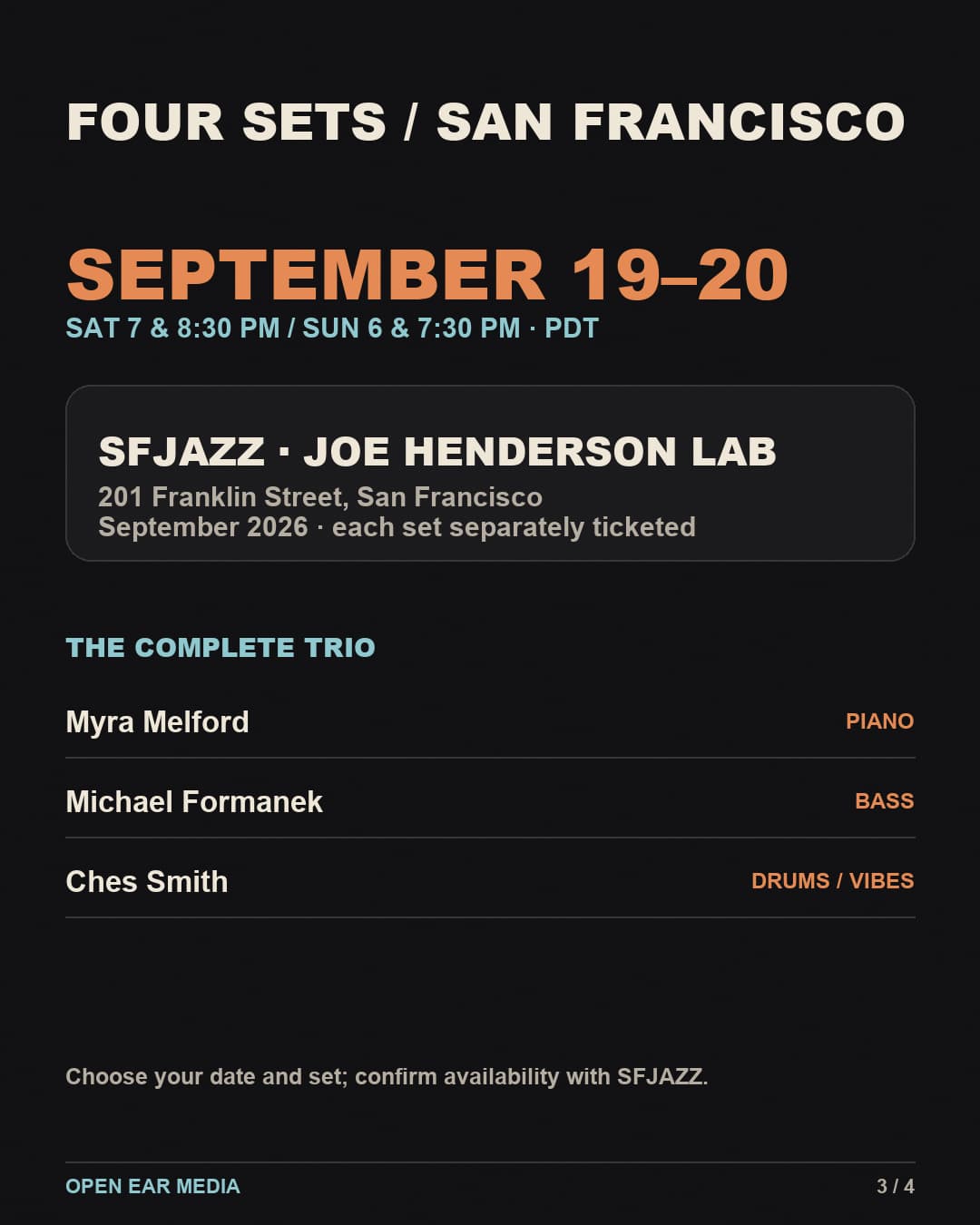
The advertised times are Saturday, September 19 at 7 and 8:30 p.m., and Sunday, September 20 at 6 and 7:30 p.m., all San Francisco local time, PDT. Each set has its own ticket link. As checked on September 12, SFJAZZ lists $44 for the Saturday sets and $39 for Sunday. Those are displayed prices, not a guarantee of final charges or remaining seats; check the selected performance at checkout. The event page does not state doors or set-end times. [1]
The visitor guide names Van Ness and Civic Center as nearby Muni Metro stations, and Civic Center for BART. Confirm service and the selected set before traveling. Most importantly, arrive with an idea rather than an imagined set list: a composed line can retain its identity while changing under someone else’s touch. Melford, Formanek and Smith have given us the recorded materials for that question. The concert is where it can become a live exchange. [12][1][3][2]
The social edition
The story in four frames
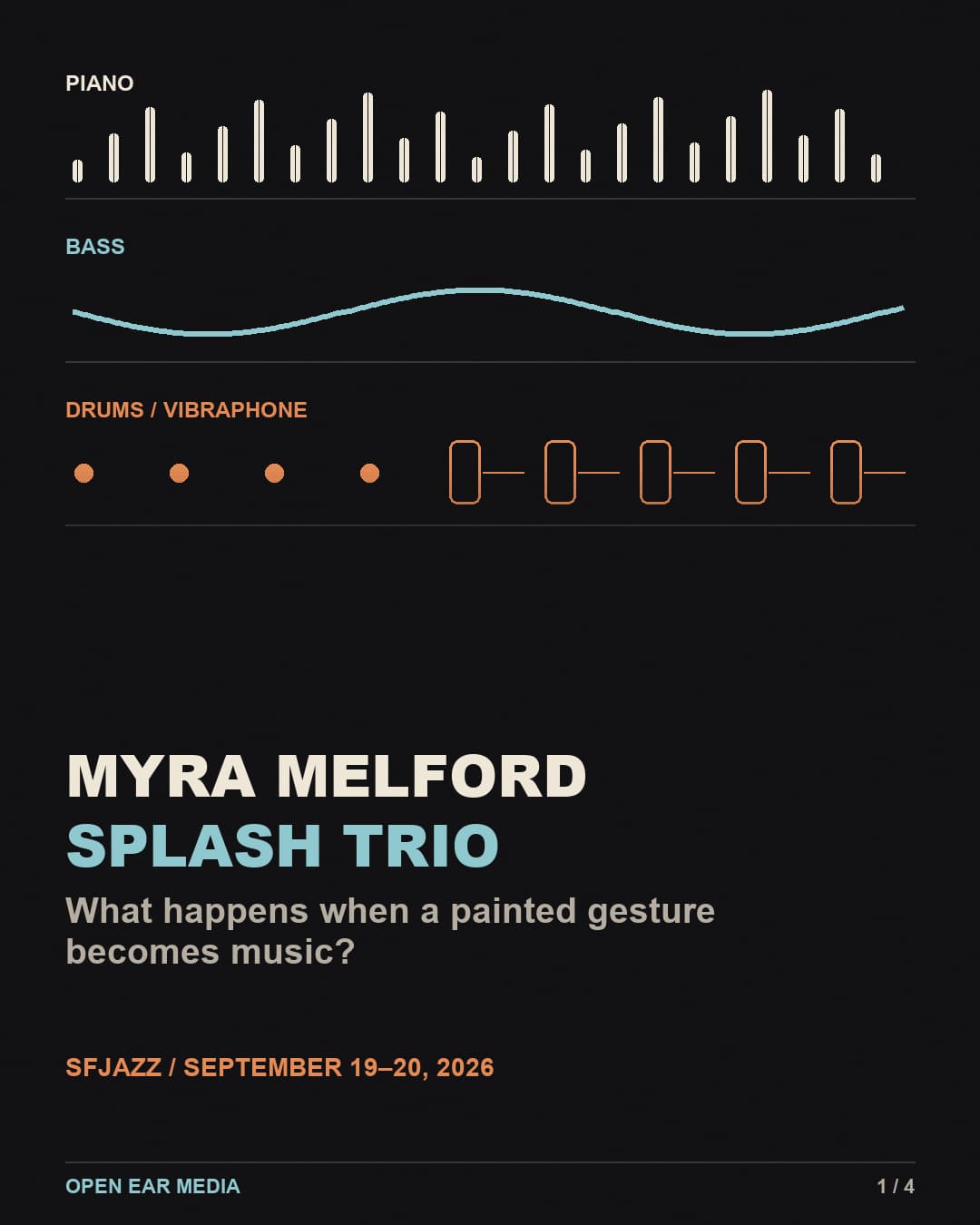
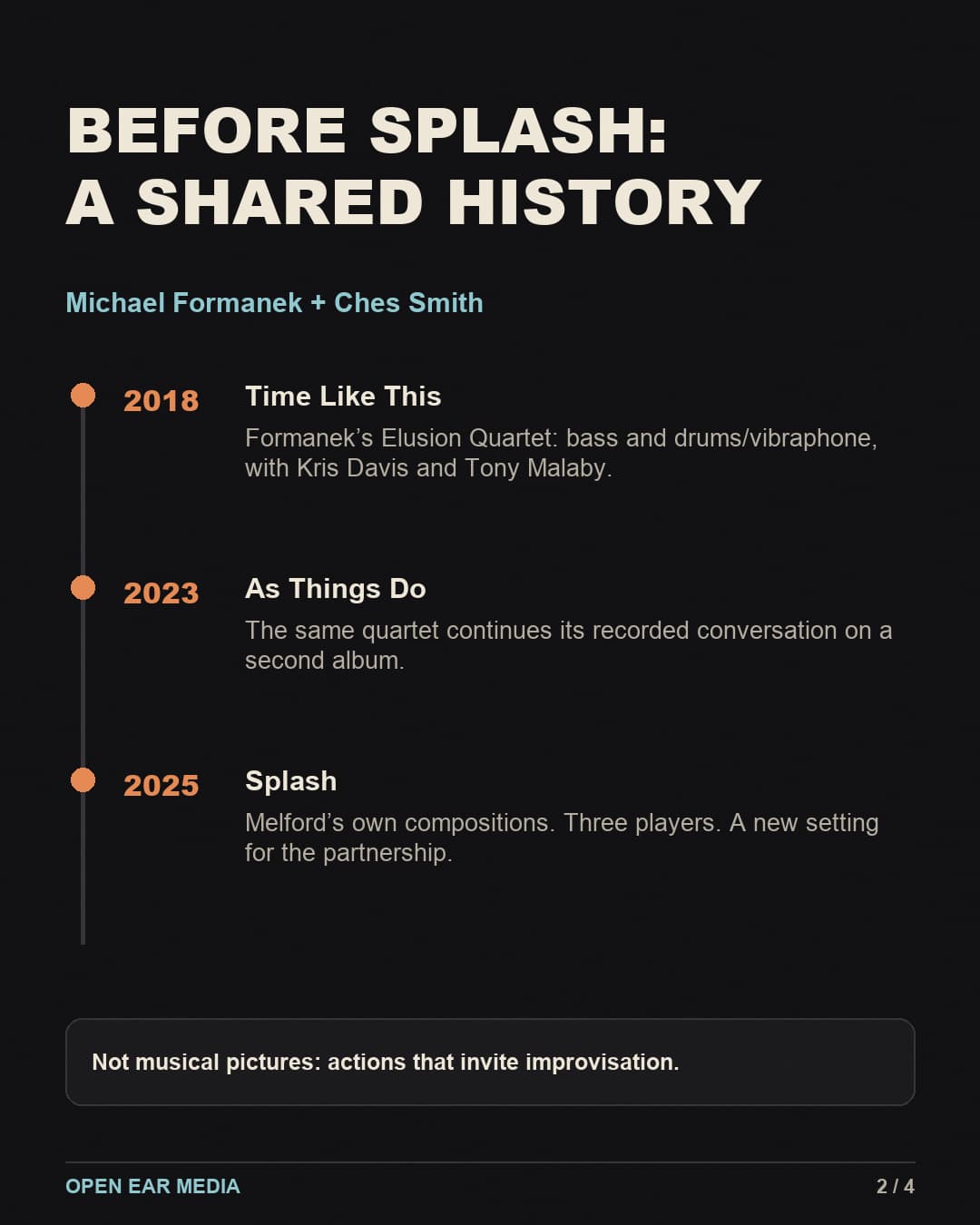
A concise visual guide for listeners, derived from the researched feature above rather than the other way around.
Research trail
Sources and further listening
Primary artist, presenter, label, and event sources lead this list. Reviews and discographic databases are used for listening context and detailed recording credits. Each source was checked on the date shown in the feature metadata.
- 1Myra Melford Splash Trio — September 19–20, 2026
SFJAZZ · official event
Supports: four set times, room and complete lineup, displayed prices, album program and official audio players, @sfjazz link.
- 2Splash Trio — project statement and upcoming shows
Myra Melford · official artist
Supports: 1994 Twombly encounter, action-word method, ensemble concept, September 19–20 engagement.
- 3Splash — Intakt 436, recording and album credits
Intakt Records · official label
Supports: 2024 recording dates and 2025 release year, compositions and personnel, Nate Chinen liner-note excerpt, bowed bass and vibraphone, cover-art copyright.
- 4Splash — official track list
Myra Melford · discography
Supports: ten-track order, interlude titles, track durations.
- 5Myra Melford — biography
Myra Melford · official artist
Supports: training and trio history, collaborative approach, Fire and Water releases and personnel, physical gesture, Bay Area work.
- 6Michael Formanek Elusion Quartet: Time Like This — Intakt 313
Intakt Records · official label
Supports: 2018 Formanek–Smith recording, full quartet and instrument credits, Formanek as composer and bandleader.
- 7Michael Formanek Elusion Quartet: As Things Do — Intakt 399
Intakt Records · official label
Supports: 2022 recording and 2023 release, continued quartet partnership, Formanek compositions.
- 8Ches Smith — About
Ches Smith · official artist
Supports: drummer, percussionist and composer identity, documented collaborators, @smithches link.
- 9SFJAZZ Singles: Myra Melford’s Fire and Water Quintet performs “Insertion 1”
SFJAZZ / YouTube · media
Supports: November 5, 2022 concert, exact filmed quintet, official channel, video title, duration and upload date.
- 10Myra Melford — faculty profile
UC Berkeley Department of Music · official artist
Supports: current faculty role, joined Berkeley in 2004, teaching subjects.
- 11SFJAZZ Center — rooms and building
SFJAZZ · official event
Supports: 100-seat Joe Henderson Lab, distinction from Miner Auditorium, building location.
- 12Visit SFJAZZ Center
SFJAZZ · official event
Supports: 201 Franklin Street at Fell Street, Hayes Valley, Muni Metro and BART guidance.
- 13Myra Melford — official website and social links
Myra Melford · official artist
Supports: official website, @myramelford Instagram link.