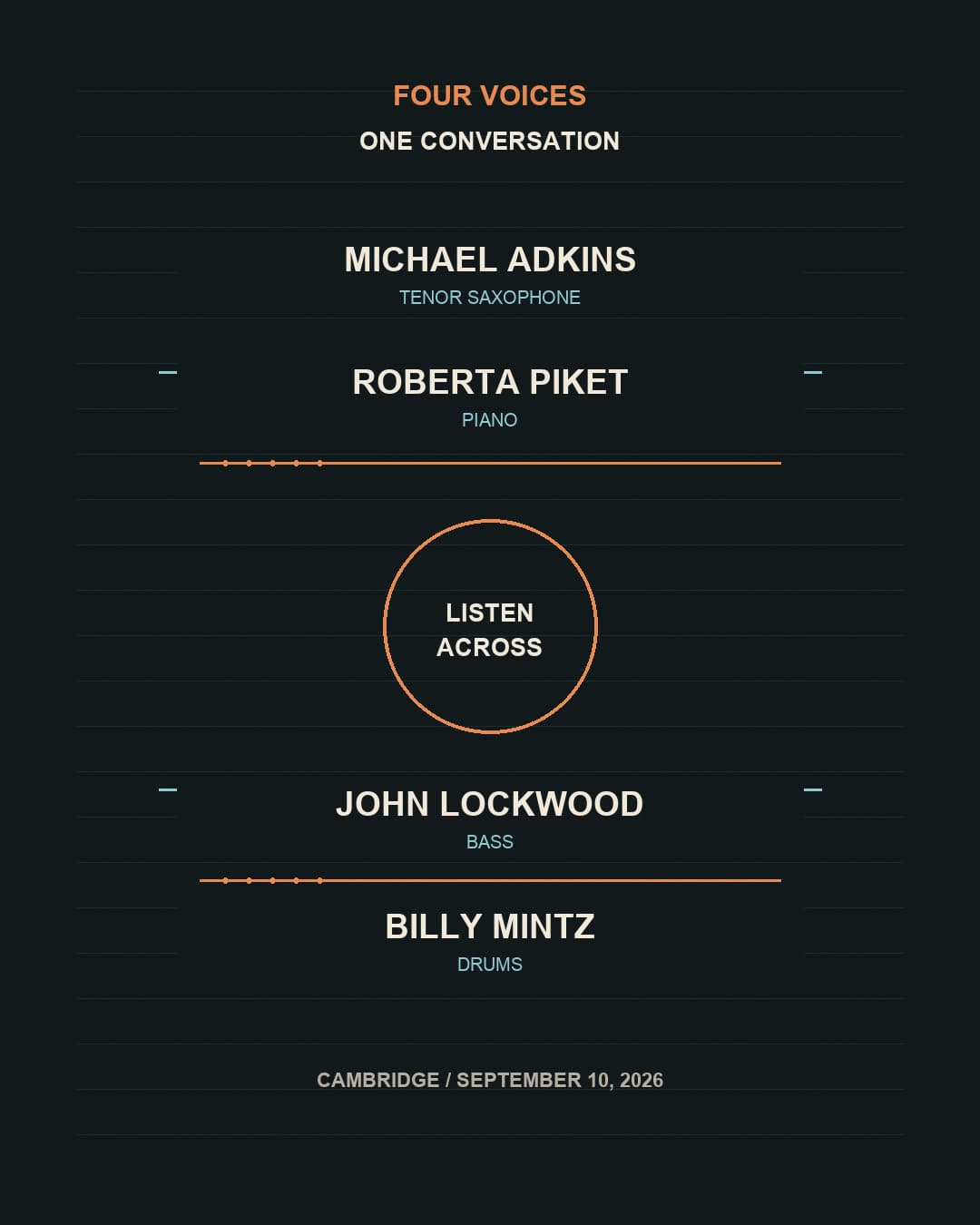
Four voices, one conversation
Michael Adkins makes room for four storytellers
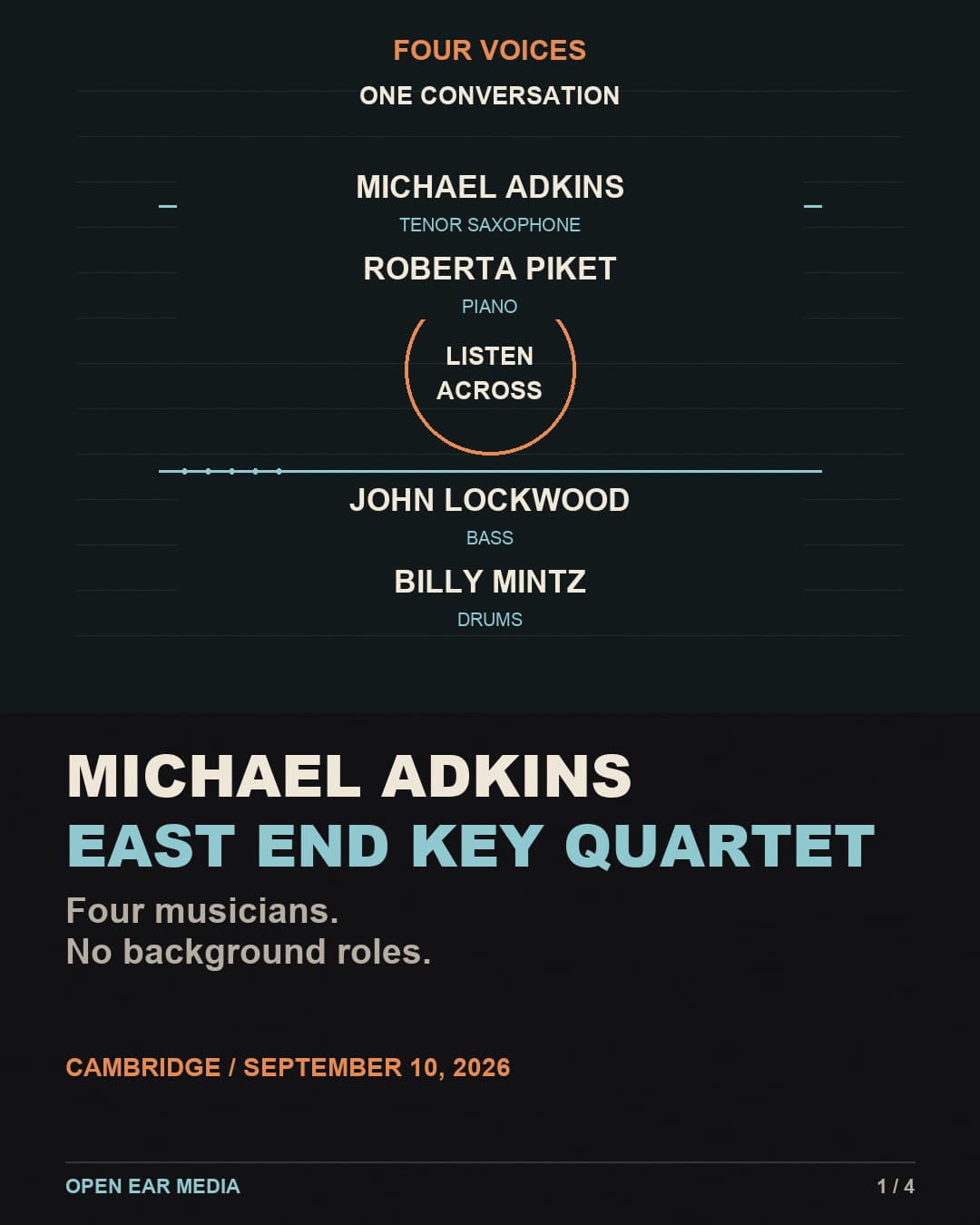
With Roberta Piket, John Lockwood and Billy Mintz, the tenor saxophonist brings several histories of collective improvisation into one Cambridge room.
A tenor-led quartet can put the tune in front and the rhythm section behind it. Michael Adkins’s East End Key Quartet offers a more interesting possibility: four musicians whose histories invite us to listen across the band, not only toward the tenor. Adkins’s recordings with Paul Motian established one setting for that kind of exchange. Roberta Piket and Billy Mintz bring a different, deeply documented partnership in which the drummer writes melodies and the pianist finds new ways through them. John Lockwood supplies a Boston connection built on performing and teaching improvisation from inside the ensemble. [4][11][9]
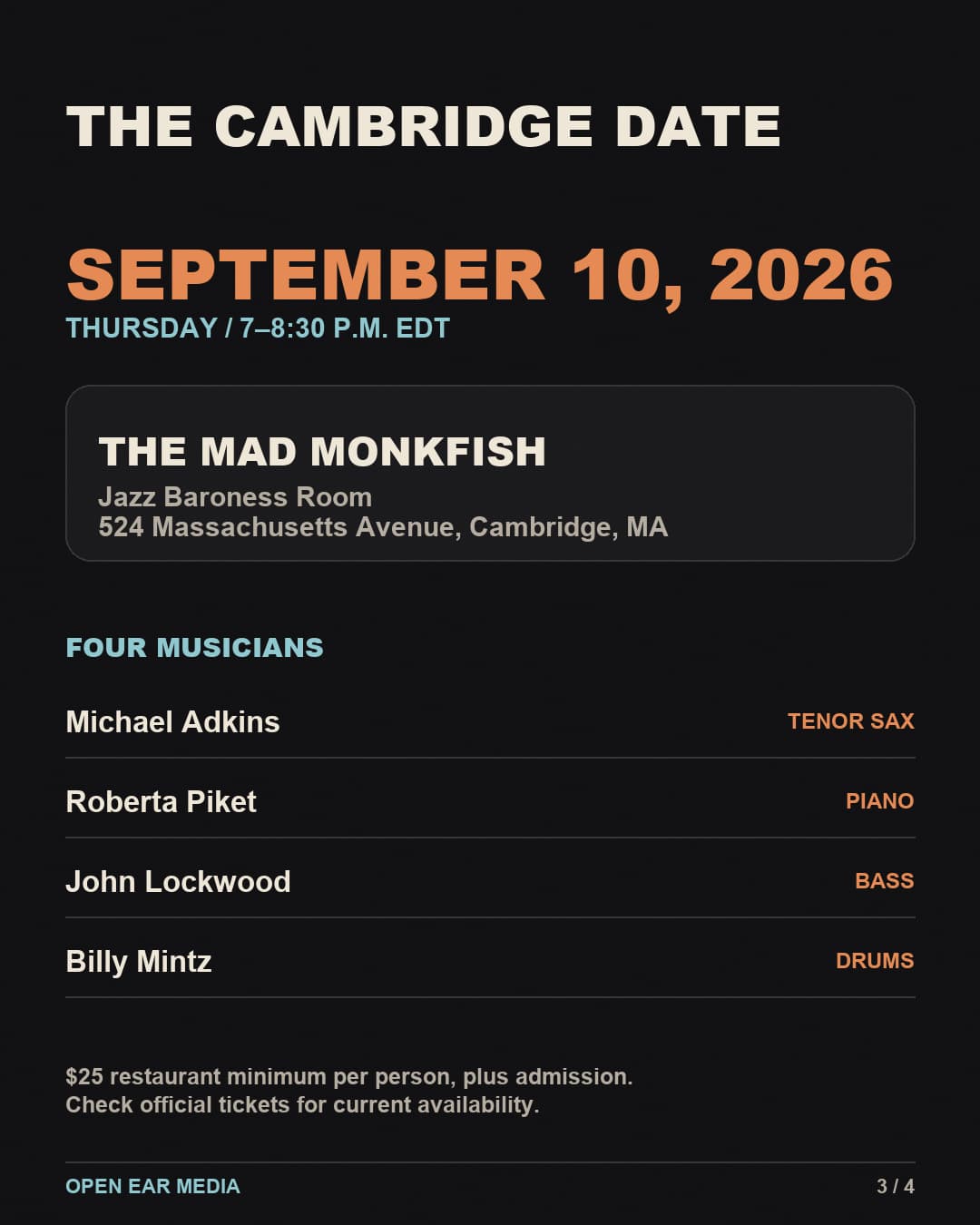
They meet on Thursday, September 10, in the Jazz Baroness Room at The Mad Monkfish in Cambridge. This is not a recreation of Adkins’s Motian quartet, nor a performance by Piket and Mintz’s recorded trio with Harvie S. The interest lies in putting those musical experiences into another configuration. The venue bills Adkins on tenor saxophone, Piket on piano, Lockwood on bass and Mintz on drums, with music scheduled from 7 to 8:30 p.m. Eastern. The listening question is simple: when any one of these four changes direction, how will the others make room? [1][2][4][13]
Adkins on record
The tenor is only the beginning
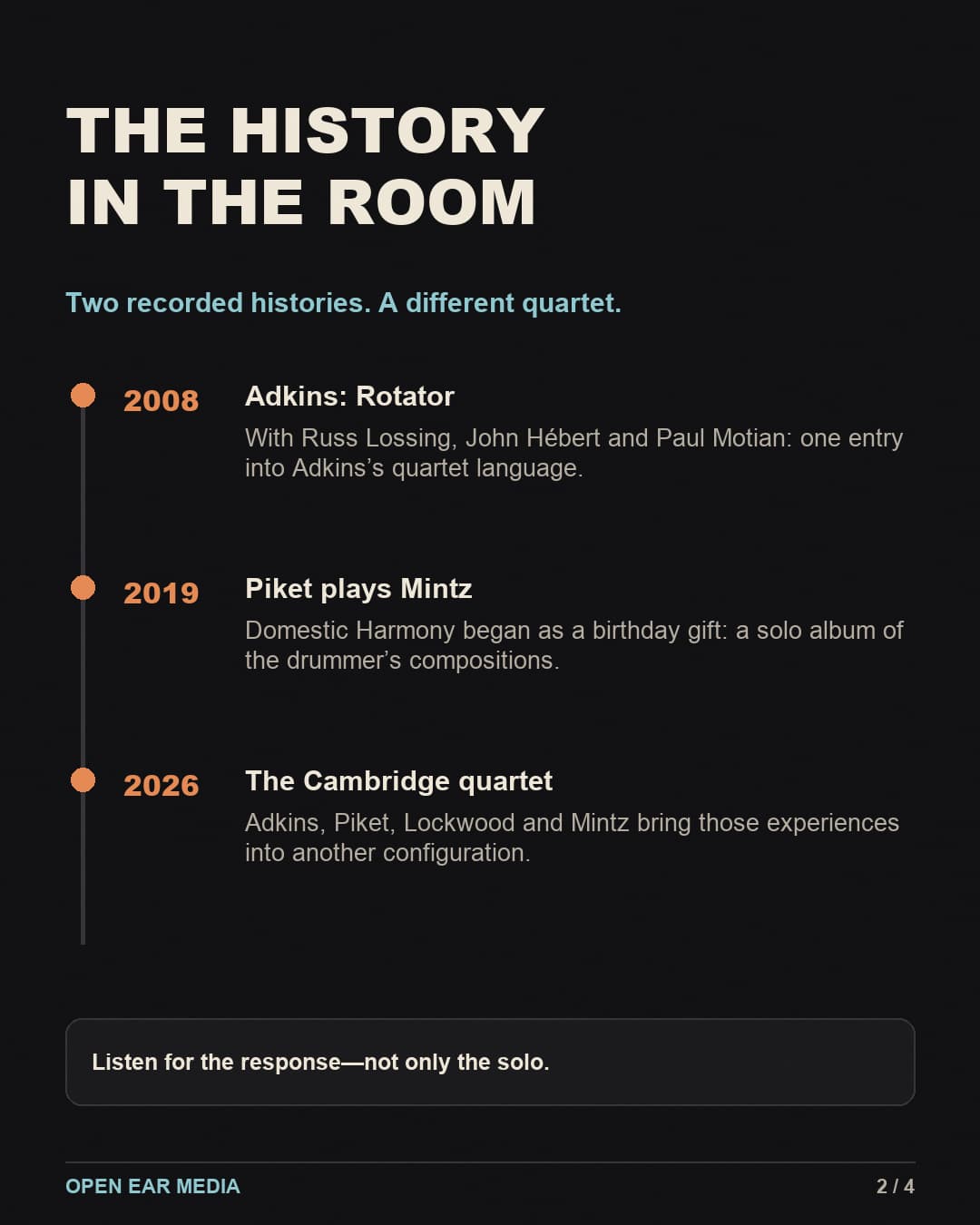
Start with Rotator, Adkins’s 2008 quartet recording. His own discography identifies Russ Lossing on piano, John Hébert on bass and Paul Motian on drums; the contemporary Free Jazz Collective review confirms that personnel. The same artist discography lists Lossing and Motian again on Flaneur, this time with Larry Grenadier on bass. That distinction matters: these records document related musical relationships, not an unchanged ensemble. Adkins’s site supplies official listening links to “Rotator” and “We’ll See,” making the records a useful first stop before Cambridge. [4][5]
The Free Jazz Collective’s reviewer, Stef, heard Rotator as intimate, structured post-bop improvisation, singling out the tenor’s warmth and traditional tonal character while also attending to form, rhythm and interaction. That is more useful than a string of awards: it identifies a productive tension. A familiar, full-bodied saxophone sound need not require a predictable route through a tune. Listen for whether a phrase seems to settle the music or instead leaves a question that the piano, bass or drums can pick up. [5][4]
The Cambridge lineup changes all three of Adkins’s partners from those records. It would be misleading to turn Mintz into a stand-in for Motian, or to assume Piket and Lockwood will reproduce Lossing and either recorded bassist. The albums are an introduction to Adkins’s ensemble thinking, not a script for this show. Their value is to shift attention away from the tenor as a self-contained solo voice and toward the consequences of each phrase for the whole group. [4][1]
The partnership
A birthday gift with musical consequences
Piket and Mintz’s shared history gives the evening a second center of gravity. Sunnyside’s account of You’ve Been Warned dates their partnership in music and life to 2001. The most revealing document, however, may be one on which Mintz does not play: Domestic Harmony: Piket Plays Mintz, released by Thirteenth Note Records on December 6, 2019. Piket recorded a solo program of his compositions as a surprise birthday gift. Public release came later; the original intended listener was the composer himself. [13][11]
That origin is more than a charming anecdote. It reverses the usual way a listener might rank the players on a club announcement. Mintz is not just the drummer who accompanies Piket; his music is substantial enough to sustain her entire solo recital. In her liner notes, Piket describes compositions that retain his recognizable voice while allowing the interpreter a viewpoint of her own. The musical relationship depends on both things being true: a piece has an identity, and another player can change how we encounter it. [11][12]
Her account of “Shmear” makes this unusually concrete. Mintz built it from a drum sticking pattern, with a solo section that keeps time but has no prescribed chord changes. In his band, he asks her for single lines rather than chords or textures. Piket says she tried to preserve that intention in her solo adaptation, even without a rhythm section. Here is a composer-drummer proposing how the pianist should think melodically, not merely setting a beat beneath her. It is an illuminating relationship to bring into an Adkins quartet, whether or not “Shmear” is played. [12][1]
Official listening
Hear the composer inside the drummer
The official “Cannonball” music video below offers a compact entry into Mintz’s writing. Posted on Piket’s own YouTube channel, it accompanies the 2017 album Ugly Beautiful. Its credited quintet is Tony Malaby, John Gross, Piket, Hilliard Greene and Mintz. Adkins and Lockwood are not on this recording. The distinction is essential: this is a listening window into two members of the upcoming quartet, not footage of the band booked at Monkfish. [14][10][1]
The label describes “Cannonball” as a 24-bar blues with Hammond B-3; Piket’s liner notes for her later solo version confirm the form. Use that information as a listening task rather than a theory quiz. Follow the length of the returning phrase, then notice how the organ’s sustained sound changes the space around the horns and drums. Piket is billed on piano in Cambridge, so the video also offers a contrast: the same musical partnership can work through very different keyboard textures. [10][12][1]
Alongside it is Piket’s official, roughly two-minute introduction to Domestic Harmony. Move from the quintet video to the solo-album presentation, and then to the free excerpts on the label page. “Cannonball” appears in both album programs. The useful comparison is not which setting is definitive, but what survives the removal of horns, bass and drums. Rhythm can be carried by the shape of a piano line; a drummer’s identity can remain present when somebody else is making every sound. [15][11][10]
Cannonball - Billy Mintz Quintet
An official music video for Billy Mintz’s 24-bar blues from Ugly Beautiful, with Tony Malaby, John Gross, Roberta Piket and Hilliard Greene. This is the recorded quintet, not the Cambridge quartet.
Watch on YouTube · Roberta PiketDomestic Harmony: Piket Plays Mintz
Piket’s official introduction to her solo interpretations of Mintz’s compositions, first recorded as a birthday gift. Pair it with the label’s audio excerpts to hear the composer without his drum kit.
Watch on YouTube · Roberta PiketThe piano chair
Piket’s two musical educations
Piket’s ability to work between a song and its less settled possibilities has a specific background. Her official biography describes learning American standards from her mother’s songs and sheet music while exploring Bartók and Schoenberg through her father’s records and scores. A Walter Bishop Jr. trio LP was an early catalyst. These were parallel interests, not a later move from one musical camp to another. They help explain why a tune can remain recognizable even when its harmony begins to invite less obvious choices. [7]
Boston belongs to that story directly. Piket completed the joint Tufts–New England Conservatory program, earning degrees in computer science and jazz piano, and studied at NEC with musicians including Fred Hersch and Stanley Cowell. After a year working as a software engineer, she returned to New York. She credits subsequent study with Richie Beirach with helping integrate her interest in modern classical music into jazz playing and composition. Her Cambridge appearance is therefore more than a New York pianist visiting a Boston-area room. [7]
You’ve Been Warned is an especially useful companion to the solo album. Recorded at Piket and Mintz’s home over two days in May 2021 and released in August 2022, it adds bassist Harvie S and compositions by all three players. Two consecutive interpretations of Mintz’s “Flight” make the point without an essay: the label identifies the first as a slow ballad and the second as a more energetic treatment opened by drums. Compare them for what tempo changes in the melody’s character—not as a prediction of this quartet’s repertoire. [13]
The complete ensemble
Bass and drums are two separate stories
Lockwood is not Harvie S, Hébert or Grenadier, and the differences should not be flattened into the phrase “rhythm section.” His Berklee faculty profile lists work with the Fringe, Joe Maneri, Donal Fox, Gary Burton, Joe Henderson and many others. The selection suggests experience across very different demands on a bassist: maintaining a clear shared form, responding to an improviser’s new direction, and finding a way to do both. His place in this quartet is part of its musical proposition, not simply a local substitution. [9][1]
In the interview on that profile, Lockwood describes learning on the bandstand, then teaching by having a student learn a tune and immediately play it. Concepts follow from the experience rather than replacing it. Applied to listening, that offers a helpful instruction: do not wait for a bass solo to hear what the bassist is doing. Follow a bass phrase beneath somebody else’s statement. Does it confirm where the music is headed, complicate that direction, or open a different path? Those are questions to take into the room, not claims about an unheard performance. [9]
Mintz’s own biography reaches from the Lee Konitz Nonet in the late 1970s through Los Angeles ensembles and a 1988 European tour with Charles Lloyd to his work as a bandleader and composer. Ugly Beautiful gives that range a compositional form: blues, ballads, open improvising structures and pieces with demanding meters inhabit the same program. The lesson is not that the Cambridge set will sample every style. It is that keeping time and reshaping the music are not mutually exclusive jobs for this drummer. [8][10]
The practical details
A concert inside Central Square’s restaurant life
The physical room is the Jazz Baroness Room at The Mad Monkfish, 524 Massachusetts Avenue, in Cambridge’s Central Square. The restaurant places itself in Central Square between MIT and Harvard and describes live jazz as part of its identity alongside Japanese, Thai, Chinese and Vietnamese culinary influences. The event is billed as a Monkfish Concert Series performance. That setting brings the music into a working neighborhood restaurant rather than separating it into a concert-hall visit. [1][2][16]
For this show, the venue and ticket page agree on Thursday, September 10, 2026, from 7 to 8:30 p.m., local Eastern daylight time. Both list the same four musicians, and Piket’s calendar independently lists the September 10 Monkfish engagement at 7 p.m. Adkins’s own calendar also links the show. No separate doors time is stated in the event copy reviewed here; treat 7 p.m. as the performance start, not an invitation to arrive then and begin sorting out dinner. [1][2][6][3]
Budget for the restaurant as well as the ticket. The event page specifies a $25 minimum spend per person, with any shortfall added to the check, and says ticket proceeds go directly to the musicians. That minimum is not the admission price. Use the official ticket link for current admission and availability, and confirm arrangements with the venue before traveling. The listing was active when checked on September 6; this feature does not make a claim about remaining seats. [1][2]
Before and after the date
Follow what happens after the phrase
A compact preparation route is already available in the sources: Adkins’s artist-selected “Rotator” and “We’ll See” links for the tenor quartet; “Cannonball” for Mintz and Piket in a horn-and-keyboard ensemble; Domestic Harmony for the compositions without the drummer; and the two versions of “Flight” on You’ve Been Warned for one tune heard at different speeds. These are contrasting reference points, not a proposed set list. They reveal how much of an ensemble’s identity can lie in choices about form, texture and timing. [4][14][11][13]
In Cambridge, try following the response instead of only the statement. After Adkins finishes a line, listen to Piket. When the piano changes the harmonic picture, stay with Lockwood. When Mintz alters the rhythmic emphasis, hear what the tenor does next. The recorded histories do not guarantee any particular result, but they make those exchanges worth attending to. Four storytellers need not take four separate turns; the most revealing story may be the one they discover between them. [1][4][12][9]
The social edition
The story in four frames
A concise visual guide for listeners, derived from the researched feature above rather than the other way around.
Research trail
Sources and further listening
Primary artist, presenter, label, and event sources lead this list. Reviews and discographic databases are used for listening context and detailed recording credits. Each source was checked on the date shown in the feature metadata.
- 1Michael Adkins East End Key Quartet: September 10
The Mad Monkfish · official event
Supports: date and performance window, four-person lineup, Jazz Baroness Room, separate $25 restaurant minimum, venue Instagram link.
- 2East End Key Quartet: tickets and location
Jamme K. Chantler / Eventbrite · official event
Supports: 7–8:30 p.m. schedule, 524 Massachusetts Avenue, personnel, restaurant minimum.
- 3Michael Adkins: performance calendar
Michael Adkins · official artist
Supports: September 10 engagement, artist website.
- 4Michael Adkins: selected discography and listening
Michael Adkins · official artist
Supports: Rotator and Flaneur personnel, different bassists on the two records, artist-selected official audio links.
- 5Michael Adkins Quartet — Rotator (Hatology, 2008)
The Free Jazz Collective / Stef · publication
Supports: contemporary listening perspective, warm tenor tone and structured improvisation, Rotator personnel and 2008 context.
- 6Roberta Piket: official site and performances
Roberta Piket · official artist
Supports: September 10 at 7 p.m., official YouTube channel, Facebook and artist links.
- 7Roberta Piket: biography
Roberta Piket · official artist
Supports: Tufts and New England Conservatory studies, Walter Bishop Jr. and modern classical influences, study with Richie Beirach.
- 8Billy Mintz: biography
Billy Mintz · official artist
Supports: Lee Konitz Nonet, Los Angeles years and Charles Lloyd tour, drummer and composer roles.
- 9John Lockwood: faculty profile and interview
Berklee College of Music · official artist
Supports: bass faculty role, The Fringe and other collaborations, learning through performance.
- 10Billy Mintz — Ugly Beautiful
Thirteenth Note Records · official label
Supports: 2017 album and quintet personnel, Cannonball as a 24-bar blues with Hammond B-3, contrasting forms and tempos, Piket–Mintz collaboration.
- 11Domestic Harmony: Piket Plays Mintz
Thirteenth Note Records · official label
Supports: December 6, 2019 release, solo piano gift for Mintz, composition and personal collaboration.
- 12Domestic Harmony: artist liner notes (PDF)
Roberta Piket / Thirteenth Note Records · official artist
Supports: Shmear instruction and drum sticking, Flight and changing tempos, Cannonball form, composer voice and performer freedom.
- 13You’ve Been Warned: official album and streaming
Sunnyside Records · official label
Supports: August 12, 2022 release, Piket, Harvie S and Mintz, May 2021 home sessions, two versions of Flight, partnership since 2001.
- 14Cannonball - Billy Mintz Quintet
Roberta Piket / YouTube · media
Supports: official artist-channel music video, 2017 quintet credits, verified title, duration and upload metadata.
- 15Domestic Harmony: Piket Plays Mintz
Roberta Piket / YouTube · media
Supports: official solo-album introduction, birthday-gift context, verified title, duration and upload metadata.
- 16About The Mad Monkfish
The Mad Monkfish · official event
Supports: Central Square setting, Jazz Baroness Room, restaurant and live-jazz context.