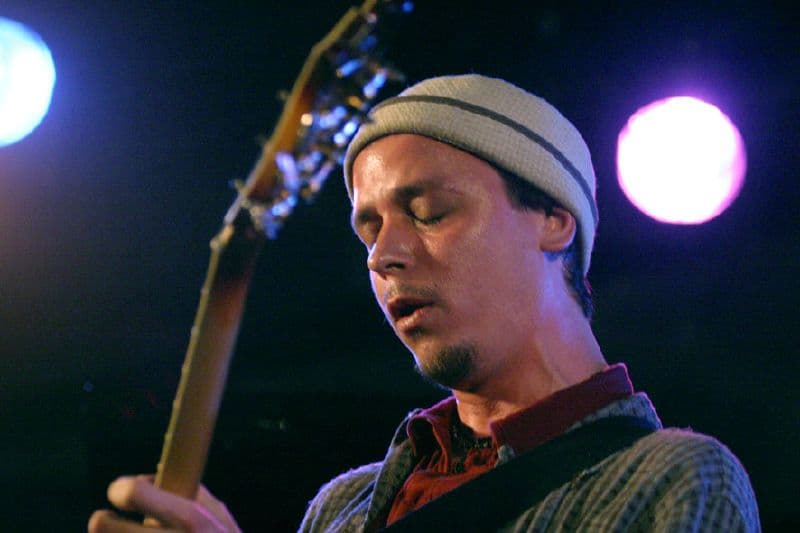
Kurt Rosenwinkel
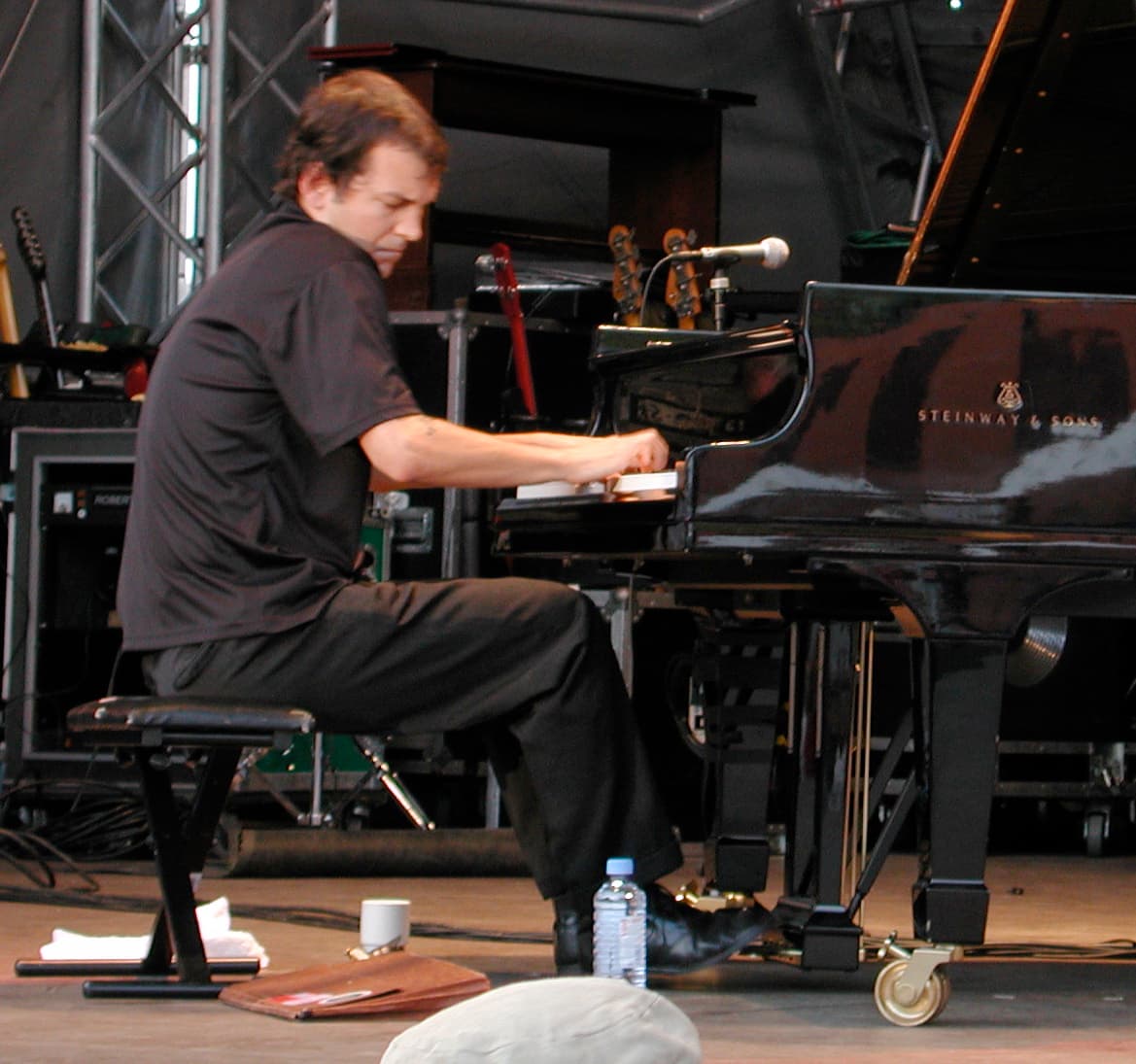
Brad Mehldau
Kurt Rosenwinkel and Brad Mehldau: from a 1996 night at Smalls to a Berlin quartet
Before Kurt Rosenwinkel and Brad Mehldau meet Doug Weiss and Joe Peri inside Berlin’s Gasometer, hear the shared history that makes this quartet more than an all-star billing.
The quickest way to misunderstand this concert is to read it as a celebrity summit assembled for one Berlin night. Kurt Rosenwinkel and Brad Mehldau are not strangers being placed beneath the same marquee. They emerged from the same early-1990s New York jazz ecosystem, crossed paths in the rooms around Greenwich Village, and left a recorded trail that reaches from an extraordinary 1996 performance of Rosenwinkel’s “Zhivago” to the 2005 album Deep Song. The July 25 quartet is compelling because the history is already inside the music before anyone plays a note. [1][5][6]
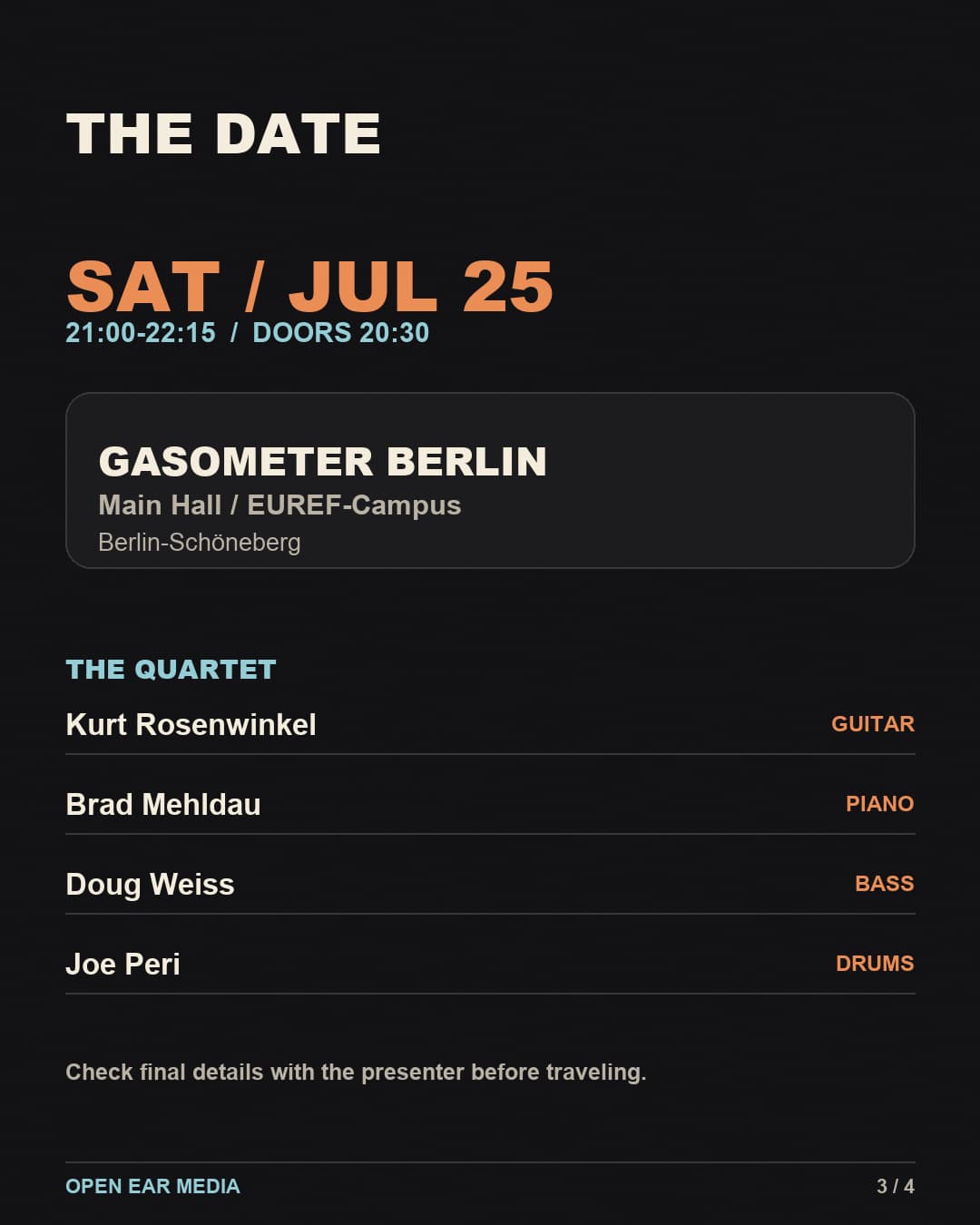
The instrumentation sharpens the proposition: Rosenwinkel’s guitar and Mehldau’s piano share the harmonic foreground, while Doug Weiss and Joe Peri form a rhythm section built for a single 75-minute festival set. The official billing does not tell us what they will play, and it would be wrong to invent a repertoire. It does tell us that this is a quartet—not a cameo, not two separate programs—and that the performance belongs to the Main Hall at Gasometer Berlin during the new ZigZag Jazz Festival. [1][3][2]
What follows is the listening map we wanted before walking into the room: the shared history, the recording that makes their connection audible, the later studio chapter, the character of the four-player lineup, and the practical details checked against the presenter’s own pages. Start with the official Heartcore video below. In eleven minutes, the backstory stops being biography and becomes sound. [7][6]
The first chapter
A shared language formed in the New York underground
Rosenwinkel’s official biography dates his arrival on the New York scene to 1991. The festival presenter places both musicians in the Greenwich Village underground of the early 1990s, naming clubs such as Smalls as part of the environment in which their generation developed. That context matters. Smalls was not simply another address on a tour schedule; it was a workshop where bands could return, stretch original material, and allow a musical vocabulary to become collective knowledge. [4][1][13]
Rosenwinkel’s Next Step group used that laboratory intensely. Contemporary reviews of the archival Live at Smalls 1996 release describe material that would later become central to The Next Step, with Mark Turner on tenor saxophone, Ben Street on bass, and Jeff Ballard on drums. Heartcore’s release notes credit Mehldau as the pianist on “Zhivago.” The point is not merely that the two headliners once occupied the same room. Mehldau entered one of Rosenwinkel’s defining compositions inside the working band and the club culture that helped shape it. [6][12][13]
Mehldau’s own official biography later described Rosenwinkel as one of the peers with whom he had collaborated for more than a decade, alongside guitarist Peter Bernstein and tenor saxophonist Mark Turner. That is unusually useful evidence because it comes from Mehldau’s side of the relationship: this was not a one-night overlap inflated by hindsight, but part of a longer network of musicians who repeatedly listened to and challenged one another. [5]
Watch and listen
“Zhivago” is the evidence
Heartcore Records released the 1996 Smalls tape in 2024 and paired “Zhivago” with an official video assembled from Kurt Rosenwinkel’s archive. Its credits are precise: Brad Mehldau on piano, Rosenwinkel on guitar and composition, Mark Turner on saxophone, Ben Street on upright bass, and Jeff Ballard on drums. This is the obvious starting point because it lets the musicians make the historical argument themselves. [7][6]
The composition moves in three, but the performance never feels contained by a polite waltz. Reviews of the release hear a gently lilting foundation, Turner weaving through Rosenwinkel’s guitar lines, and Mehldau delivering the piano statement that changes the temperature of the track. The performance lasts more than eleven minutes—room for the tune’s architecture to remain clear while the players test how far its harmony and pulse can open. [7][12][13]
It also clarifies what a Rosenwinkel–Mehldau reunion can mean. Guitar and piano are both chordal instruments, so the easy result would be congestion: two sophisticated harmonic thinkers reaching for the same space. “Zhivago” instead documents a conversation in which orchestration, touch, register, and patience matter as much as the density of ideas. That old problem—how to share the harmonic center without crowding it—is one of the live questions carried into Berlin. [7][5][4]
Kurt Rosenwinkel “Zhivago” feat. Mehldau, Turner, Street & Ballard (Live at Smalls 1996)
The official Heartcore Records video for the 1996 Smalls performance of Kurt Rosenwinkel’s “Zhivago,” featuring Brad Mehldau on piano with Mark Turner, Ben Street, and Jeff Ballard.
Watch on YouTube · Heartcore RecordsBrad Mehldau — piano; Kurt Rosenwinkel — guitar, composition; Mark Turner — saxophone; Ben Street — upright bass; Jeff Ballard — drums.
The studio chapter
Deep Song widened the frame in 2005
Nine years after the Smalls recording, Mehldau became a major voice on Rosenwinkel’s Deep Song. Apple Music identifies it as a 2005 Verve release; the detailed recording credits place Mehldau on piano for nine of the album’s ten tracks, alongside Larry Grenadier on bass, Joshua Redman on tenor saxophone, and drummers Ali Jackson and Jeff Ballard. This was not a decorative guest spot. Mehldau occupied nearly the whole album’s harmonic and ensemble world. [8][9][10]
AllMusic characterized the record as intimate and atmospheric, language that fits the way the ensemble balances complexity with color. Rosenwinkel’s writing can contain long harmonic paths and tightly connected melodic cells; Mehldau’s official biography describes a player driven by both spontaneous invention and formal architecture. Deep Song gives those instincts a studio setting in which composition and improvisation continually trade authority. [10][5][4]
There is a useful factual wrinkle for attentive listeners: the album’s title track is the one selection on which the available track-level credits do not list Mehldau. The collaboration is the album, not necessarily the song that shares its name. That distinction is why the 1996 “Zhivago” video is the better embedded preview for this concert—it puts both musicians unmistakably inside the same performance. [9][7]
The live proposition
Two unmistakable musical minds, one harmonic foreground
Rosenwinkel’s official biography emphasizes the harmonic vision and melodic identity that have made his guitar language so influential. Those qualities are linked: the harmony is not an intellectual coating placed over the melody; it is the terrain through which the melody discovers its shape. His sound can blur the border between guitar, voice, and sustained horn-like line, making a quartet feel less like a soloist plus accompaniment than a field of moving color. [4][6]
Mehldau’s official biography offers an unusually revealing description of his own method: the improviser and the formalist operating at once, with musical ideas unfolding in a strongly felt narrative arc. That helps explain why he is such a consequential partner for Rosenwinkel. Both players can think across long spans, but their attacks, decay, physical touch, and relationship to silence are different. The interest lies not in hearing them agree on everything, but in hearing how two structural imaginations negotiate the same instant. [5][7]
The Berlin set therefore carries several plausible directions without guaranteeing any of them: revisiting Rosenwinkel compositions associated with their shared past, approaching standards through two independent harmonic lenses, or using new material as the neutral ground. The responsible preview does not guess the set list. It identifies the question the lineup makes unavoidable: what happens when two players who can each reorganize a tune’s inner logic have to build one version together, in real time? [1][7][11]
The full quartet
Doug Weiss and Joe Peri are the condition that makes the meeting possible
A headline built around Rosenwinkel and Mehldau can make bass and drums look like supporting information. In this instrumentation, the opposite is closer to the truth. Doug Weiss has to give the harmony weight without sealing it shut; Joe Peri has to define motion while leaving enough air for two chordal instruments to reshape the pulse. Their choices determine whether the music feels like alternating solos or one responsive quartet. [1][3]
The spelling of Peri’s name required a small fact-check. The event header and the organizer’s Instagram announcement both say Joe Peri, while one prose sentence on the event page says Joe Perry. Jazz DateBook follows the structured lineup and corroborating social announcement. It is a minor correction, but this kind of precision matters: the quartet deserves to be presented as four named musicians, not two stars and anonymous infrastructure. [1][3]
Place matters
A Berlin chapter inside the Gasometer
Berlin is more than a pin on this tour. Rosenwinkel’s Heartcore Records was founded in the city in 2016, and the label’s 2024 release is what brought the 1996 Smalls performance into public circulation. The Berlin concert folds that archival New York chapter back into the city where Rosenwinkel has built a substantial part of his later creative life. [4][6]
The setting is the Main Hall at Gasometer Berlin, part of the EUREF-Campus in Schöneberg. The festival presents the hall as its acoustic and dramatic center, while the broader site adds courtyard programming and high-rise Sky Sessions. The industrial scale is a striking counterpoint to a musical relationship documented in the compressed intimacy of Smalls: a language developed in a basement-sized club now projected inside one of Berlin’s most recognizable structures. [2][1]
There is one practical discrepancy worth making visible. The individual event detail names EUREF-Campus 21; the festival’s general venue and transit information names EUREF-Campus 17. Because both official sources agree on Gasometer Berlin, the Main Hall, the EUREF-Campus, and Berlin-Schöneberg, those are the details this feature publishes. Use the presenter’s live directions rather than relying on a building number copied here. [1][2]
Before downbeat
What to listen for in the room
First, listen to the handoff between guitar and piano. Does one instrument establish the harmonic frame while the other draws the line, or do those roles keep reversing? In “Zhivago,” the surrounding band and the composition allow each voice to arrive with definition. A quartet without saxophone creates a different balance, making register and restraint even more consequential. [7][12]
Second, listen to form over time. Both headliners have reputations built not only on individual phrases but on how ideas accumulate. A motive introduced quietly can return altered several minutes later; a standard can become a long-form argument rather than a sequence of choruses. The most rewarding moments may be less about technical display than about recognizing that the quartet has remembered something it played earlier and found a new use for it. [5][4][10]
Finally, listen to Weiss and Peri whenever the foreground appears to loosen. If the harmony becomes ambiguous or the pulse stretches, bass and drums will reveal whether the quartet is suspending the form, redirecting it, or preparing to land. That is where an all-star billing becomes an ensemble—and where this concert can offer something no discography alone can provide: four musicians deciding what their shared history means tonight. [1][3][7]
The social edition
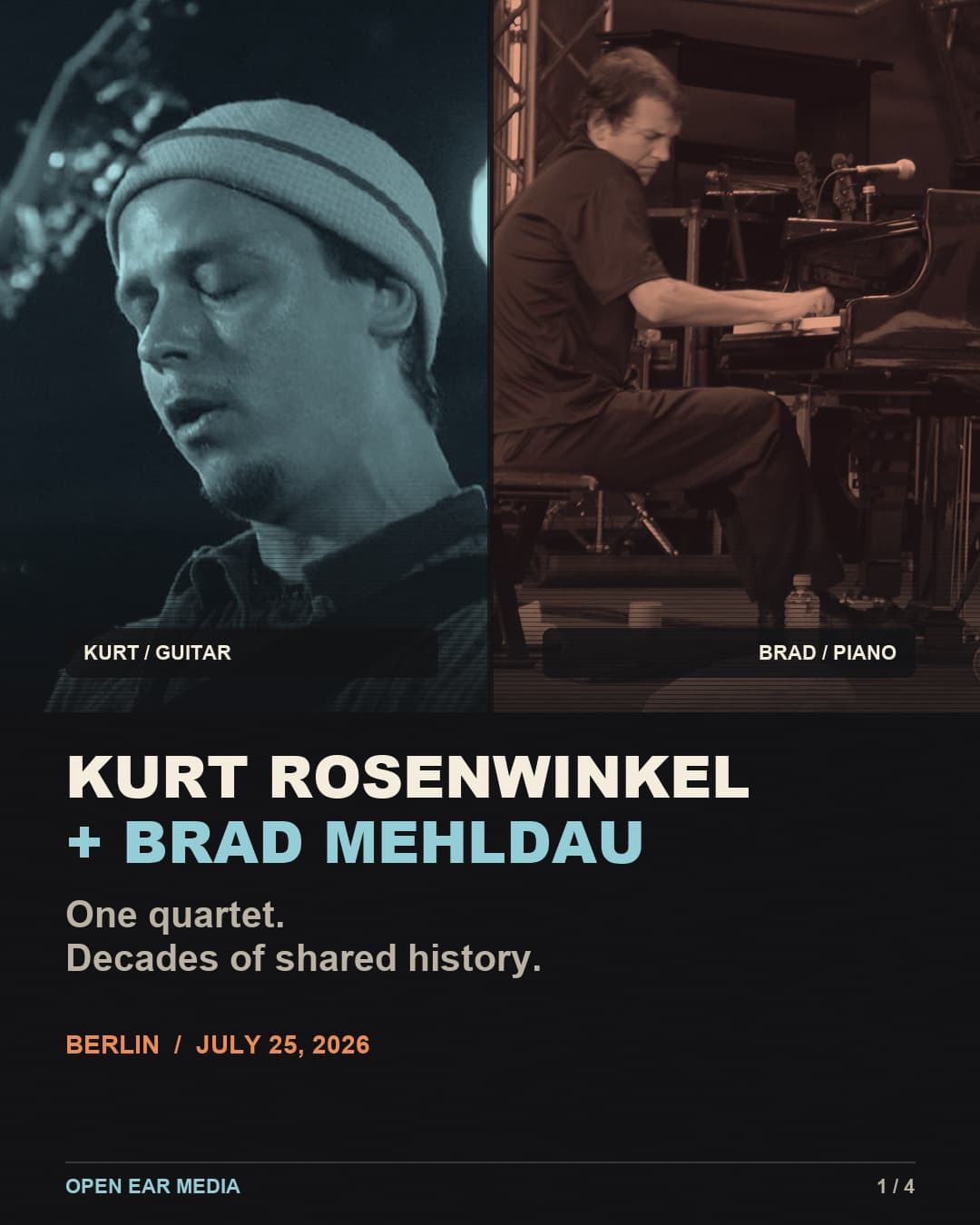
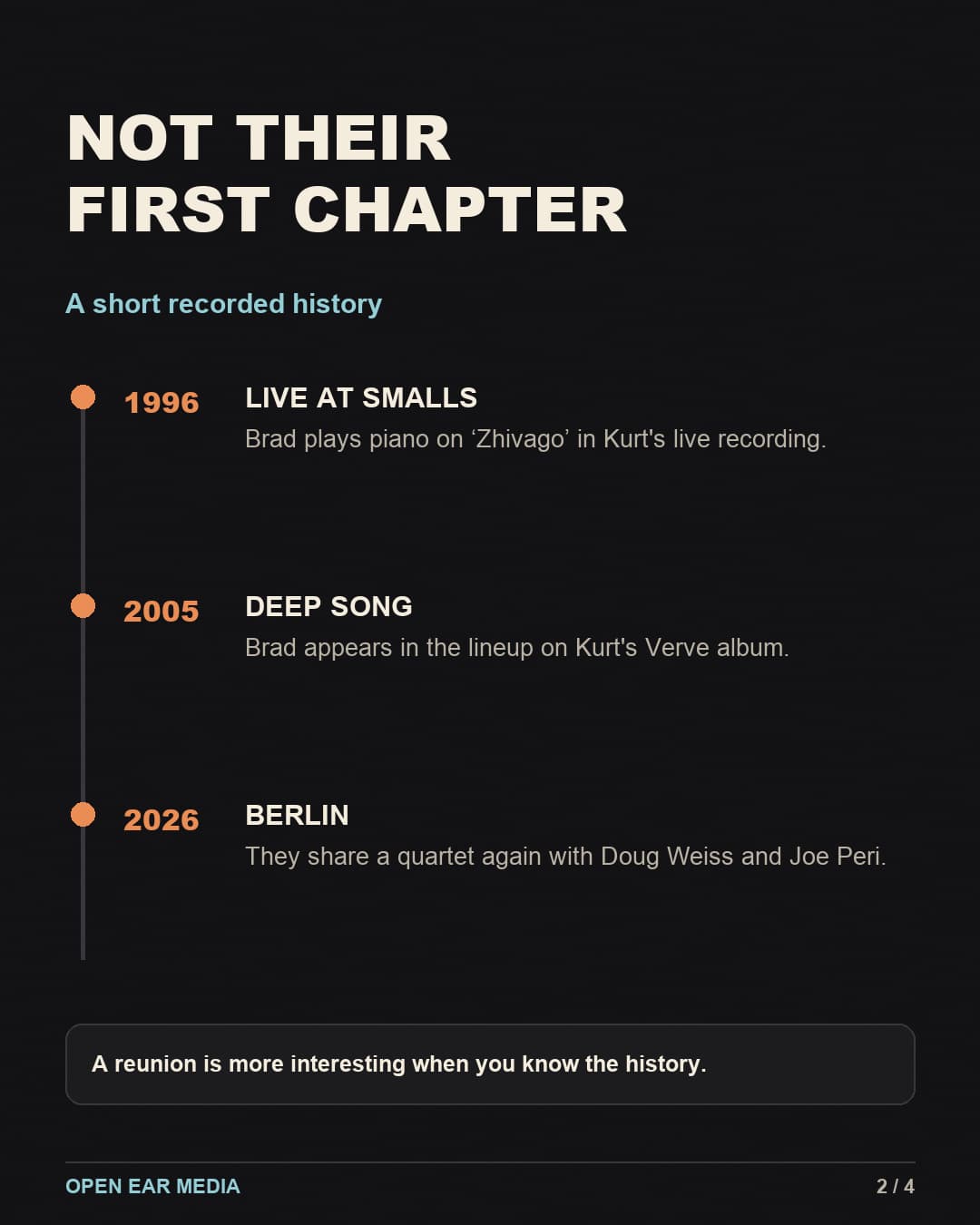
The story in four frames
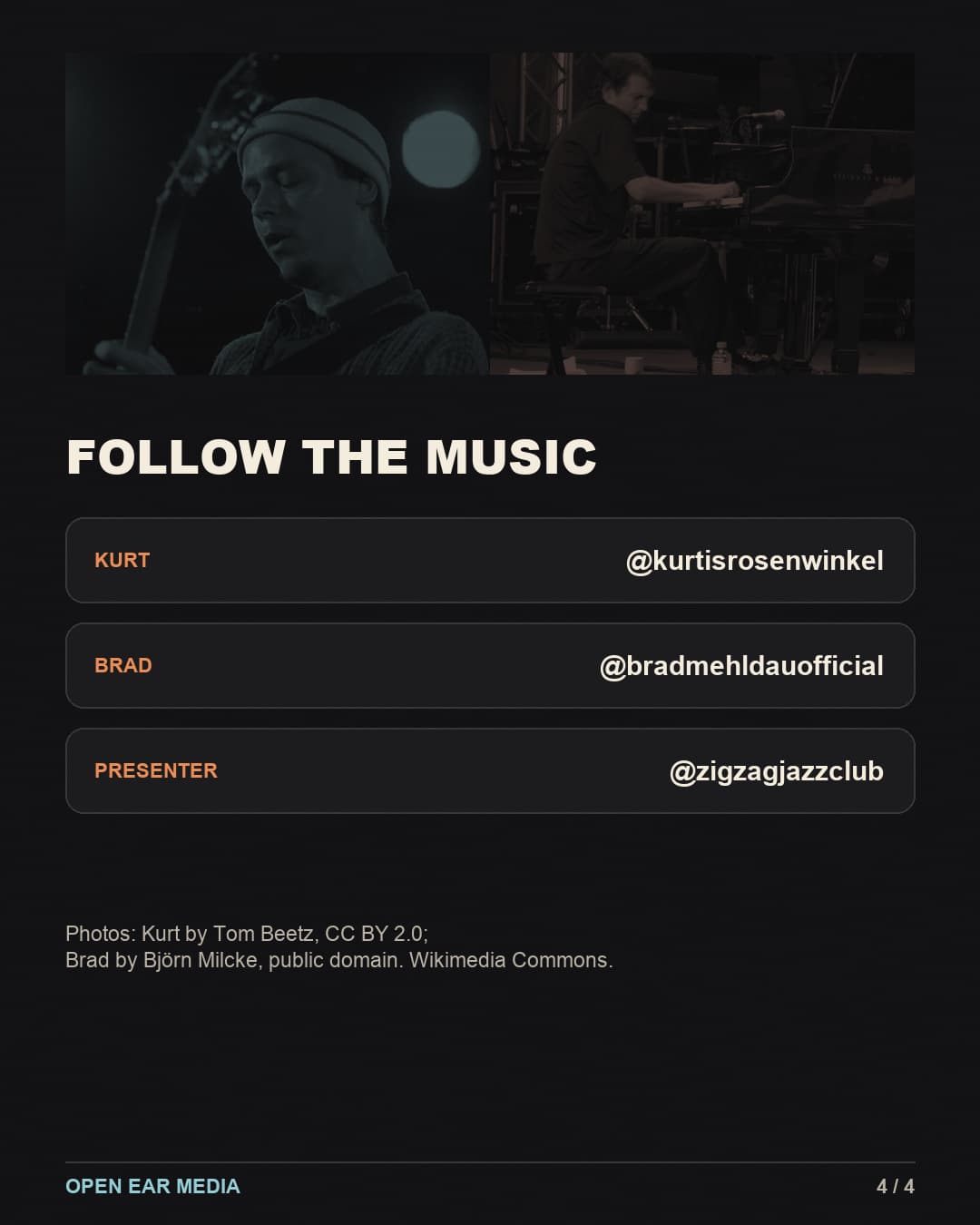
A concise visual guide for listeners, derived from the researched feature above rather than the other way around.
Research trail
Sources and further listening
Primary artist, presenter, label, and event sources lead this list. Reviews and discographic databases are used for listening context and detailed recording credits. Each source was checked on the date shown in the feature metadata.
- 1The Zig Zag Jazz Festival: Kurt Rosenwinkel 4tet feat Brad Mehldau
Zig Zag Jazz Club Berlin · official event
Supports: date, time, doors, lineup, Main Hall location, shared history, Deep Song connection.
- 2The ZigZag Jazz Festival 2026 at Gasometer Berlin
The ZigZag Jazz Festival · official event
Supports: festival dates, Gasometer venue, Main Hall context, EUREF-Campus directions, presenters.
- 3Kurt Rosenwinkel quartet event announcement
@zigzagjazzclub · official social
Supports: July 25 start time, Gasometer Berlin, Kurt Rosenwinkel, Brad Mehldau, Doug Weiss, Joe Peri, artist handles.
- 4Kurt Rosenwinkel official website and biography
Kurt Rosenwinkel · official artist
Supports: official identity, New York arrival in 1991, artistic profile, Heartcore’s Berlin history, official Instagram and listening links.
- 5About Brad
Brad Mehldau · official artist
Supports: career timeline, improviser and formalist description, long-running collaboration with Kurt Rosenwinkel, official Instagram and YouTube links.
- 6The Next Step Band (Live at Smalls, 1996)
Kurt Rosenwinkel / Heartcore Records · official label
Supports: 1996 Smalls recording, Zhivago personnel, 2024 release, Next Step band context, Heartcore release credit.
- 7Kurt Rosenwinkel “Zhivago” feat. Mehldau, Turner, Street & Ballard (Live at Smalls 1996)
Heartcore Records · media
Supports: official performance video, full personnel, composition credit, performance duration, 2024 publication date.
- 8Deep Song by Kurt Rosenwinkel
Apple Music · discography
Supports: 2005 release date, Verve label, track list, album duration.
- 9Kurt Rosenwinkel — Deep Song release credits
Discogs · discography
Supports: album personnel, track-level piano credits, rhythm-section credits, production credits.
- 10Kurt Rosenwinkel: Deep Song — review, tracks, and credits
AllMusic · publication
Supports: album review, ensemble personnel, track list, Brad Mehldau piano credit.
- 11Deep Song
Kurt Rosenwinkel — Topic / Universal Music Group · official label
Supports: 2005 Verve copyright, album title track, official label distribution.
- 12Kurt Rosenwinkel: The Next Step Band Live At Smalls 1996
Jazz Journal · publication
Supports: Smalls residency context, album review, Zhivago performance assessment, personnel.
- 13Kurt Rosenwinkel — The Next Step Band — Live at Smalls, 1996
UK Jazz News · publication
Supports: Smalls context, Next Step material, Zhivago musical description, personnel, 2024 release.
- 14Kurt Rosenwinkel photograph by Tom Beetz
Wikimedia Commons · image license
Supports: photographer credit, CC BY 2.0 license, source image.
- 15Brad Mehldau photograph by Björn Milcke
Wikimedia Commons · image license
Supports: photographer credit, public-domain status, source image.