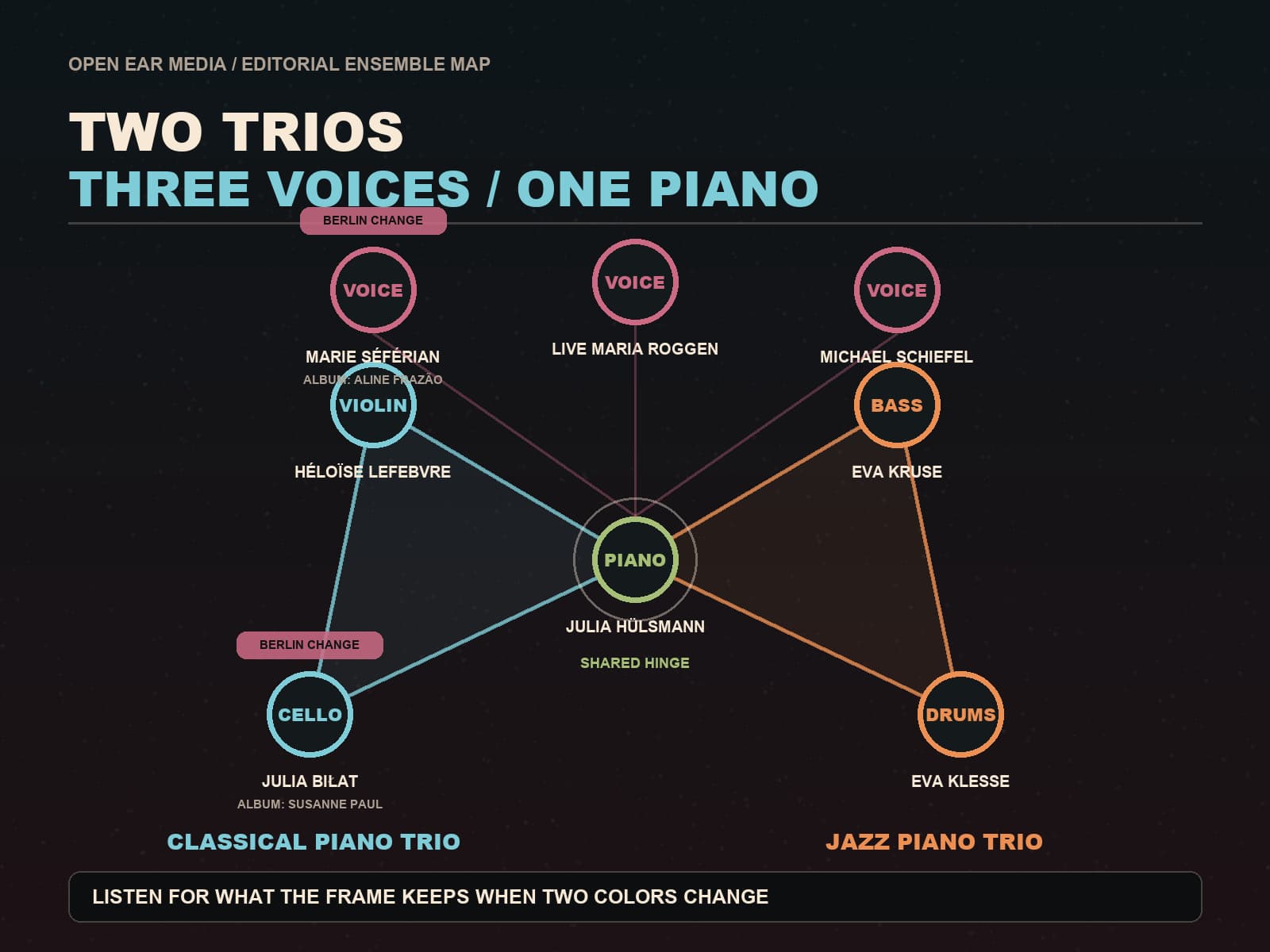
Two trios, three voices, one shared piano
Julia Hülsmann changes two voices inside one eight-part frame
The ECM album joins a classical trio, a jazz trio and three singers around one shared piano. Berlin keeps that architecture but changes a vocalist and the cello chair—making personnel, not repertoire, the night’s decisive variable.
Julia Hülsmann’s octet is built from a piece of musical arithmetic. A classical piano trio contributes violin, cello and piano. A jazz piano trio contributes piano, double bass and drums. Because the piano belongs to both, those six functions require only five instrumentalists. Add three singers and the result is eight: not a large ensemble for its own sake, but two traditions sharing a hinge while three distinct voices move through them. [2][3]
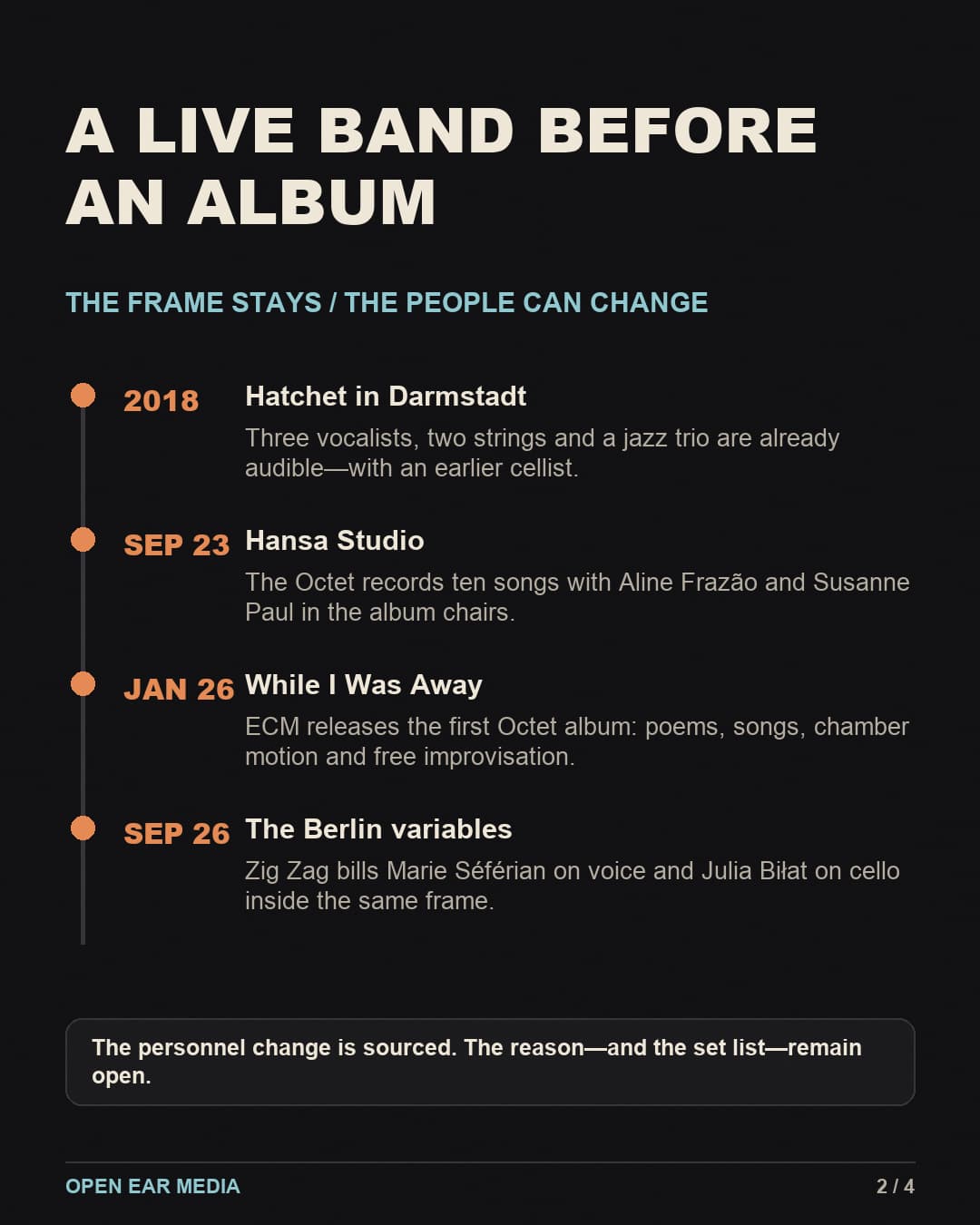
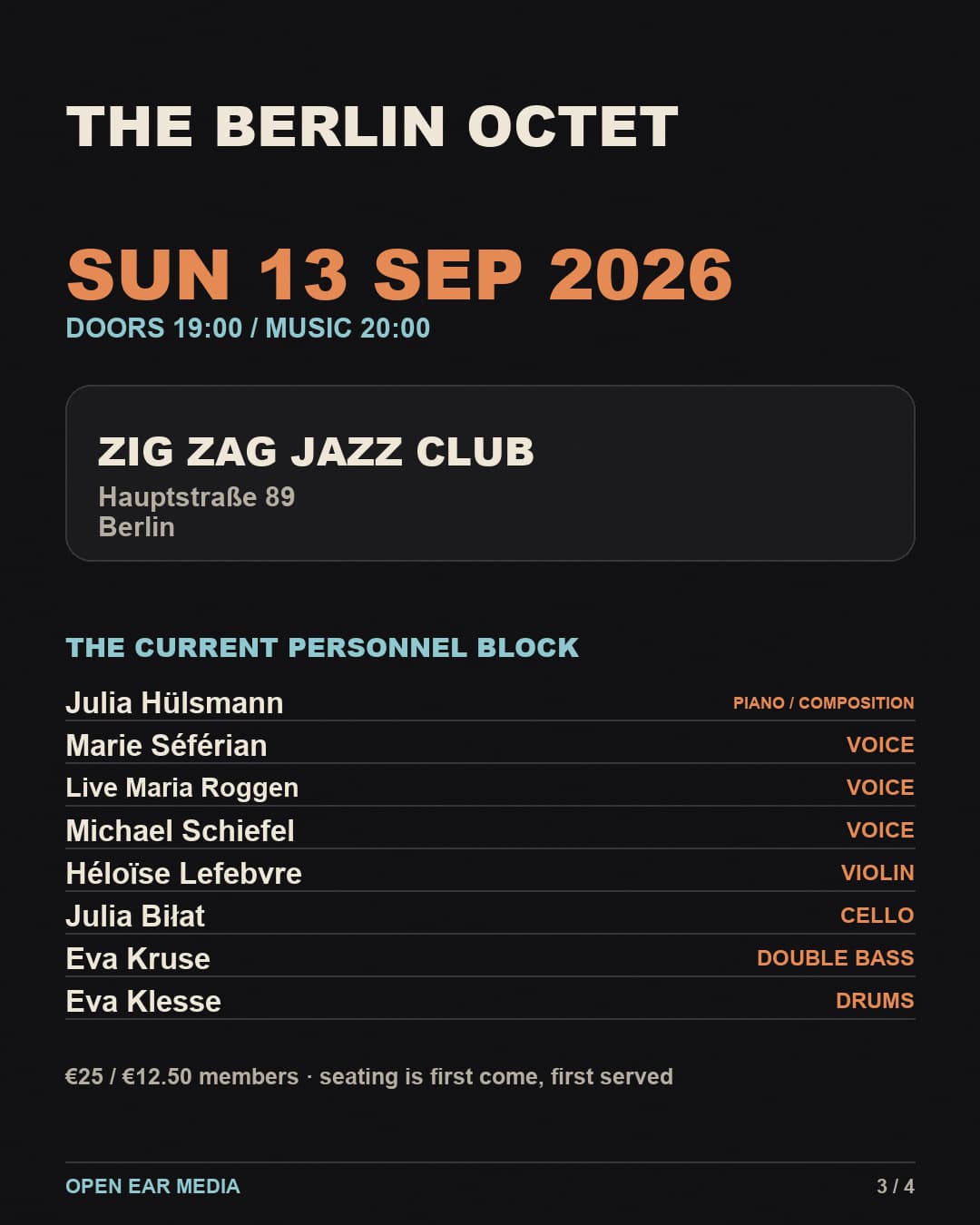
The September 13 Berlin billing keeps that architecture and changes two of the people who defined it on ECM’s While I Was Away. Zig Zag’s current personnel block places Marie Séférian in the vocal group where Aline Frazão appears on the album, and Julia Biłat in the cello chair recorded by Susanne Paul. The page’s older descriptive paragraph still names Frazão and Paul, but Séférian’s site lists the tour’s September 11 Singen date and Biłat’s calendar explicitly lists the September 12 Munich and September 13 Zig Zag concerts. The current header wins. [1][2][7][10]
That is more than a correction. The album’s ten songs depend on particular relationships among text, timbre and role: three voices sometimes lead alone, sometimes narrate against one another, sometimes become a spoken or sung unit; violin and cello can accompany, improvise or function as a chamber ensemble. Berlin asks what remains when one third of the vocal color and one half of the string pair change at once. No official set list explains the answer in advance. [2][5][1]
Reading the current page
The lineup block and the album copy tell different truths
Zig Zag’s page has three layers. Its top calendar block labels the event from 7 p.m.; its practical section says the music starts at 8 after 7 p.m. doors; and its dedicated personnel block names Hülsmann, Séférian, Roggen, Schiefel, Lefebvre, Biłat, Kruse and Klesse. Lower on the same page, inherited project copy describes Frazão and Paul. Publishing every layer as if it agreed would create a false lineup and a false downbeat. [1]
The safest resolution uses specificity and corroboration. A current personnel block is more event-specific than a general project biography. The logistics line is more precise than a multi-hour calendar shell. Séférian’s own homepage places her in Singen on September 11, the first date ECM lists for the Octet’s September run. Biłat’s own calendar names Hülsmann’s Octet at Unterfahrt on September 12 and Zig Zag on September 13. Those independent artist records support the substitutions without inventing a reason for them. [1][7][10][2]
What cannot be published is motive. No source says whether Frazão and Paul are unavailable, whether the changes apply to the full tour, or whether Berlin will alter specific arrangements. “Replacement” here describes a documented chair difference between album and event, not a personnel dispute or permanent membership change. Preserving that boundary lets the musical question remain interesting without turning uncertainty into backstage fiction. [1][2][7][10]
Before the first album
The Octet had a live history before ECM fixed it in place
While I Was Away was recorded at Berlin’s Hansa Studio in September 2023 and released by ECM on January 30, 2026. The delay between session and release is only one part of the chronology. Hülsmann’s own channel documents the Octet performing Archive’s “Hatchet” in Darmstadt in footage published in 2018, with Frazão, Roggen and Schiefel already forming the vocal group, Lefebvre on violin, Kruse and Klesse in the jazz rhythm section—and Stephan Braun then holding the cello chair. [2][6]
That older video proves that personnel variation is not new to the project. By the 2023 session, Paul had taken the cello role, and the repertoire had moved from Archive and a broad range of pop-song transformations toward a ten-track program of originals, poetry settings, Ani DiFranco and Brazilian song. ECM sometimes calls the octet newly formed because this is its first label album; other press notes describe a band heard at special live occasions for roughly a decade. The apparent contradiction disappears once “recording debut” is separated from “first performance.” [6][2][4]
The Berlin date therefore sits after three forms of rehearsal: years of concerts, a 2023 studio document and the 2026 performances following its release. Séférian and Biłat do not enter a blank score. They enter an architecture whose habits are mature enough to be changed—and whose recorded version gives listeners an unusually precise reference for hearing what their presence alters. [2][6][7][10]
The ensemble design
One piano belongs to two trios at the same time
The shared piano is the design’s most efficient idea. With Lefebvre and Biłat, Hülsmann can complete a classical piano trio capable of linear counterpoint, blended sustain and chamber-scale dynamics. With Kruse and Klesse, the same piano becomes part of a jazz trio built to articulate pulse, harmony and improvising form. Hülsmann does not move physically between groups; her touch and register tell the listener which frame is active—or whether the two have become inseparable. [2][1]
Three singers make the word “voice” plural in another sense. On the album, Frazão brings Portuguese-language songwriting and sings Hülsmann’s setting of Emily Dickinson; Roggen contributes complete songs and lyrics to an existing Hülsmann quartet piece; Schiefel moves toward music-theatre intensity and contributes “Iskele.” They are not interchangeable sections in a choir. Their separateness is the compositional resource, and their occasional convergence gains force because listeners can first identify each character. [2][4]
The rhythm section is equally specific. Kruse and Klesse can create a conventional piano-trio foundation, but ECM’s notes emphasize passages where song form opens into brief improvisation or denser collective freedom. The strings can float above that foundation, replace it with chamber movement or answer voices as if they were voices themselves. The octet works not because eight parts sound at once, but because Hülsmann can continually redraw smaller ensembles inside the eight. [2][4]
One of the central ideas of the project was to have everyone contribute their own character to the mix.
The repertoire on record
Poems do not sit above the music; they generate its time
The album’s text sources demand different musical clocks. “Sleep” uses Emily Dickinson’s “Sleep Is Supposed To Be,” whose compact language can be stretched by melody and interrupted by instrumental reflection. “You Come Back” sets Margaret Atwood with Schiefel in the foreground and the two women shaping harmony around his narration. “TicToc” turns E. E. Cummings into rhythmic speech, unison and dispersing harmony. The words are not literary decoration; syllable and syntax supply compositional pressure. [2][5]
The non-poetry sources widen the frame. Zélia Fonseca and Rosanna Tavares’s “Coisário De Imagens” opens the record with Portuguese voice and a baião impulse. Ani DiFranco’s “Up, Up, Up, Up, Up, Up” lets improvising passages grow out of song form and recede into it. Roggen’s “Felicia’s Song” and “Moonfish Dance,” and Schiefel’s “Iskele,” ensure that the singers contribute composition as well as timbre. [2][4]
Zig Zag’s inherited copy also mentions older Octet interpretations of Alanis Morissette, Archive and Feist. Those belong to the project’s broader live history, not the ten-track ECM sequence. Because the Berlin source publishes no set list, either period may matter—or neither may define the night. The responsible listening guide distinguishes recorded repertoire from historical repertoire and leaves the concert’s selection open. [1][3][2][6]
The album’s clearest listening test
“TicToc” makes three voices behave like a rhythm instrument
The official ECM audio for “TicToc” credits all three album vocalists, Hülsmann as composer and arranger, and E. E. Cummings as lyricist. Its premise is already audible in the title: language and time become the same material. ECM describes the chorus as a rhythmically dancing spoken-word unison before the voices separate into different harmonies. Listen first for collective consonants and attacks, then for the instant individual identities reappear. [5][2]
The track is also a map of the full architecture. Piano can punctuate language rather than simply harmonize it; bass and drums give spoken syllables a grid to align with or resist; violin and cello can lengthen sound beyond the clipped edge of a word. When Hülsmann solos, the text-driven clock does not vanish—it remains as memory inside the instrumental time. That is the difference between setting a poem and letting a poem organize a band. [5][2][4]
Berlin changes the experiment because Séférian replaces one voice in the recorded unison and Biłat replaces one source of string sustain. If “TicToc” is performed, the comparison will be direct; if it is not, the listening principle still holds. Notice how consonants line up, how three vocal timbres separate, and how cello attack or resonance determines whether a phrase feels percussive, harmonic or theatrical. [1][5][10][8]
TicToc
The ECM track sets E. E. Cummings with all three album vocalists, turning spoken unison, separated harmony and instrumental time into one model of the Octet’s architecture.
Watch on YouTube · Julia Hülsmann Octet — Topic / ECM RecordsJulia Hülsmann Oktett — Hatchet
Hülsmann’s artist-published 2018 performance documents the Octet’s pre-album life, its original three-vocalist design and an earlier cello lineup.
Watch on YouTube · Julia HülsmannThe Berlin variables
Marie Séférian and Julia Biłat bring practices the album did not contain
Séférian’s background crosses the boundaries already built into Hülsmann’s group. She began on violin before moving to piano and jazz voice, studied at the Jazz Institute Berlin and later with Lauren Newton and Nils Wogram, and has written for string quartet plus rhythm section. Her biography also documents Indian vocal study, chanson work and compositions using James Joyce’s poetry. She enters an octet where strings, jazz rhythm and literary language are not side interests but the basic frame. [8][9][1]
Biłat is a classically trained cellist, improviser and composer whose solo practice expands cello through voice, body and movement. Her current work ranges across Stegreif.Orchester, Camila Nebbia’s The Hanged One, Trickster Orchestra and her own solo improvisation; her calendar explicitly names the Munich and Berlin Octet dates immediately before a September solo-album release. This is not a player being asked only to reproduce Paul’s chamber part. Biłat arrives with a documented language of extended, performative improvisation. [10][1]
Those biographies do not dictate Hülsmann’s arrangements. Séférian may sing parts associated with Frazão, take different material or alter ensemble balance; Biłat may follow written cello lines closely or receive improvising space. No source says. What can be heard without speculation is the change in available color: a vocalist with violin and composition history enters the three-voice system, while a cellist who treats voice and movement as extensions of the instrument enters the chamber system. [8][10][2][1]
The six returning chairs
The substitutions matter because the rest of the frame remains stable
Roggen and Schiefel preserve two thirds of the recorded vocal triangle. Roggen’s compositions and lyric writing connect directly to the album’s material; Schiefel’s relationship with Hülsmann reaches back to their student years in 1991, according to ECM’s background. Their familiarity can give Séférian fixed points inside arrangements that depend on rapidly changing lead, harmony and narration roles. [2][1]
Lefebvre preserves the upper string voice while Biłat changes the lower one. That continuity matters because violin and cello on the album do more than thicken chords: reviews hear them carrying intertwined lines, solos and instrumental answers with vocal effect. Kruse and Klesse preserve the bass-drums relationship that can turn the chamber group back into a jazz piano trio in a few attacks. [2][4][1]
Hülsmann remains the hinge. She composed or arranged most of the album, chose collaborators whose own writing enters the book, and occupies the only instrument counted in both trio designs. The changed Berlin lineup will reveal how much of the Octet’s identity lives in fixed timbre and how much lives in her system for giving strong individual musicians enough room to remain recognizable. [2][3][1]
The date and the open questions
An intimate room makes ensemble balance impossible to hide
Zig Zag lists Sunday, September 13, at Hauptstraße 89 in Berlin. The detailed event logistics say doors at 7 p.m. and music at 8 p.m.; admission is €25 or €12.50 for members. Tickets may be reserved for cash payment at the box office or purchased online, but seating is first come, first served in either case. The event remains active, with no cancellation, postponement or sold-out notice observed at publication. [1]
The club scale is revealing for an ensemble that depends on internal subsets. Listeners can follow the cello’s physical attack, the moment three singers breathe together, the bass-drum pivot into jazz time and the piano’s move from chamber counterpoint to solo voice without relying only on amplification or album mixing. Balance becomes a visible series of choices rather than a polished studio fact. [1][2]
No official source promises an album-only program, a stream or a recording of the Berlin date. Prepare with “TicToc,” “You Come Back,” “Up, Up, Up, Up, Up, Up” and the older “Hatchet” performance, then listen for personnel rather than titles: where Séférian enters the vocal geometry, how Biłat alters the cello register, and whether the two-trio frame remains audible when two of its recorded colors are gone. That question will outlast the release cycle because it tests what a band actually is. [5][2][6][1]
The social edition
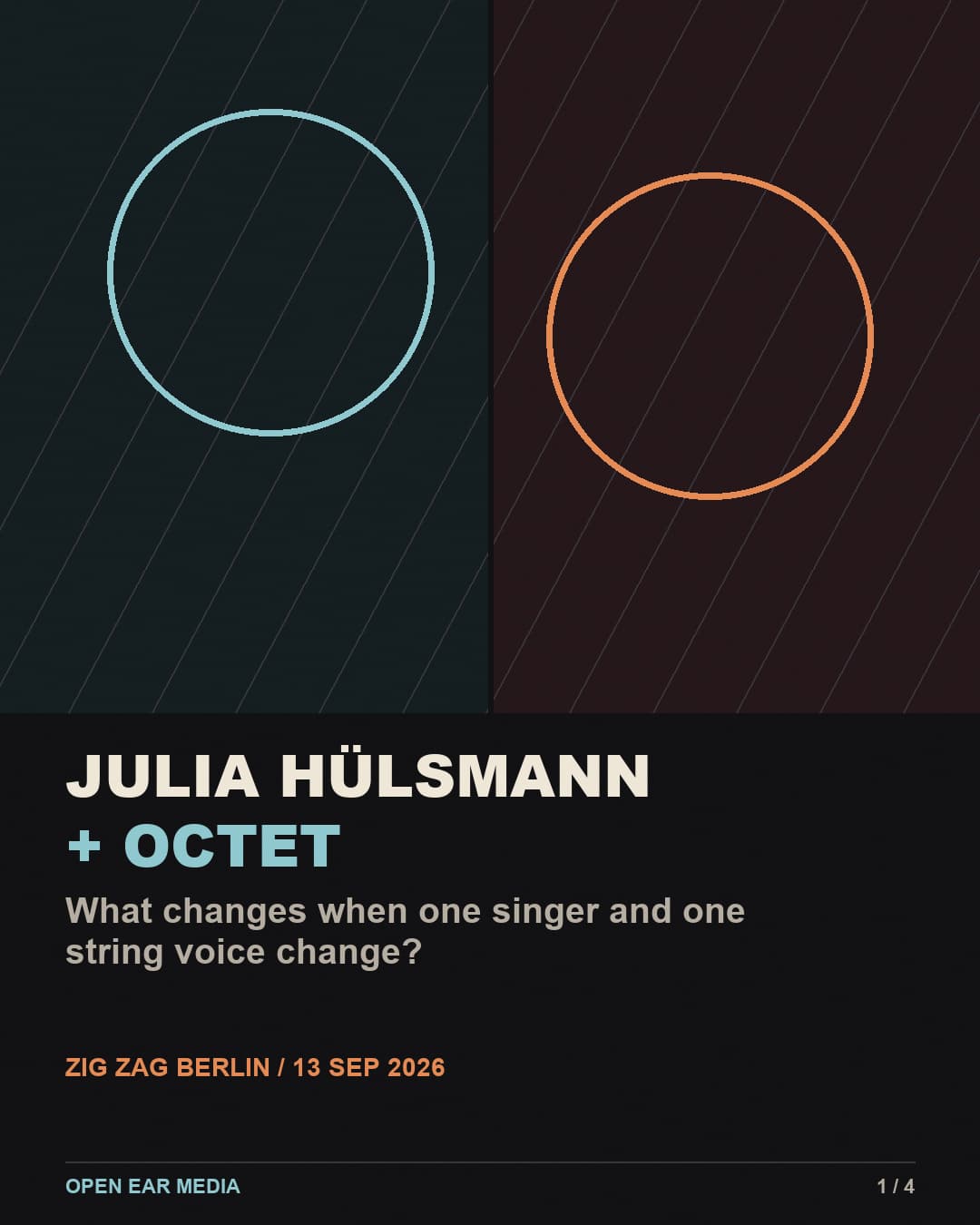
The story in four frames
A concise visual guide for listeners, derived from the researched feature above rather than the other way around.
Research trail
Sources and further listening
Primary artist, presenter, label, and event sources lead this list. Reviews and discographic databases are used for listening context and detailed recording credits. Each source was checked on the date shown in the feature metadata.
- 1Julia Hülsmann Octet
Zig Zag Jazz Club · official event
Supports: September 13 date, current eight-person event lineup, Marie Séférian and Julia Biłat billing, 7 p.m. doors and 8 p.m. detailed start time, prices, ticket options and first-come seating, venue address, inherited album-lineup copy conflict.
- 2While I Was Away
ECM Records · official label
Supports: January 30, 2026 release, September 2023 Hansa Studio recording, complete album personnel, classical-trio plus jazz-trio plus three-vocalist architecture, ten-track sequence and credits, poetry and song sources, artist statements and September tour dates.
- 3Julia Hülsmann Octet
Julia Hülsmann · official artist
Supports: project concept, album-era core lineup, classical and jazz trio intersection, three-vocalist roles, older pop-song repertoire context.
- 4Julia Hülsmann Octet — While I Was Away
Jazz Views · publication
Supports: Nick Lea review and listening interpretation, complete album personnel, recording date, selected track observations, genre and ensemble analysis.
- 5TicToc
Julia Hülsmann Octet / ECM Records · media
Supports: official ECM audio, Aline Frazão, Live Maria Roggen and Michael Schiefel vocal credits, Julia Hülsmann composer-arranger credit, E. E. Cummings lyric credit, upload date and duration.
- 6Julia Hülsmann Oktett — Hatchet
Julia Hülsmann · media
Supports: artist-published 2018 Octet performance, Archive composition and Hülsmann arrangement, three album vocalists, Héloïse Lefebvre, Stephan Braun, Eva Kruse and Eva Klesse personnel, pre-album project history, upload date and duration.
- 7Marie Séférian — upcoming concerts
Marie Séférian · official artist
Supports: September 11, 2026 Singen appearance, current vocalist identity, tour-lineup corroboration.
- 8Marie Séférian biography
Marie Séférian · official artist
Supports: violin, piano and vocal background, Berlin jazz studies, string-quartet composition, Indian vocal study, James Joyce poetry setting, chanson and international project context.
- 9Marie Séférian
Berlin University of the Arts · official artist
Supports: Jazz Institute Berlin education, composer-vocalist career, string-quartet and rhythm-section writing, current UdK teaching role, discography.
- 10Julia Biłat — cellist, improviser, composer
Julia Biłat · official artist
Supports: classical training and improvising practice, cello, voice, body and movement approach, Berlin project affiliations, September 12 Munich and September 13 Zig Zag Octet dates, official Instagram and YouTube links.
- 11Julia Hülsmann — pianist and composer
Julia Hülsmann · official artist
Supports: official artist identity, project navigation, official Instagram, YouTube and listening links.
- 12Julia Hülsmann (@julia_huelsmann)
Julia Hülsmann / Instagram · official social
Supports: official artist handle.
- 13Julia Biłat (@julia_bilat)
Julia Biłat / Instagram · official social
Supports: official cellist handle.
- 14Zig Zag Jazz Club (@zigzagjazzclub)
Zig Zag Jazz Club / Instagram · official social
Supports: official venue handle.