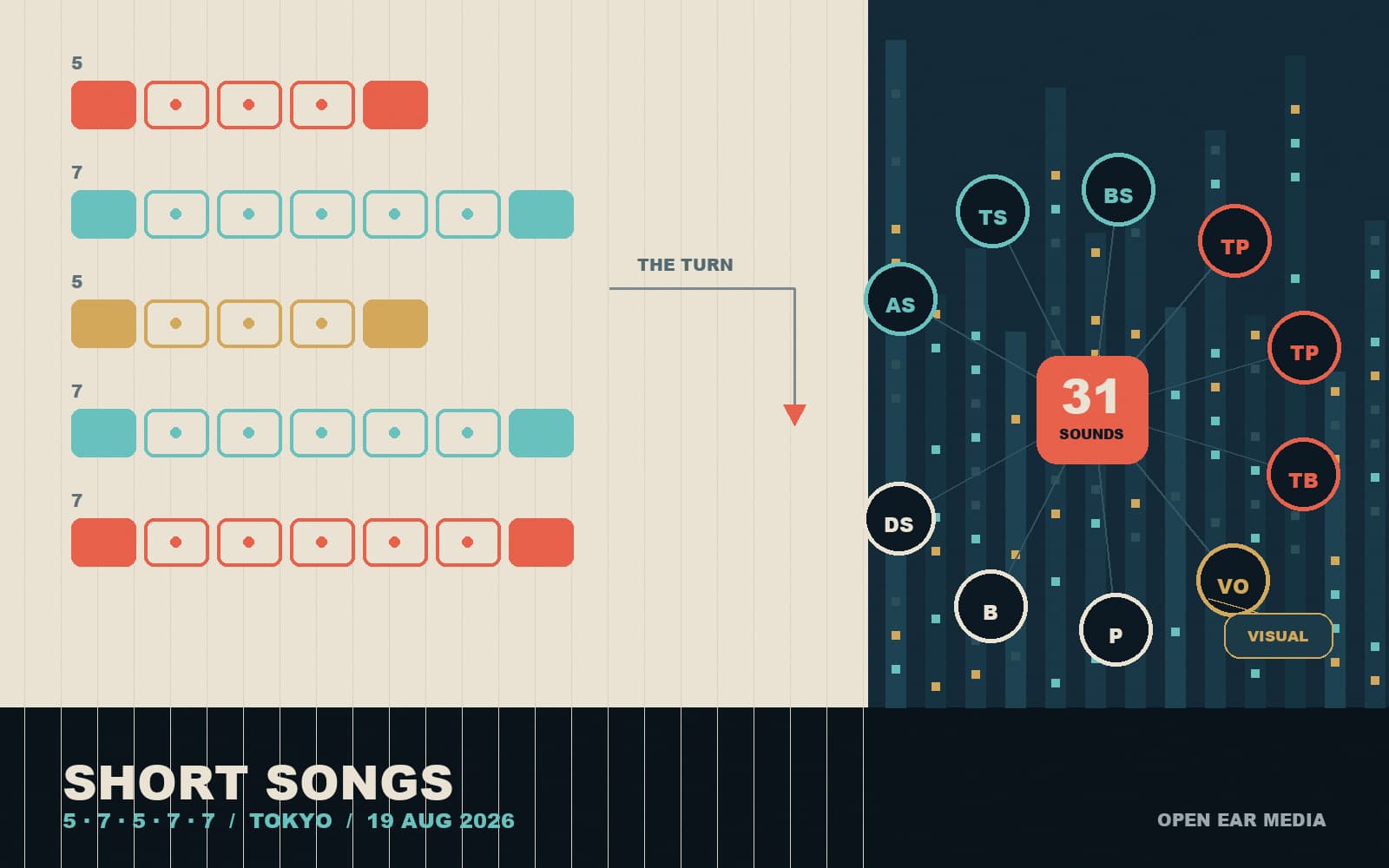
Hina Oikawa Short Songs — editorial interpretation
Hina Oikawa makes a ten-piece jazz language from 31 sounds
The Tokyo release show keeps the six-horn shape of her Brooklyn-recorded debut but hands it to a mostly new band, turning tanka’s 5-7-5-7-7 frame into a live test rather than an album replay.
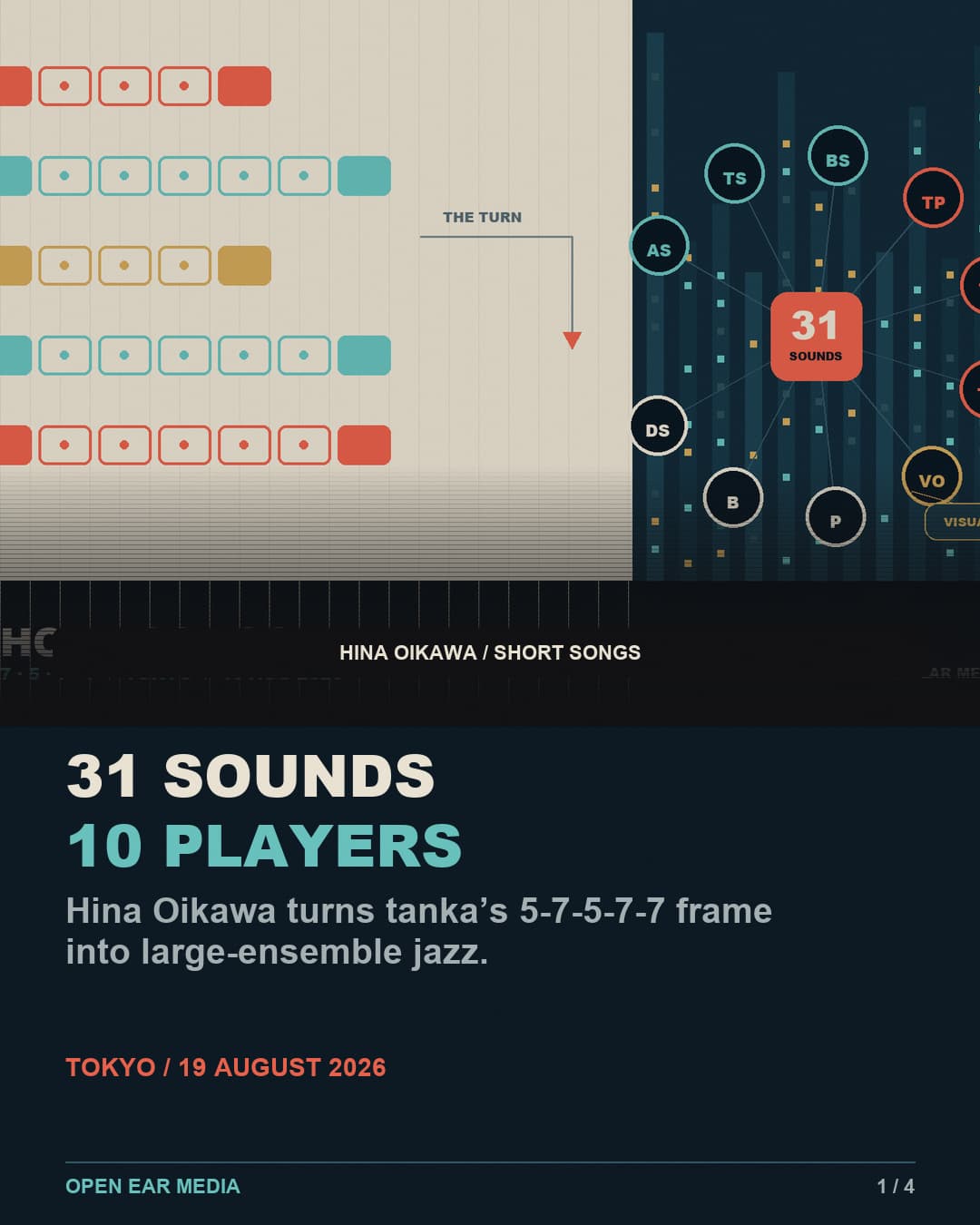
Thirty-one sound units are a very small container. Hina Oikawa has made them hold six horns, voice, piano, bass, drums and moving images. On her debut album Short Songs, the Queens-based alto saxophonist, composer and tanka poet does not merely set Japanese poems to jazz: she lets tanka’s 5-7-5-7-7 proportions govern phrases, meter and the space in which improvisers move. The result asks a useful musical question—whether a fixed form can generate freedom rather than restrict it. [6][9][12]
The August 19 Tokyo release concert makes that question harder. Shinjuku Pit Inn’s current bill preserves the recording’s basic architecture—a six-horn front line, a vocalist and a piano-bass-drums rhythm section—but only Oikawa and trumpeter, composer and arranger Naoya Ogura return from the album’s ten-player studio cast. This is therefore not a live replica of the record. It is a transfer of the same poetic and instrumental grammar into a mostly new body. [1][3][7]
One name also changed after the first announcement. Oikawa’s tour page and early album publicity still list David Berkman, but Pit Inn now says he cannot appear and names Shota Lee at piano. That correction matters artistically as well as practically: Lee is himself a pianist-composer with big-band experience, so the replacement places another large-ensemble thinker inside music whose written design is central. [2][1][7][27]
The form inside the form
Five, seven, five, seven, seven is more than a lyric count
Tanka is commonly described in English as a thirty-one-syllable Japanese poem arranged 5-7-5-7-7; its name translates as “short song.” The Academy of American Poets also emphasizes a pivotal image or turn that connects the upper 5-7-5 unit to the lower 7-7 response. Oikawa’s title therefore names both the literary source and a compositional proposition: short song is not a metaphor applied after the music is written, but a pre-existing architecture with count, balance and a hinge. [12][9]
The album notes identify three distinct uses of that architecture. Tanka texts become lyrics; poems supply images and emotional subjects; and the numerical pattern itself enters the writing and improvising design. The 1:21 opening “Introduction” rebuilds the count as meter, while the closing “Thirty-One Syllables” maps the full sequence onto a melodic skeleton. Between those endpoints, form can be heard as a set of proportions rather than a literary explanation pasted onto the record. [9][6]
That distinction is the key to listening. A poem can be sung and remain separate from the band; a number can become a gimmick. Oikawa’s deeper wager is that constraint affects ensemble behavior: where a phrase gathers weight, when one color yields to another, how long a soloist can resist resolution, and whether a musical turn can feel as consequential as a poetic one. The concert will test whether those relations survive when most of the interpreters change. [9][12][1]
The title is literal as well as musical: tanka means “short song.”
The long route to a debut
The album began as a daily practice, then became a band
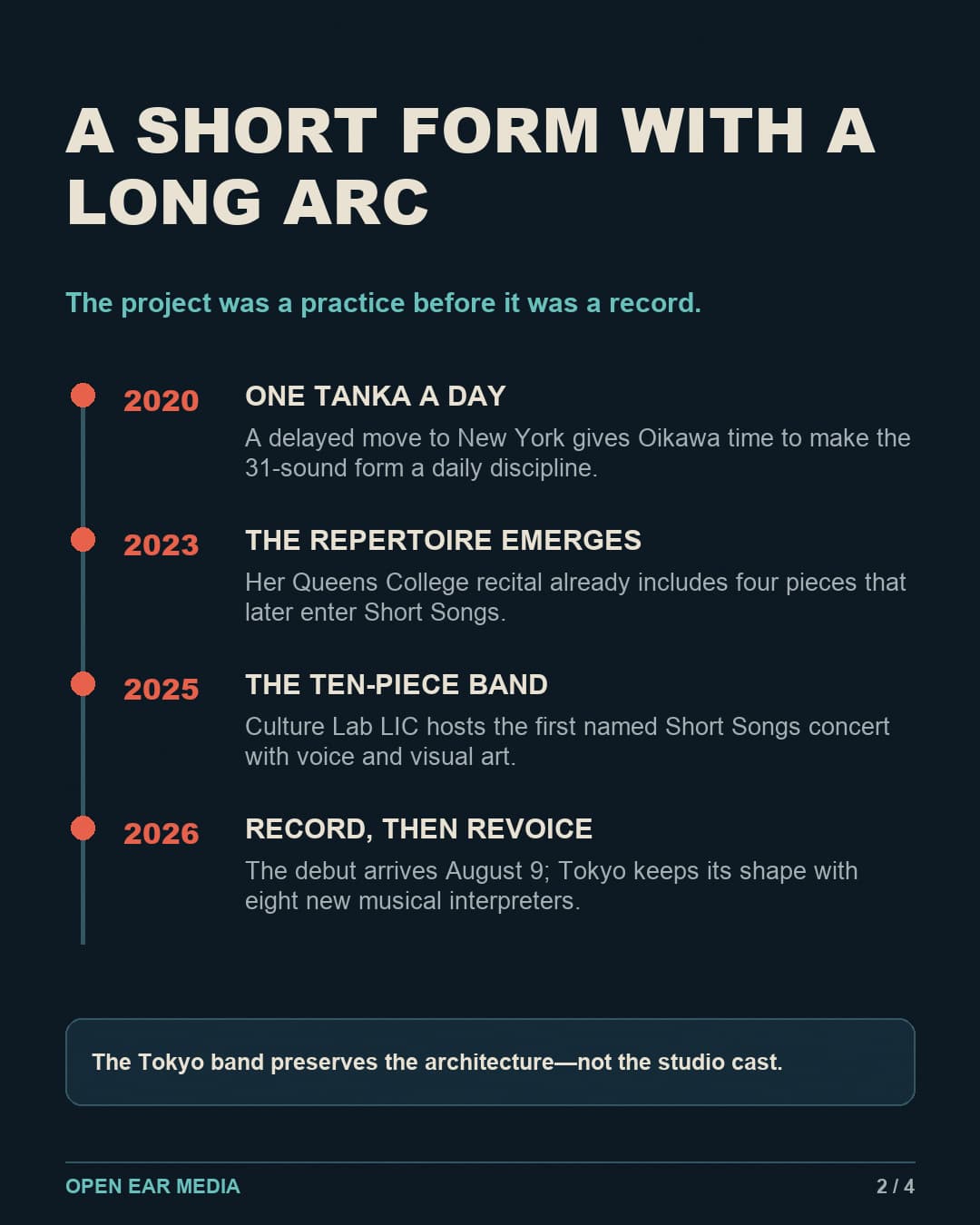
Oikawa’s route into tanka was not initially an album plan. Shukan NY Seikatsu reports that she expected to leave Japan after graduating from Shobi University in 2020, but the pandemic delayed her move to New York by a year. In that suspended period she encountered tanka; a 2025 profile records her saying she made one poem a day a practice beginning in 2020. The discipline arrived before the large ensemble that would eventually carry it. [11][14]
She entered the Queens College graduate jazz program in 2021 and completed it in 2023, receiving the school’s Marvin Hamlisch Award for arranging. Her May 2023 degree recital already contained much of the later album’s vocabulary: “You’re Still Here,” Dave Brubeck’s “Summer Song,” “Yuba no Kuni” and “Beyond the Night, Swallowing the Morning” all appear in the institutional video’s program. Short Songs was therefore assembled from work tested in concert, not conceived only for a recording session. [5][13][9]
The named Short Songs project reached its first full concert at Culture Lab LIC on February 28, 2025. The official highlight video credits ten musicians plus visual artist Jan Suphitcha; the Long Island City Partnership described a large ensemble playing Oikawa’s poetry-inspired originals. In April 2026, Brooklyn Botanic Garden programmed the group for a full hour at Hanami Nights, evidence that the format had become a repeatable performance language rather than a one-night recital concept. [15][14][19]
The record was made at the Bunker Studio in Brooklyn in July 2025 and is scheduled for release on August 9, 2026, on Tiny Storage Music. Oikawa’s announcement places three singles before it—“Yuba no Kuni,” “Manhattan” and “Short Songs”—and two Japan release concerts after it, in Tokyo and Kobe. Pit Inn is thus the first listed release show after the album date, and the point where a project built in Queens and Brooklyn is revoiced in Japan. [9][7][1]
The listening map
Nine tracks make the constraint audible from several angles
Short Songs runs nine tracks and 44:19. Oikawa composed the opening, “Manhattan,” “You Are Still Here,” “Beyond the Night, Swallowing the Morning” and “Thirty-One Syllables”; she also composed the title track, arranged there by Ogura, and arranged Dave Brubeck’s “Summer Song.” Ogura composed “Broken Meter” and “Yuba no Kuni.” The sequence moves between pieces derived directly from poems, pieces shaped by the numerical form, and instrumental writing whose connection is more atmospheric than literal. [9][7]
The studio band gives that material a consistent palette: Oikawa, Sam Dillon and Skyler Hagner form the saxophone and reed row; Summer Camargo, Ogura and Altin Sencalar complete the brass; Ben Rosenblum, Marty Kenney and Alon Benjamini supply piano, bass and drums; and Mỹ Tâm Huynh sings. Ryan Keberle advised the project, Joseph Herbst assisted production and conducted, Todd Carder recorded it, and Dave Darlington mixed and mastered it. [7][9]
Voice is not an ornamental eleventh color. Free Flying’s notes identify Huynh as a Vietnamese American singer who does not speak Japanese as a first language and describe her clear, level delivery as a way for the words to enter the ensemble without theatrical overstatement. That choice makes language slightly unfamiliar even on the record. In Tokyo, Yurie Nejime takes the vocal chair, changing the relation among text, pronunciation and ensemble before any arrangement changes are considered. [9][3][26]
Images are equally structural. Oikawa describes Short Songs as a meeting of language, sound and image, and the released alternate-take videos place Jan Suphitcha’s visual work alongside the ten musicians. Ken Ito designed the album’s visual identity; at Pit Inn he is credited for live visuals. The Tokyo performance therefore does not add projection as decoration. It moves one of the record’s designers into a time-based performance role. [6][16][18][9][3]
Hina Oikawa Short Songs at Culture Lab LIC
Official highlights from the project’s first concert show the ten-musician ensemble, voice and visual art before the album was recorded.
Watch on YouTube · Hina Oikawa 及川陽菜Hina Oikawa - 湯葉の国 (Yuba no Kuni)
The artist’s official alternate-take video joins Naoya Ogura’s setting of Oikawa’s tanka with the studio-band instrumentation and Jan Suphitcha’s visual work.
Watch on YouTube · Hina Oikawa 及川陽菜Short Songs
The distributor-provided title-track audio gives listeners the released 6:17 studio version before the Tokyo band reinterprets the project live.
Watch on YouTube · Hina Oikawa - Topic / Ultra-VybeTwo architects remain
Hina Oikawa and Naoya Ogura carry the record across the personnel change
Oikawa and Ogura’s collaboration reaches beyond one co-writing credit. Shukan NY Seikatsu reports that they met at Queens College and later married. It also traces “Yuba no Kuni” to Oikawa’s tanka sequence: Ogura set the cycle as part of his marriage proposal. On the finished album she supplies the text and he the composition; its domestic image of a dryer-fresh sheet and the phrase “from the land of yuba” becomes material for a six-horn ensemble rather than a private miniature. [11][16][9]
Ogura’s album role is broad: trumpet and flugelhorn, two compositions, the title-track arrangement and co-production. His own background in big bands and graduate arranging at Queens helps explain why he functions as more than a featured brass voice. In Tokyo he is the only studio horn player besides Oikawa onstage, making the pair the most direct carriers of the written balances, cues and transitions developed during the recording. [7][9][25][1]
That continuity should not be mistaken for control over every outcome. A score can preserve voicing and proportions, but attacks, breath lengths, time feel and the pressure behind a solo belong to the musicians in the room. The useful tension at Pit Inn is between two people who know the project from inside and eight musical interpreters who did not make the album. The live version matters precisely because fidelity and difference will coexist. [7][3][9]
Same architecture, different bodies
The Tokyo lineup turns an album release into a new reading
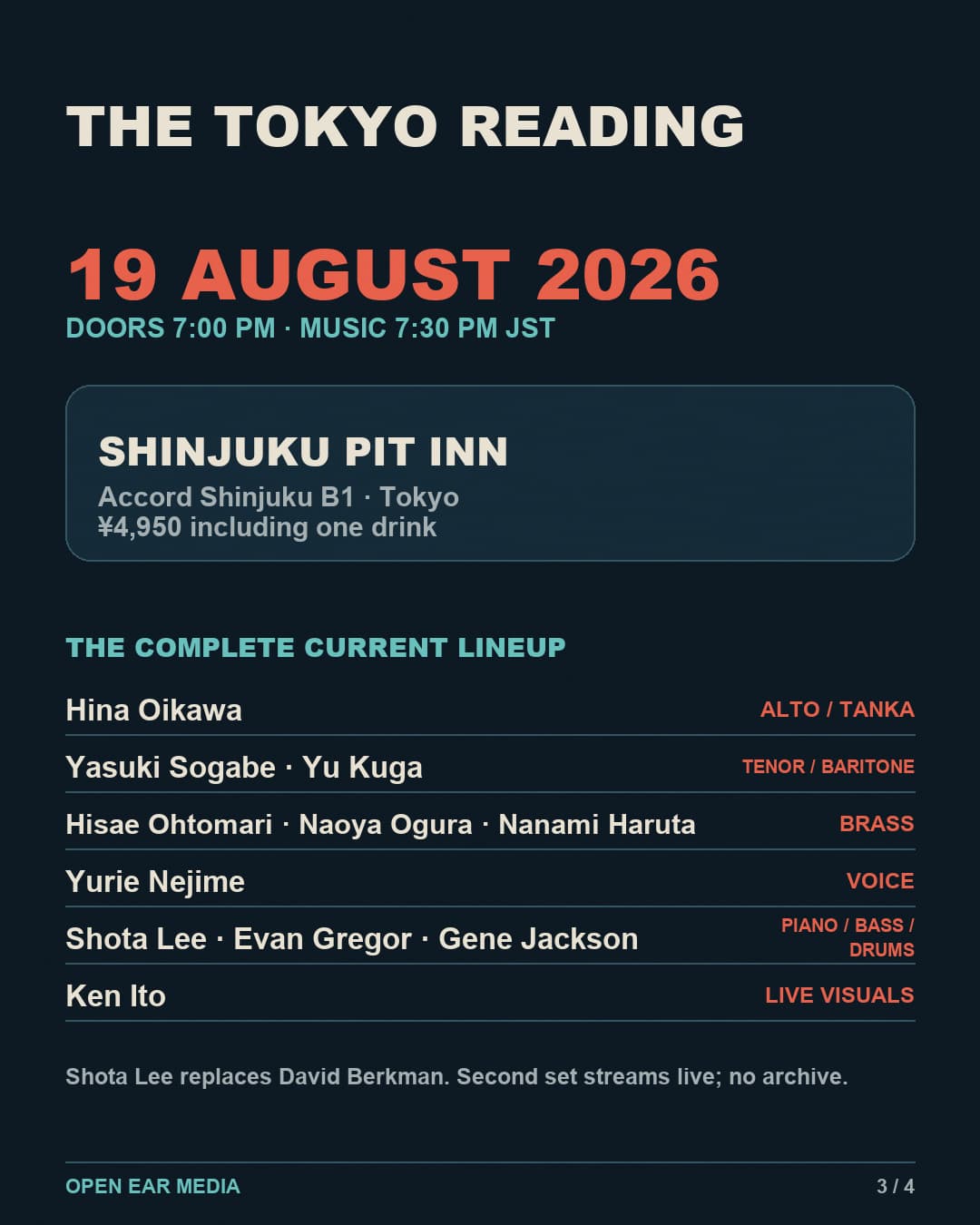
Pit Inn’s current lineup is Oikawa on alto saxophone and tanka; Yasuki Sogabe on tenor saxophone; Yu Kuga on baritone saxophone; Hisae Ohtomari and Ogura on trumpets; Nanami Haruta on trombone; Nejime on voice; Lee on piano; Evan Gregor on bass; Gene Jackson on drums; and Ito on visuals. The instrumental design exactly retains the album’s six horns, voice and trio even though eight of the ten musical chairs change. [1][3][7]
The reed and brass section is built for both weight and internal mobility. Sogabe’s institutional biography documents work with Junko Onishi’s Orchestra and other big bands. Kuga studied jazz composition at Berklee, works across the saxophone family and woodwinds, and has arranged for large groups including Tenors in Chaos and No Name Horses. Haruta is a New York-based trombonist with two leader recordings. Alongside Ohtomari and Ogura, they give the score players accustomed to functioning as section members and individual voices. [20][21][22][28][25]
The rhythm section introduces a different kind of scale. Lee has led and written for his own big band after studying composition at Queens. Gregor’s official biography is crowded with large-ensemble work, from Darcy James Argue’s Secret Society and Miho Hazama’s m_unit to WDR projects. Jackson, now primarily based in Japan, spent much of the 1990s touring in Herbie Hancock’s trios and quartets, including work with Wayne Shorter and Dave Holland. Their shared task is to make counted form breathe rather than merely keep its borders visible. [27][23][24][3]
There are also cross-generational and trans-Pacific threads inside the horn line. Sogabe, Oikawa and Haruta are all alumni of the Seiko Summer Jazz Camp in different years; Oikawa and Haruta were booked into its tenth-anniversary programs immediately before this release show. That does not prove a common improvising language, but it does place part of the section inside a continuing educational network linking Japanese players to New York teachers and stages. [20][22][5][11]
Three ways into the music
Watch the project change before hearing Tokyo change it again
Begin with the official Culture Lab LIC highlights. This is the project’s first concert, not a film of the album session, but much of the later recording personnel is visible: Oikawa, Hagner, Camargo, Ogura, Sencalar, Rosenblum, Kenney, Benjamini and Huynh, with Sean Hong Wei on tenor and Suphitcha making visuals. Watch how voice, section writing, solo space and projected image are presented as parallel layers. The ensemble is large, but the point is not continuous mass. [15][14][7]
Then use “Yuba no Kuni” as the clearest view of poetry becoming a shared object. Oikawa’s official video is an alternate take, so it should not be confused with the album master. It credits Ogura’s composition, Huynh’s voice, the complete studio-band instrumentation and Suphitcha’s visuals. The poem’s collision of an everyday sheet fresh from the dryer with an arrival from an imagined “land of yuba” is a compact example of the ordinary and strange occupying one frame. [16][9][11]
Finally, the distributor-provided “Short Songs” upload is the released title track itself. Its 6:17 span is long enough for the form to exceed any simplistic thirty-one-beat exercise. Listen for recurring proportions, changes of density and a possible hinge between an initial image and an answering idea; those are listening prompts, not a claimed bar-by-bar decoding. The track establishes the album version against which the Tokyo performance can eventually be remembered. [17][9][12]
None of these sources supplies a Pit Inn set list, and this feature does not invent one. The album is the likely center of a release concert, but which pieces appear, how they are ordered and how much room the new band receives remain open until downbeat. That uncertainty is part of the proposition: a project about fixed poetic shape still depends on live choices. [2][7][9]
The room and the broadcast
Pit Inn makes the second reading available beyond Tokyo—briefly
Shinjuku Pit Inn lists doors at 7 p.m. and music at 7:30 on Wednesday, August 19. Admission is ¥4,950 including one drink, and the venue says web, counter and telephone reservations receive priority entry; reservations close the previous day. The club is in the basement of Accord Shinjuku at 2-12-4 Shinjuku, Shinjuku-ku, Tokyo. The current venue notice, not older tour copy, is the authority for Lee’s substitution at piano. [2][1][4]
Pit Inn also lists a stream of the second set. Its English streaming page currently shows an 8:45 p.m. JST start window and says access is included in the ¥1,100 monthly unlimited plan. The concert page says there will be no archive and that the approximate live start will be announced on the venue’s X account that day. Anyone watching remotely should treat the broadcast as time-sensitive rather than an on-demand release. [2][3]
The most revealing moment may be neither a poem nor a solo but a handoff: one section completing a counted phrase, the rhythm team opening it, Nejime changing the weight of a Japanese line, or Ito making the visual field answer the band. Short Songs has already moved from private daily practice to graduate recital, Queens premiere, Brooklyn studio and public garden. Tokyo is the next translation, useful because it keeps the form while changing the people who must make it live. [11][13][15][9][3]
The social edition
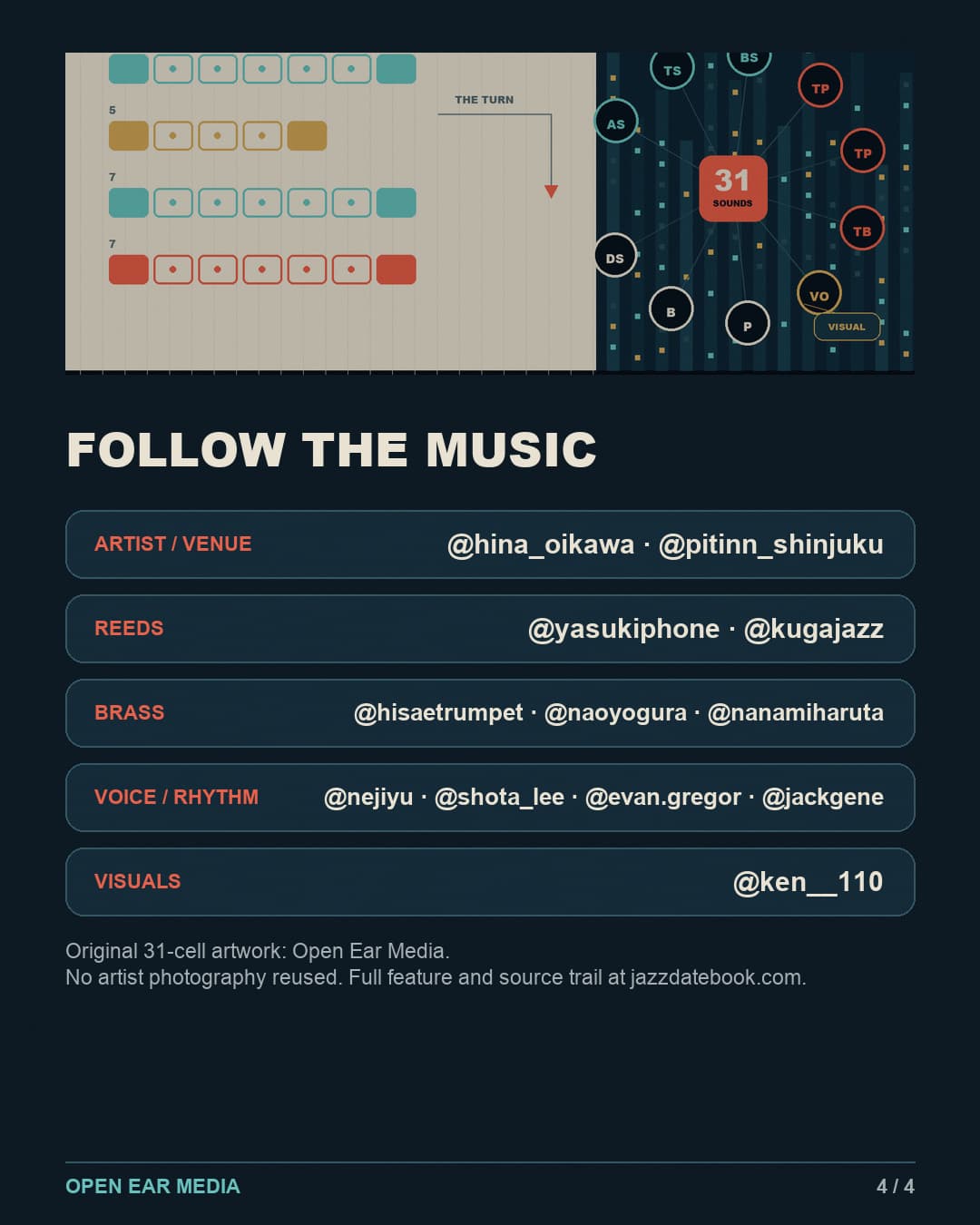
The story in four frames
A concise visual guide for listeners, derived from the researched feature above rather than the other way around.
Research trail
Sources and further listening
Primary artist, presenter, label, and event sources lead this list. Reviews and discographic databases are used for listening context and detailed recording credits. Each source was checked on the date shown in the feature metadata.
- 1Hina Oikawa Short Songs ‘Short Songs’ Release Concert
Shinjuku Pit Inn · official event
Supports: August 19 date, current lineup in English, doors and start time, price, David Berkman withdrawal.
- 2Hina Oikawa Short Songs ‘Short Songs’ release live — member change notice
Shinjuku Pit Inn · official event
Supports: current Japanese lineup, Shota Lee replacement, reservation policy, second-set livestream, no archive notice.
- 3Hina Oikawa Short Songs ‘Short Songs’ Release Concert — August 19, 2026
Pit Inn Net Jazz · official event
Supports: English performer romanizations, stream window, subscriber access, current stream listing.
- 4Shinjuku Pit Inn — official site
Shinjuku Pit Inn · official event
Supports: venue address, telephone, night-program conventions.
- 5Hina Oikawa — About
Hina Oikawa · official artist
Supports: artist biography, Queens base, Queens College award, official social links.
- 6Hina Oikawa Short Songs
Hina Oikawa · official artist
Supports: project concept, tanka and large-ensemble design, visual-art component, 2025 premiere.
- 7Debut album ‘Short Songs’ will be released in August
Hina Oikawa · official artist
Supports: release date, single schedule, album personnel, recording credits, Japan release shows.
- 8New Music, One Step Closer
Hina Oikawa · official artist
Supports: Manhattan alternate take, featured soloists, title-track release.
- 9Hina Oikawa / Short Songs
Free Flying Productions · official label
Supports: album concept, track list and durations, personnel and production, tanka-derived musical structures, recording date and studio.
- 10Hina Oikawa — releases
Ultra-Vybe · official label
Supports: single discography, official artist social links, distribution.
- 11短歌とジャズの融合で新世界 及川陽菜さん
Shukan NY Seikatsu · publication
Supports: artist background, pandemic-era tanka practice, Oikawa and Ogura collaboration, Yuba no Kuni origin, album concept.
- 12Tanka
Academy of American Poets · publication
Supports: thirty-one-syllable definition, 5-7-5-7-7 form, pivotal-image turn, historical context.
- 13Degree Recital: Hina Oikawa, saxophone
Queens College Music · media
Supports: May 2023 recital program, early Short Songs repertoire, ensemble personnel.
- 14Hina Oikawa: Short Songs at Culture Lab LIC
Long Island City Partnership · official event
Supports: February 2025 concert, large-ensemble project description, venue and date.
- 15Hina Oikawa Short Songs at Culture Lab LIC
Hina Oikawa 及川陽菜 · media
Supports: official first-concert highlights, 2025 ensemble credits, visual artist, project description.
- 16Hina Oikawa - 湯葉の国 (Yuba no Kuni)
Hina Oikawa 及川陽菜 · media
Supports: official alternate-take video, poem text, personnel and production credits, visual collaboration.
- 17Short Songs
Hina Oikawa - Topic / Ultra-Vybe · media
Supports: official title-track audio, July 31 release date, Tiny Storage Music credit.
- 18Hina Oikawa - Manhattan
Hina Oikawa 及川陽菜 · media
Supports: official alternate-take video, poem text, featured soloists, visual collaboration.
- 19Hanami Nights 2026
Brooklyn Botanic Garden · official event
Supports: April 2026 Short Songs performance, project description, performance duration.
- 20Yasuki Sogabe
Seiko Summer Jazz Camp · official artist
Supports: tenor saxophone biography, large-ensemble work, official Instagram.
- 21Yu Kuga
No Name Horses · official artist
Supports: reed and arranging biography, Berklee jazz composition studies, large-ensemble work.
- 22Nanami Haruta
Seiko Summer Jazz Camp · official artist
Supports: trombone biography, New York base, recordings, official Instagram.
- 23Evan Gregor — About
Evan Gregor · official artist
Supports: bass biography, large-ensemble credits, official Instagram.
- 24Gene Jackson — Modern Drums
Gene Jackson · official artist
Supports: drumming biography, Herbie Hancock, Wayne Shorter, and Dave Holland history, Japan base.
- 25Focus on Challengers Vol. 3: Naoya Ogura
KOBEjazz.jp · publication
Supports: trumpet and arranging biography, Queens College period, large-ensemble background.
- 26NEJIME YURIE Official Site
Yurie Nejime · official artist
Supports: vocalist identity, official artist site.
- 27作曲家の裏話 no.3: Shota Lee
Sakiko Masuda · publication
Supports: piano and composition biography, Queens College study, large-ensemble leadership.
- 28Hisae Ohtomari (@hisaetrumpet)
Instagram · official social
Supports: official handle, trumpeter identity.
- 29
- 30
- 31
- 32
- 33
- 34
- 35