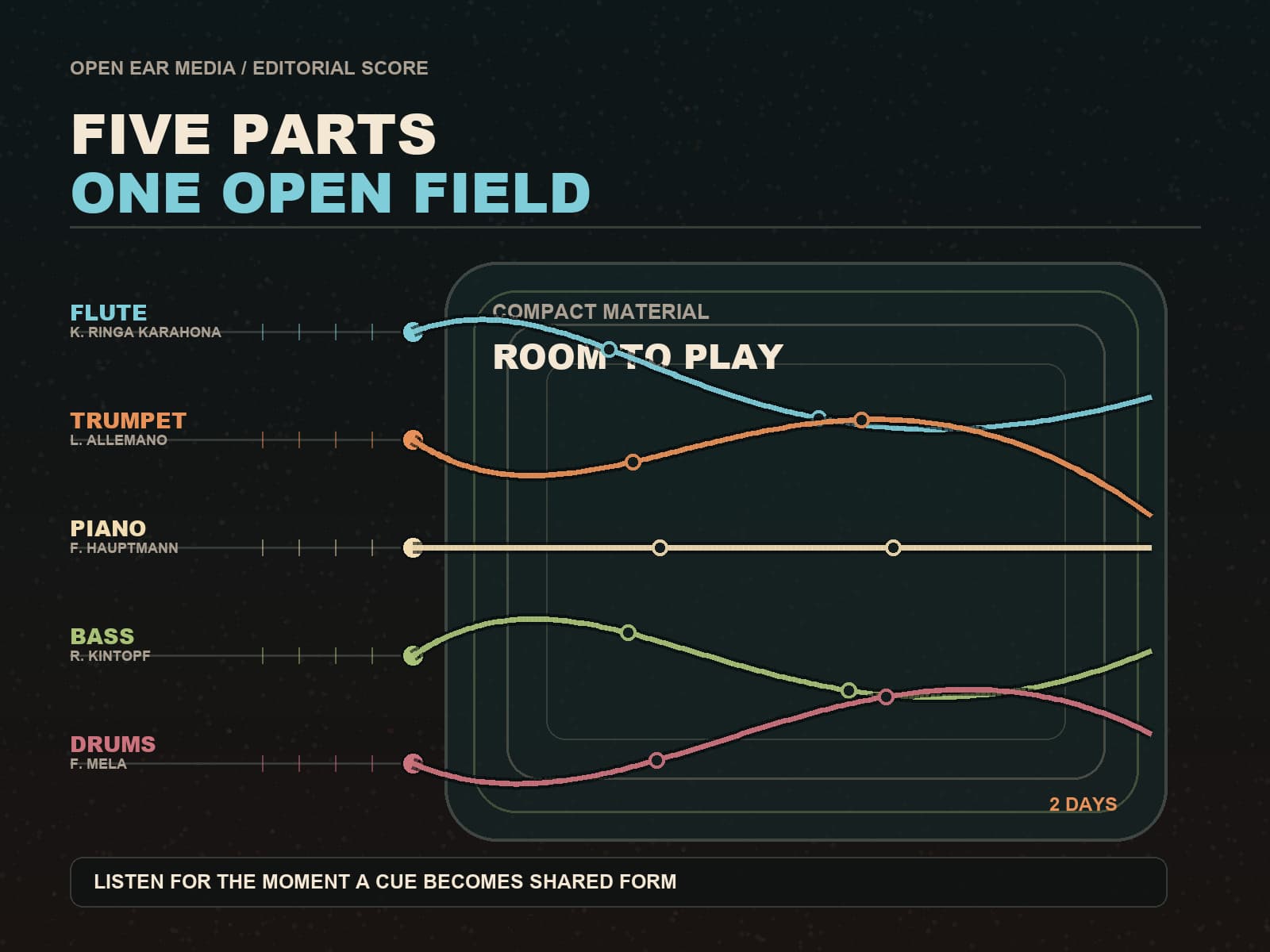
Five parts, one open field
Felix Hauptmann leaves room for five voices to meet
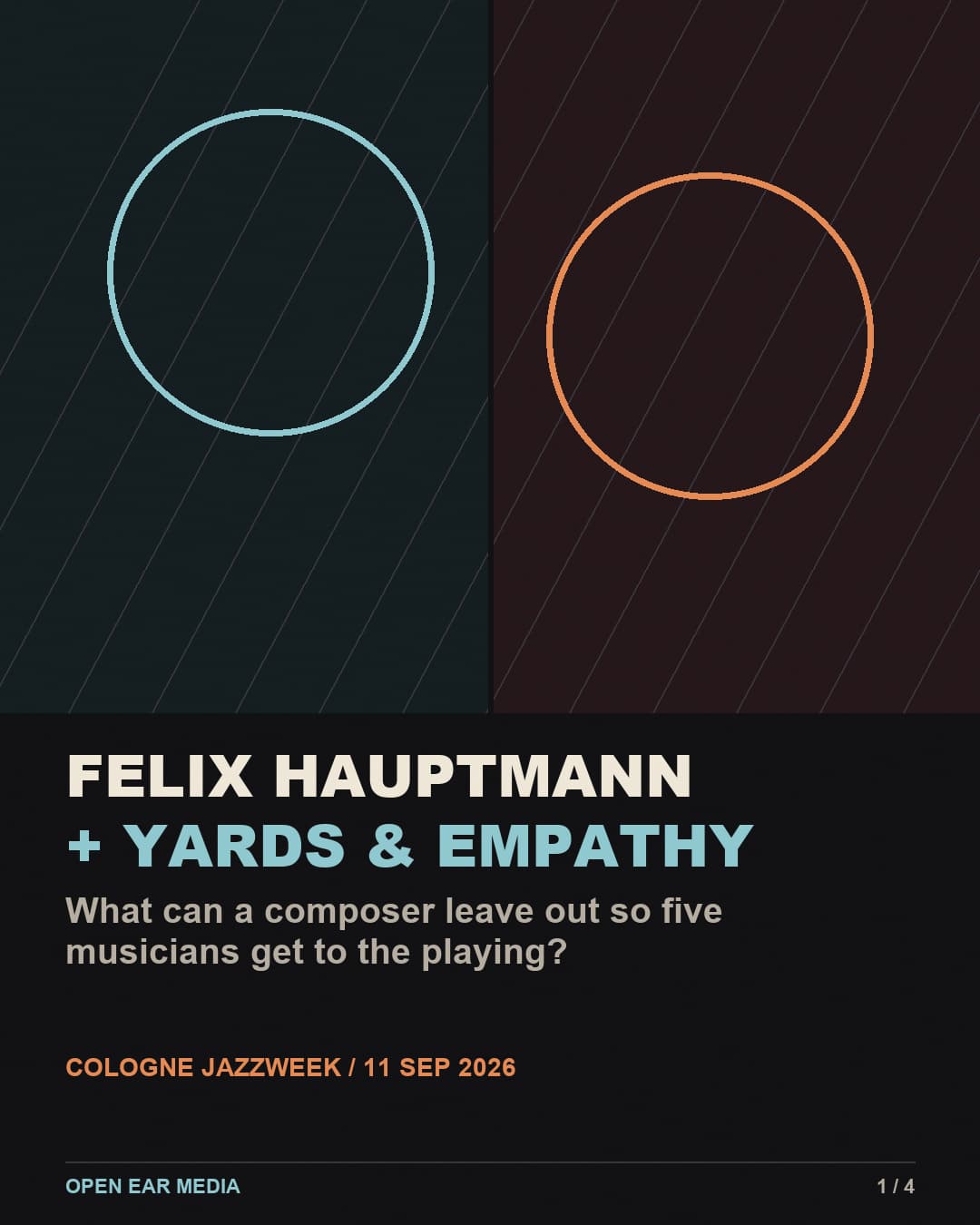
For a new Cologne Jazzweek commission, a composer known for rehearsal-heavy detail is writing compact material so an international quintet can reach improvisation in two days.
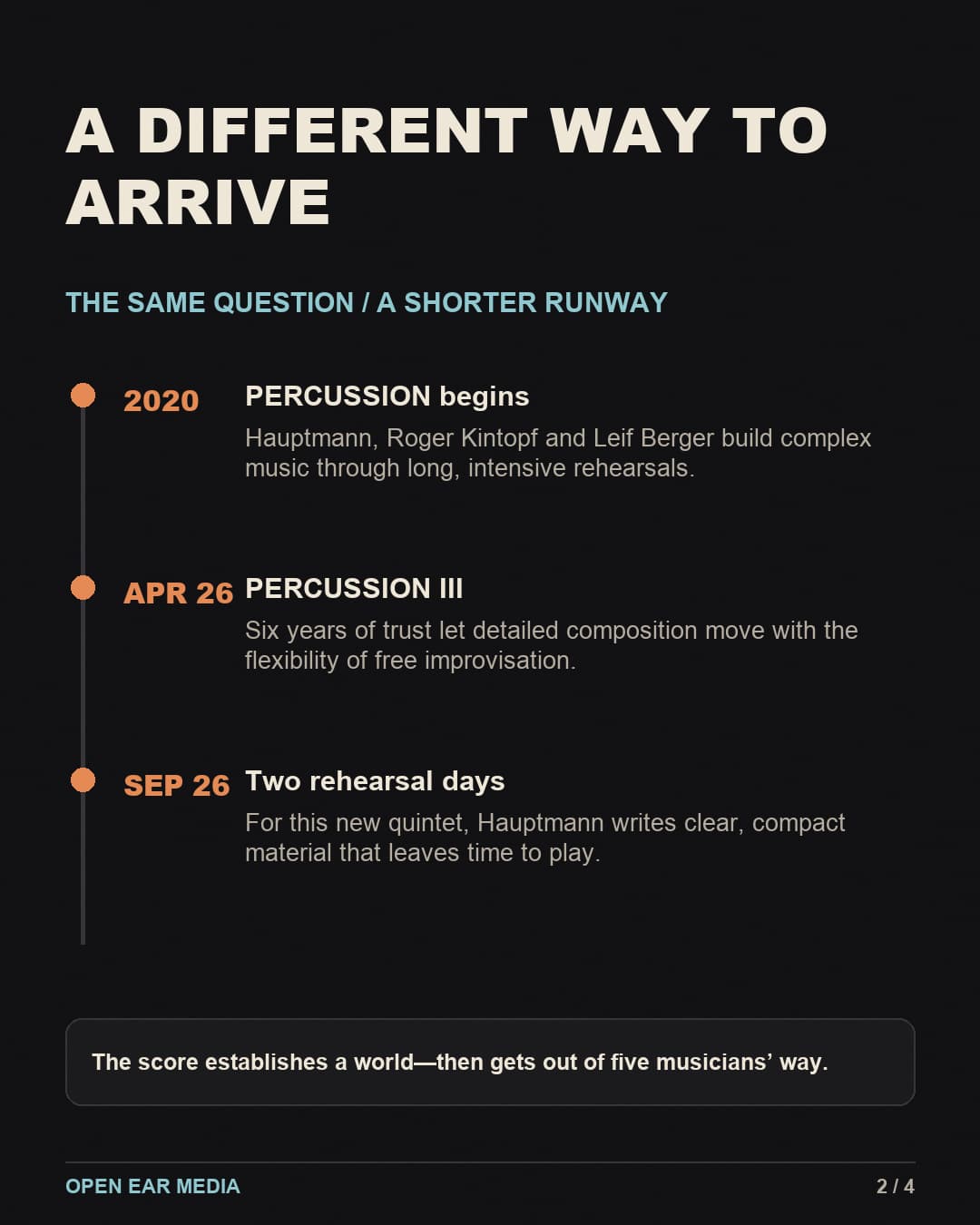
Felix Hauptmann’s world-premiere commission begins with a limit that can be heard before a note exists: this new quintet gets two rehearsal days. In Cologne Jazzweek’s own interview, the pianist-composer contrasts that window with his usual projects, where complex pieces require long rehearsals and careful calibration. For YARDS & EMPATHY, he says the written material has to become clearer and more compact so the musicians can get beyond learning it and into playing, improvising and shaping it together. [3]
That is not a story about lowering ambition. It is a compositional question: how little instruction can still create a distinctive world when the five people were chosen before the music was written? The official program describes precisely defined forms meeting free expression, but Hauptmann’s interview reveals the practical wager beneath that language. The score must establish identity without consuming the short period in which this particular band can discover one another. [2][3]
On September 11 at Stadtgarten, Hauptmann will place his piano between Ketija Ringa Karahona’s flute, Lina Allemano’s trumpet, Roger Kintopf’s double bass and Francisco Mela’s drums. One relationship in that lineup has been tested through years of rehearsal; the others widen the sound toward breath, extended trumpet color and a drummer whose leader records keep song, Afro-Caribbean memory and free improvisation in the same frame. The point is not to predict the premiere. It is to hear why leaving room may be its most consequential written decision. [1][6][9][12][15]
The commission
The personnel came before the notes
Hauptmann describes choosing the instrumentation and the individual players as his first act after accepting the commission. Writing, for him, is attached to people: he imagines a fixed ensemble and a fixed body of sound rather than producing neutral material to be assigned later. Once the lineup was settled, he withdrew for several days during a NICA-supported residency and made the first sketches. YARDS & EMPATHY is therefore site-specific in a human sense—the commission names the occasion, but the musicians define what can be composed for it. [3]
The two-day rehearsal window changed the grammar of those sketches. Hauptmann says his other bands often spend substantial time learning complex content and balancing fine details before appearing in public. Here, too much written information would leave the quintet occupied with execution rather than improvisation. His answer is “clear, compact material”: enough to focus five strong identities, not so much that the page becomes the performance. The constraint does not eliminate composition; it relocates composition into the conditions for collective choice. [3][2]
Even the title resists a fixed program. In the interview, Hauptmann says “yards” suggests something everyday and slightly abstract—small gardens—while “empathy” names a feeling. He likes the resonance created when the words face one another and leave listeners to decide what the pairing means. That invitation mirrors the score’s proposed behavior: defined elements are present, but neither the musicians nor the audience is told there is only one correct emotional reading. [3]
Hauptmann’s compositions unfold a special depth that arises from a delicate juxtaposition of structure and freedom.
The established method
Years of work went into making complexity sound unforced
The useful comparison is PERCUSSION, Hauptmann’s acoustic trio with Kintopf and drummer Leif Berger. Founded in 2020, it became the central laboratory for his balance of rhythmic complexity, tonal color, structure and freedom. NICA’s artist profile calls attention to the trio’s shared aesthetic sensibility; Hauptmann’s own account emphasizes an initial half-year of intensive rehearsal before its first Cologne concert. This is music designed for trust accumulated over time, not a set of charts assembled at soundcheck. [4][5]
In a detailed King Georg interview, Hauptmann explains why the trio can be mistaken for a freely improvising group even though most of its performance material is composed. The players learned the pieces from memory, and the quantity and difficulty of that material made PERCUSSION the band he had rehearsed most. Removing the stands did not remove form; it let form become embodied enough to flex. His maxim in that conversation—harmony is bounded by twelve tones, while rhythm feels unlimited—helps explain why pulse became such a deep field of inquiry. [8]
PERCUSSION III, released by Unit Records in April 2026, documents the mature version of that process. Hauptmann describes detailed composition and free improvisation producing a continuous tension between limitation and freedom, insecurity and playfulness. The trio recorded it in November 2024 after more than six years of working together. YARDS & EMPATHY keeps that artistic problem but removes the long runway: the new score has to make space quickly, and only Kintopf arrives carrying the PERCUSSION vocabulary from inside. [6][7][3]
The lineup
One player carries the memory; four alter the frame
The official pages do not sell this quintet as a reunion, nor do they make an exhaustive claim that its members have never crossed paths. They document something more concrete: Hauptmann assembled this exact flute-trumpet-piano-bass-drums formation for the commissioned premiere because of the players’ sensitivity to texture and rhythm. That distinction matters. Novelty is not evidence by itself; the musical proposition lies in how an established compositional concern changes when it is voiced by this instrumentation and these people. [1][2][3]
Kintopf is the continuity point. He has shared PERCUSSION’s rehearsal-intensive work with Hauptmann for six years, on acoustic and electric releases, and he is also a composer-bandleader whose STRUCTUCTURE project treats instrumental roles as movable rather than fixed. Its own description asks why bass should remain in the low register when it can squeal or chirp, and presents open rhythm as a trigger for dialogue. In Cologne, that history makes Kintopf more than harmonic support: he knows how Hauptmann’s written puzzles are meant to breathe. [6][14]
But memory can only be one part of this band. Flute and trumpet replace the conventional piano-trio front line with two columns of air; Mela replaces Berger’s accumulated PERCUSSION language with a different rhythmic intelligence. The score’s compactness should let those differences register rather than forcing every player through years of trio-specific habits in forty-eight hours. Listen for who states an idea, who colors it, who refuses it and whether the piano acts as a third melody voice, a field of resonance or a source of interruption. [2][3][6]
Flute and trumpet
Two wind voices bring different ideas of openness
Latvian flutist Ketija Ringa Karahona moved from classical training toward jazz and improvisation at the Conservatorium van Amsterdam and The New School in New York. A 2026 Jazz in Duketown profile describes her phrasing as lyrical and exploratory, with melodies allowed to breathe and interaction given room; it also places her in projects led by Kika Sprangers, Petter Eldh and Kit Downes. Her own teaching profile makes the method practical: improvisation develops through listening, experimenting, transcription, rhythmic flexibility and immediate application rather than abstract theory alone. [9][10]
Canadian trumpeter Lina Allemano arrives from another sustained study of composition inside improvisation. Splitting her working life between Berlin and Toronto, she specializes in extended trumpet technique and leads projects ranging from acoustic quartet to solo trumpet, electronics and chamber groups. Her 2023 album Canons is especially relevant preparation: five written pieces use two-, three- or four-part canonic procedures while incorporating improvised sections, turning a strict imitative device into a framework that performers can bend from within. [12][13]
Together, flute and trumpet can make Hauptmann’s “texture” idea audible without behaving like a standard two-horn front line. Karahona’s breath, articulation and upper-register translucence can merge with Allemano’s air sounds and extended colors, or the two can separate into cleanly opposed contours. Those are possibilities, not promised effects. The more reliable listening question is whether Hauptmann writes them as blended material, independent voices or changing functions—and how much of that identity is decided in the room. [2][10][12]
Bass and drums
Francisco Mela makes “freedom” a rhythmic question
Mela’s résumé supplies famous names, but its useful thread here is how many kinds of time he has had to hold. Berklee traces his move from Cuba to Boston in 2000, his development as house drummer at Wally’s Cafe and his long work with Joe Lovano; McCoy Tyner later brought him into his trio. The same biography identifies leader bands that connect modern jazz to the traditional Cuban music Mela grew up with. That is not a shorthand for one predictable groove. It is evidence of a drummer accustomed to negotiating form, song and open interaction. [15]
His MPT Trio debut provides a more direct listening route. With Hery Paz on tenor saxophone and Juanma Trujillo on guitar, Mela works without a bassist across pieces that retain refrains and recognizable song forms, then move toward textural disassembly, hard crescendos and free-jazz friction. The record grew through two and a half years of rehearsal and periodic performance. Hearing it before Cologne clarifies both his range and the change at Stadtgarten: Kintopf gives Mela a low-string partner, while Hauptmann’s commission offers only two days to establish their shared center of gravity. [16][3][2]
The crucial rhythm-section exchange may therefore be less about keeping time than deciding what time feels available. Kintopf already understands Hauptmann’s fluid meters and encoded detail; Mela enters with a forceful sound, Afro-Caribbean foundations and extensive freely improvised work. If the written material really is compact, every attack, sustain and silence between them gains structural weight. Listen for whether they converge on pulse, maintain parallel time streams or make the horns and piano responsible for locating the beat. [6][15][16]
The official preview
Watch the blueprint rather than an imaginary set list
Cologne Jazzweek’s seven-minute CLOSE-UP is the most valuable advance document because it captures the composer explaining work that has not premiered yet. Interviewer Philomena Juen asks about the title, commission process, intended audience experience and the music’s imagined texture; Sebastian Lautenbach filmed the conversation at Stadtgarten. There is no performance to decode and no repertoire to infer. Instead, the video gives listeners the decision-making architecture that any eventual music must test. [3]
Start around 1:34, where Hauptmann says the lineup came first and composition is bound to specific people and sound. At roughly 2:39, he explains the two rehearsal days and why his usual complexity would keep the band from playing; around 4:27, he says he wants the music to leave listeners room rather than dictate sadness or happiness. These moments turn the festival description’s “structure and freedom” from an attractive phrase into a practical method with real limits. [3][2]
At 5:58, asked what texture the music would be, Hauptmann answers: forest floor. He arrives there intuitively, then describes a surface that is pleasant to walk on, smells good, contains many textures and holds decay and new growth at once. It is a better listening prompt than a guessed genre label. Notice whether the premiere accumulates small layers, whether quiet details support eruptions, and whether old material appears to decompose into conditions for something new. [3][1]
CLOSE-UP: Felix Hauptmann ⎪ CJW 2026 🔵
The composer explains why this commission starts with its people, how two rehearsal days changed his writing, and why he wants the music to leave both players and listeners room.
Watch on YouTube · Cologne JazzweekThe place
The commission returns the experiment to its home base
Stadtgarten is not a neutral rental room in this story. The Initiative Kölner Jazz Haus took a long-term lease on the site in 1985 and opened the concert hall in September 1986; the complex now presents as many as 400 concerts a year. Since 2018 it has developed as a European Center for Jazz and Contemporary Music, and NICA’s artist-development program is based there. Hauptmann has been a NICA artist since 2024, so the premiere joins artist support, commission, festival and physical room inside one institution’s ecosystem. [17][4][7]
Cologne Jazzweek’s venue guide describes the hall’s founding purpose as an independently managed, content-led program for contemporary improvised music with guaranteed minimum fees for musicians. Whatever the institution has become over four decades, that origin makes YARDS & EMPATHY unusually legible here: a new work is not being dropped into a prestige hall after completion. It was developed through NICA, discussed on camera at Stadtgarten and will be tested in the room around which that support structure is organized. [18][3][2]
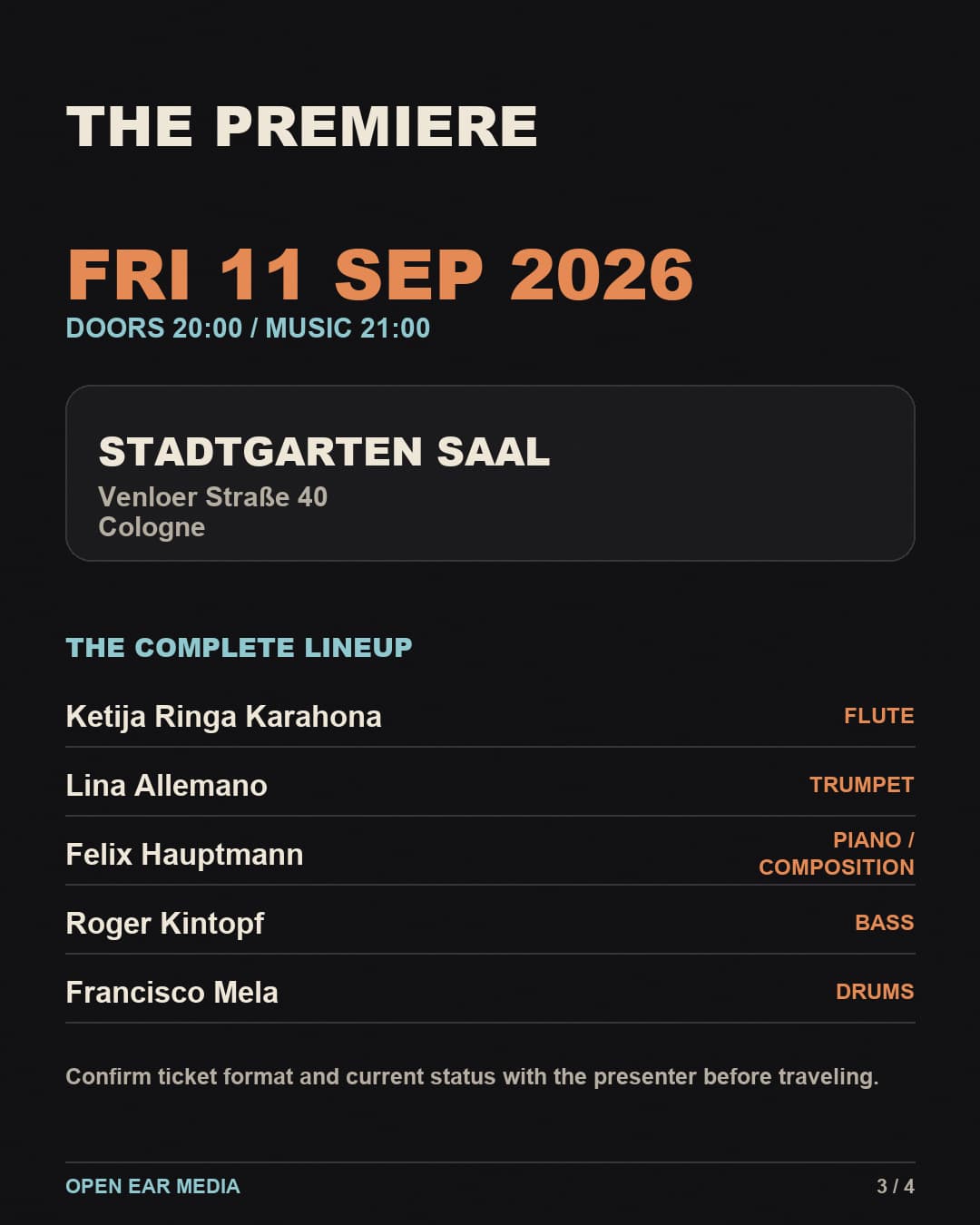
The current event page lists Friday, September 11, in the Konzertsaal, with doors at 8 p.m. and music at 9 p.m. The complete billing is Karahona on flute, Allemano on trumpet, Hauptmann on piano and composition, Kintopf on bass and Mela on drums. Stadtgarten lists €29 advance admission and €22 reduced; its checkout link presently routes to the festival-ticket offer rather than a dedicated single-event checkout, so buyers should confirm the available format directly instead of assuming a standalone ticket remains available. [1][2]
The hall is at Venloer Straße 40. The festival guide directs wheelchair users to the entrance at the corner of Spichernstraße and Venloer Straße, with a ramp to the grounds, a gravel-free path to the concert hall, an accessible toilet and two wheelchair spaces for seated programs. Neither official event page currently promises a stream or archive. Those practical facts may change more quickly than the musical context, so the presenter’s page remains the final check before travel. [18][1]
Before and after
Hear the methods; leave the premiere unknown
Begin with PERCUSSION III, not because YARDS & EMPATHY is expected to repeat it, but because it supplies the control case. Hear how Hauptmann, Kintopf and Berger move detailed material without making every transition announce itself as composition, and how titles such as “floristic realms” and “dark soils” frame an album concerned with warmth, limitation and play. Then carry only the method forward: in the commission, Kintopf knows that language while three different instrumental voices and a different drummer change its balance. [6][7]
Next, branch outward rather than searching for a nonexistent YARDS recording. Karahona’s artist channel and recent quartet work foreground flute-led, chordless interaction. Allemano’s Canons demonstrates how written procedures can coexist with improvised sections. Mela’s MPT Trio Volume 1 moves between Caribbean-rooted form and rougher textural freedom. Kintopf’s STRUCTUCTURE shows a bassist comfortable redistributing ensemble roles. None reveals the September music; together they sharpen the ear for what each musician might recognize as usable space. [9][13][16][14]
At the premiere, the most revealing moments may be transitions: the instant a compact cue stops governing, the instant a player’s choice becomes shared form, or the instant five interpretations of “open” fail to agree and produce useful friction. Afterward, the durable question will not be whether the band fulfilled a promised mood. It will be whether Hauptmann’s reduced instructions let these particular musicians create detail that two rehearsal days could never have specified in advance. Until downbeat, that remains honestly unresolved. [3][2]
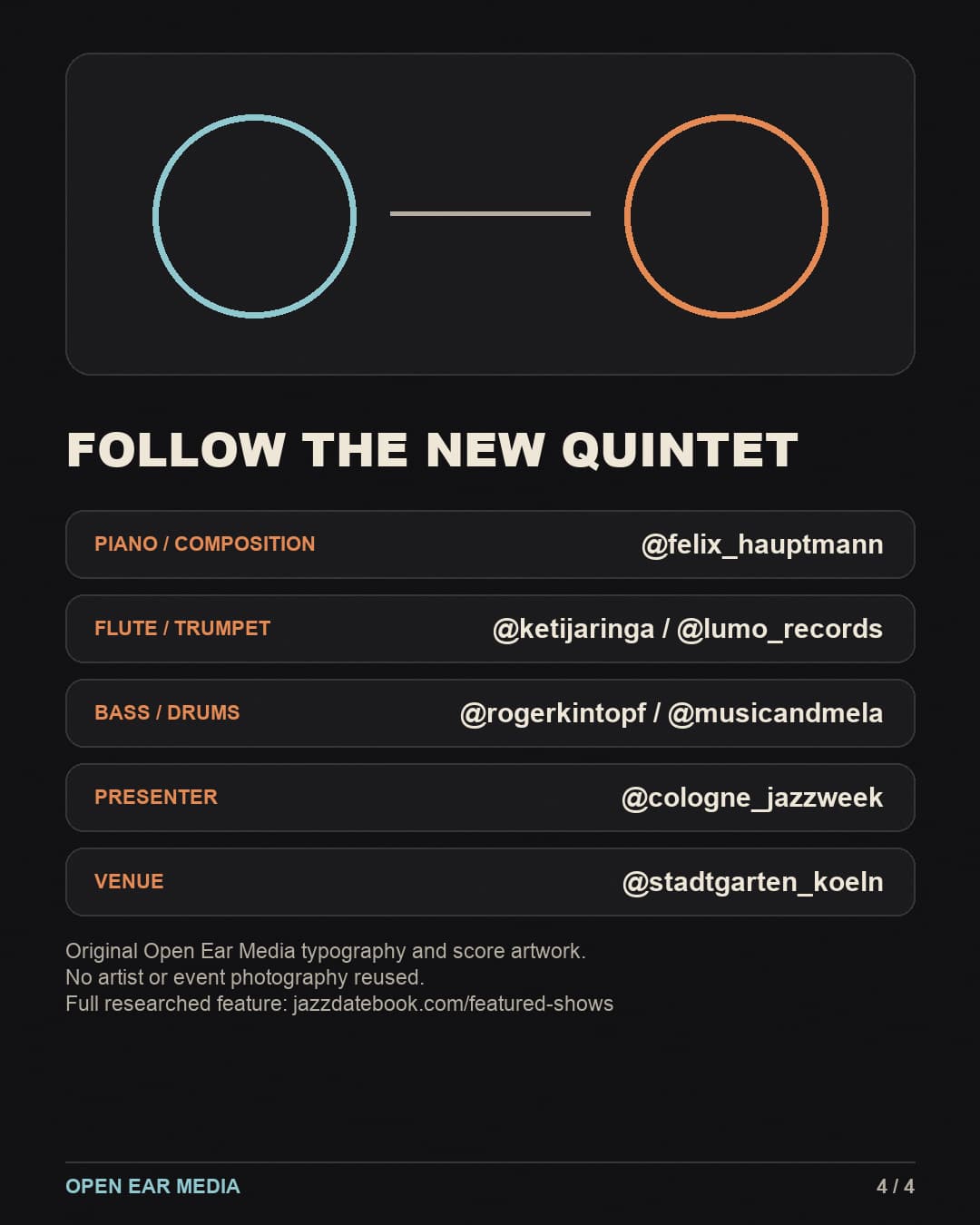
The social edition
The story in four frames
A concise visual guide for listeners, derived from the researched feature above rather than the other way around.
Research trail
Sources and further listening
Primary artist, presenter, label, and event sources lead this list. Reviews and discographic databases are used for listening context and detailed recording credits. Each source was checked on the date shown in the feature metadata.
- 1NICA x CJW: Felix Hauptmann — YARDS & EMPATHY
Stadtgarten Köln · official event
Supports: scheduled September 11, 2026 performance, 9 p.m. start and 8 p.m. doors, Konzertsaal room, complete lineup and roles, world-premiere commission description, advance prices, Felix Hauptmann and venue social links.
- 2NICA x CJW: Felix Hauptmann — YARDS & EMPATHY
Cologne Jazzweek · official event
Supports: world-premiere status, Cologne Jazzweek and NICA commission, complete lineup, formation selected for the program, structure-and-freedom program thesis, Stadtgarten Saal location, Cologne Jazzweek social link.
- 3CLOSE-UP: Felix Hauptmann ⎪ CJW 2026 🔵
Cologne Jazzweek · media
Supports: title interpretation, personnel-first writing process, NICA-supported writing residency, two rehearsal days, clear and compact material, desired audience openness, forest-floor texture analogy, video credits, upload date and duration.
- 4Felix Hauptmann
NICA artist development · official artist
Supports: NICA participation since 2024, PERCUSSION history and lineup, structure, freedom, tone color and rhythmic complexity, education and Cologne scene activity, official website, Instagram, YouTube and Bandcamp links.
- 5PERCUSSION
Felix Hauptmann · official artist
Supports: 2020 trio founding, Felix Hauptmann, Roger Kintopf and Leif Berger lineup, half-year initial rehearsal period, rhythmic and aesthetic focus, Cologne first concert.
- 6PERCUSSION III
Felix Hauptmann / Unit Records · official label
Supports: April 17, 2026 release, November 2024 recording at LOFT Köln, complete trio personnel, six-year working relationship, detailed composition and free-improvisation method, track list and official listening path.
- 7Felix Hauptmann and PERCUSSION III
Unit Records · official label
Supports: PERCUSSION as central artistic project, album history and April 2026 release, NICA and Cologne background, limitation, freedom, insecurity and playfulness artist statement.
- 8‘Rhythm is unlimited’
King Georg · publication
Supports: Hauptmann interview, PERCUSSION composition-versus-improvisation balance, memorized material and rehearsal process, rhythm as an artistic research field.
- 9Ketija Ringa Karahona
Jazz in Duketown Conservatorium Talent Award · publication
Supports: Latvian flutist identity, Conservatorium van Amsterdam background, lyrical, exploratory and interactive approach, project associations, chordless quartet, official YouTube link.
- 10Ketija Ringa Karahona — flute, jazz and improvisation
Vivaldi Music Lessons · official artist
Supports: first-person artistic and teaching profile, classical roots, Amsterdam and New York studies, improvisation through listening and experimentation, rhythmic flexibility and contemporary flute techniques.
- 11Ketija Ringa Karahona (@ketijaringa)
Instagram · official social
Supports: current artist name and Instagram handle.
- 12Lina Allemano — bio
Lina Allemano / Lumo Records · official artist
Supports: Canadian trumpeter, composer and improviser identity, Berlin and Toronto base, extended trumpet technique, leader projects and discography, official Lumo Records Instagram and Bandcamp links.
- 13Canons
Lina Allemano / Lumo Records · official label
Supports: December 2023 release, artist statement, two-, three- and four-part canon structures, composed and improvised sections, complete personnel and official listening path.
- 14STRUCTUCTURE
Roger Kintopf · official artist
Supports: Roger Kintopf bassist-composer identity, open rhythm and redistributed instrumental roles, ensemble trust and interaction, official website, Instagram and Bandcamp links.
- 15Francisco Mela
Berklee College of Music · official artist
Supports: Cuban background and 2000 Boston move, Wally’s Cafe development, Joe Lovano and McCoy Tyner ensemble history, leader projects and recordings, modern jazz and Cuban musical foundations, official Instagram link.
- 16MPT Trio Volume 1
Francisco Mela / 577 Records · official label
Supports: January 2021 release, Mela, Hery Paz and Juanma Trujillo personnel, two-and-a-half-year development process, Caribbean, song-form, contemporary and free-jazz approaches, official listening path.
- 17Stadtgarten history
Stadtgarten Köln · official event
Supports: Initiative Kölner Jazz Haus lease, September 1986 hall opening, up to 400 annual concerts, European Center for Jazz and Contemporary Music development, venue address.
- 18Stadtgarten Saal
Cologne Jazzweek · official event
Supports: venue address, contemporary improvised-music mission, independent programming history, wheelchair entrance, path, toilet and seating information.