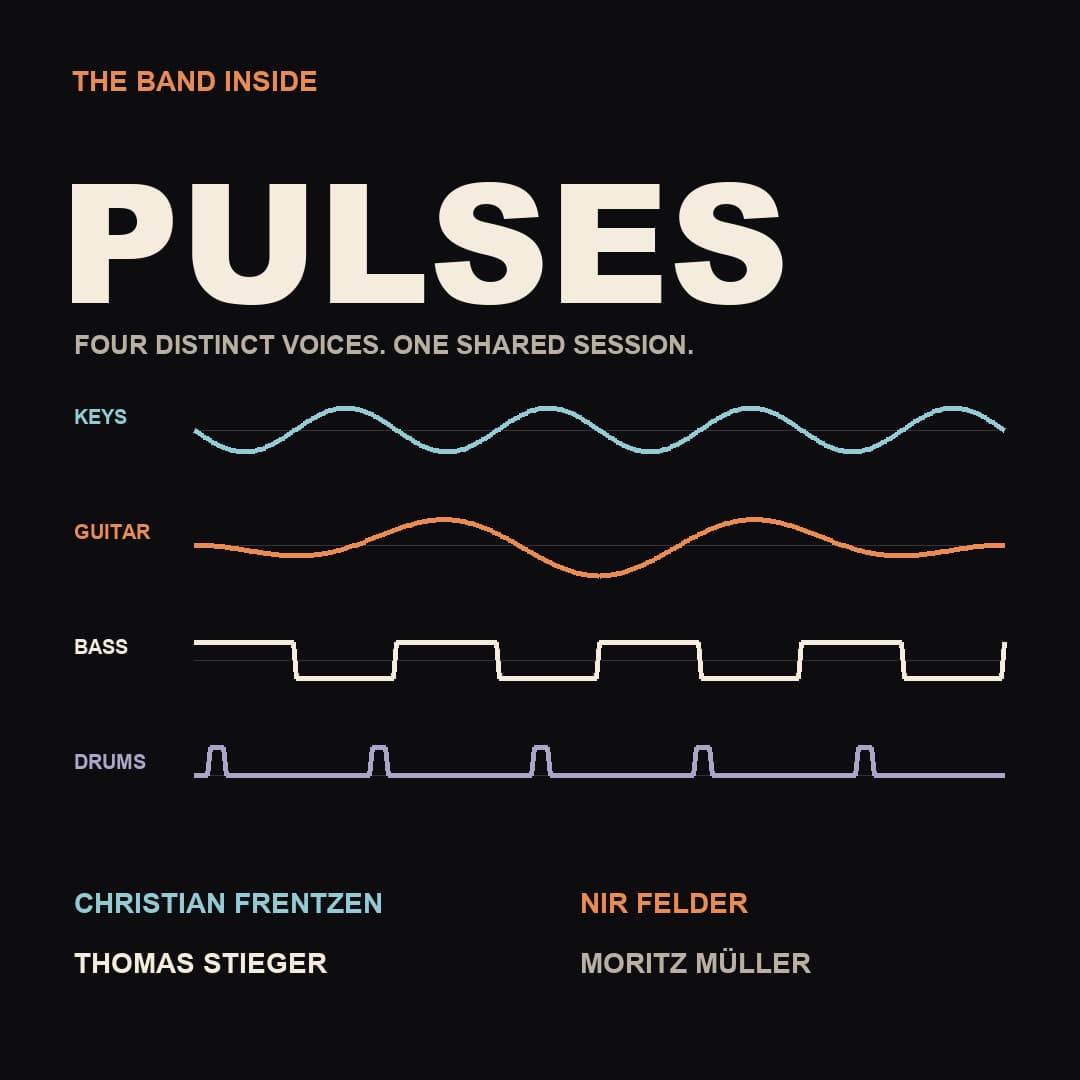
The four-player core of Pulses
Christian Frentzen and Nir Felder: the band inside Pulses
A recording partnership becomes a touring quartet: Frentzen, Felder, Thomas Stieger and Moritz Müller bring the core of a many-colored album to Berlin.
The revealing detail in Christian Frentzen’s Berlin booking is not simply the presence of Nir Felder. It is the continuity of the whole band. The pianist and keyboardist brings Felder, bassist Thomas Stieger and drummer Moritz Müller to A-Trane on October 11: the same four musicians Frentzen says gathered in Cologne to record the core of Pulses. A guest credit has become a shared working situation. That makes the concert a chance to follow a relationship beyond the album sleeve, rather than just catch a visiting guitarist’s solo. [1][2]
There is a second, productive wrinkle. Pulses credits eight players, including percussion and three wind players; A-Trane advertises four. The question is not whether the quartet will reproduce every layer of the record. It is what the songs can reveal when their authorship, textures and pulse are carried by this smaller group. Frentzen’s compositions are the common material; the live balance among keyboards, guitar, bass and drums is the part still to be discovered. [5][1]
Composition and production
Two musicians who think beyond their instruments
Frentzen’s biography places recording engineering alongside piano and keyboards. He records, mixes and produces, and has developed sample libraries; Pulses specifically credits him with its compositions, mix and production. That combination matters to the concert’s premise. A keyboard part can be a harmonic statement, but choosing its sound is also an arranging decision. The artist who made those studio decisions will be on the bandstand, able to approach the songs from inside both their writing and their recorded construction. [3][5]
Felder brings his own documented interest in a broad studio palette. On II, released in 2020, his credits extend far beyond guitar to mandolin, banjo, electric sitar, key bass, Fender Rhodes, theremin, synthesizers and MPC. Matt Penman plays acoustic bass and Jimmy Macbride drums, with additional contributions credited to Jeff Babko and Doug Yowell. Felder also wrote and produced the album. His work on II makes an illuminating companion to this collaboration: both musicians approach a recording as a world they can construct, not simply a document of their principal instrument. [8]
Put those two working practices together and a useful listening question emerges: when does a sound function as decoration, and when does it help define the composition? Frentzen’s Pulses page explicitly centers the writing while placing the music between jazz, pop and electronica. Felder’s own record offers a parallel route through multiple timbres. The common ground is not a promise of maximum electronic density. It is the possibility that an identifiable song can survive, and gain meaning from, a change in its instrumental surface. [6][8]
The complete quartet
Stieger and Müller are part of the story, not the scaffolding
Thomas Stieger’s background makes the bass chair especially pertinent. His official biography describes work across pop, rock, soul and jazz, and identifies him as a producer and composer as well as a bassist. His own 2024 album Choices includes guests such as Randy Brecker, Will Lee, Tim Lefebvre and Wolfgang Haffner. In a group whose leader declines a single stylistic lane, that experience offers a practical point of connection: the bass part has to give each song its particular weight, rather than impose one definition of jazz time on everything. [9][4]
A-Trane introduces Moritz Müller through credits including the Heavytones, The Intersphere and Gianna Nannini. That is a different route into this music from a conventional jazz-only résumé. More directly relevant than the associations is his place on the Pulses record and in the River Studios quartet film. He is not merely the drummer hired for the Berlin date; the documented studio band already includes him. Listen for the relationship between his accents and Stieger’s bass phrasing, not just the point at which either player takes the foreground. [1][5][7]
The Berlin lineup puts piano and keys, guitar, bass and drums in the foreground, with no singer, percussionist or horn player billed. That gives the four-way exchange its particular appeal. A change in the rhythm section can clarify a transition just as decisively as a new keyboard color or a guitar entrance. Listen across those roles: the most consequential contribution need not be the loudest or most obviously soloistic one. [1][5]
Watch and listen
Start with eight minutes, not a trailer
The most useful advance introduction is Frentzen’s official “In My Humble Opinion” video, embedded here. Published on his channel on July 5, 2026, the eight-minute, 26-second film credits the exact A-Trane quartet and identifies the setting as River Studios, Cologne. Frentzen is credited with keyboards and composition, Felder with guitar, Stieger with bass and Müller with drums. The song also opens the published Pulses tracklist. Unlike a clip of a related ensemble, this gives the listener a direct point of contact with the band being advertised. [7][5][1]
For a first pass, follow the composition rather than keeping a score of solos. Pick a phrase you can recognize, then ask what makes it remain recognizable when your attention shifts to another instrument: its contour, its rhythm, a bass movement, a particular keyboard sound? The album credits all the music to Frentzen. Keep that authorship in mind, but let your ear roam among the four contributions. How much of a phrase’s character lies in its notes, and how much in the way the ensemble frames it? [7][5]
On a second pass, change the center of attention. Stay with Stieger and Müller while the keyboards or guitar draw the eye, then reverse the exercise. Notice who makes a change feel settled and who keeps it open. With this instrumentation, a listener can follow harmony through both guitar and keys, and pulse through more than the drums alone. Returning to the same passage with a different player in focus is a simple way to hear past the headline pairing. It also gives the bass and drums their due as part of the composition’s character. [7][1]
The film credits recording to Nick Benoy, lighting design to Konrad Simon, and cameras to Michael Hohnstock and Sascha Thiele. Its setting is the studio, not A-Trane. Take it as an introduction to the players and a composition, then leave room for the concert to differ. The value of seeing the same band in another setting is precisely that familiar material can take on a different balance. [7]
Christian Frentzen feat. Nir Felder / In My Humble Opinion Live
The complete 8:26 River Studios performance by the exact advertised Berlin quartet: Christian Frentzen, Nir Felder, Thomas Stieger and Moritz Müller. A studio-session introduction to the opening Pulses composition, not footage from A-Trane.
Watch on YouTube · Christian FrentzenThe listening map
Eight names on the record, four on the bill
The album’s published sequence moves from “In My Humble Opinion” through “Last November,” “Cuban House Jam,” “Way Up High,” “Distant Future” and “Only Time Will Tell,” then closes with “Pulses” and “Moog Sequence.” All eight compositions are credited to Frentzen. Beginning with the opening piece makes the full quartet film an easy doorway into that sequence. Afterward, the album offers a longer view of Frentzen’s writing than a single performance can. [5][1]
Beyond the quartet, the album credits Roland Peil on percussion, Marc Doffey on tenor saxophone and flute, Chris Mehler on trumpet and flugelhorn, and Michael Theissing-Tegeler on trombone. These are album-wide credits, not the A-Trane lineup. The range of instruments suggests a useful comparison between record and stage: listen for what draws your attention in the larger palette, then what becomes prominent when the quartet carries the music. A smaller ensemble can expose relationships that an additional layer directs the ear away from. [5][1]
There is a useful boundary elsewhere in the tour, too. Frentzen’s schedule bills the October 16 Düsseldorf date with Hanno Busch and Marc Doffey, while Berlin is billed with Felder. The tour opens more than one window onto the writing. Berlin’s particular attraction is the continuity with the four-player studio group, a chance to follow this combination rather than treat the album title as the whole identity of the concert. [10][1][7]
The room and the date
An early Sunday at A-Trane
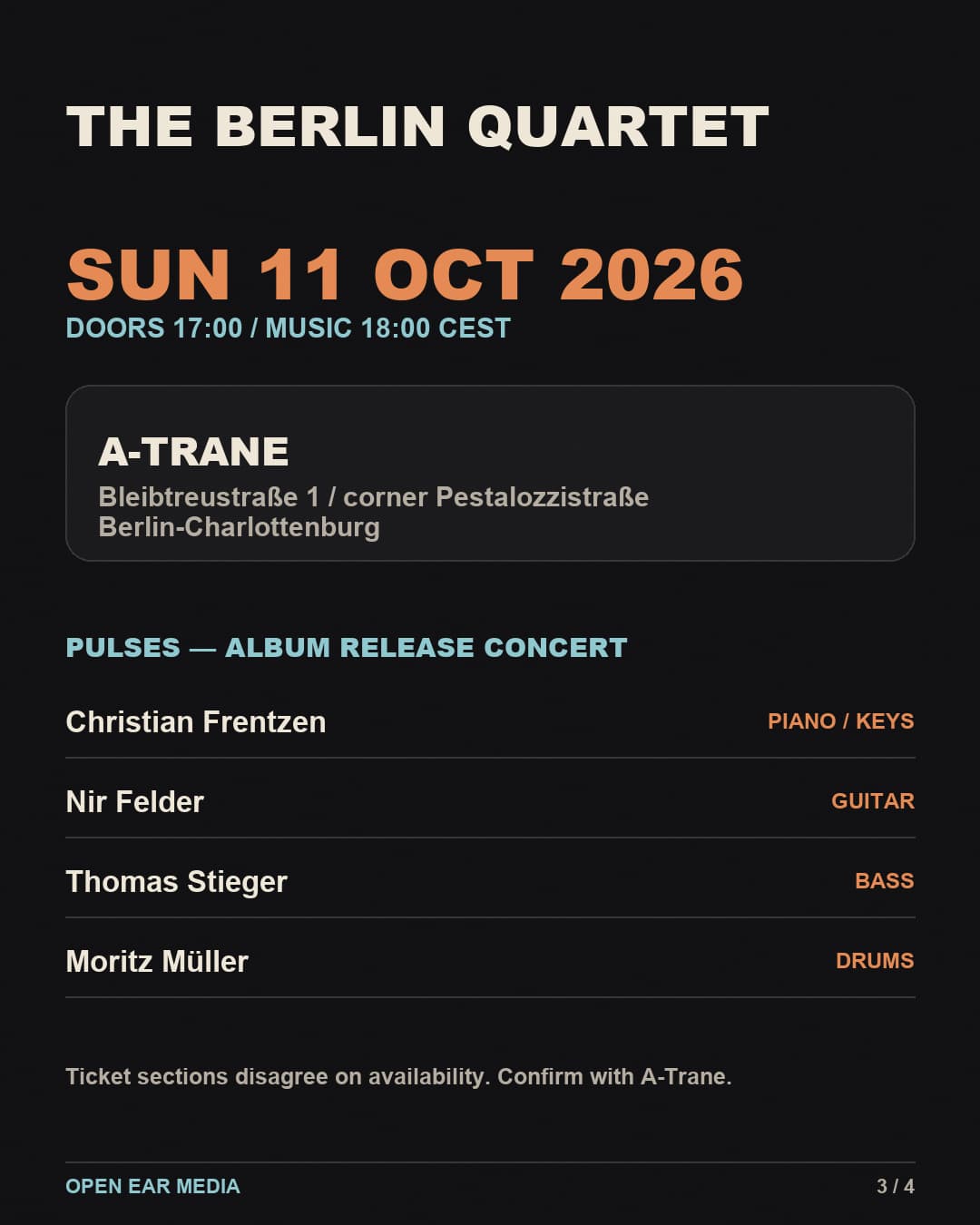
A-Trane is the presenter and the physical club, at Bleibtreustraße 1 on the corner of Pestalozzistraße in Berlin-Charlottenburg. The club identifies its history as beginning in 1992. For this Sunday, October 11, booking, its event page prominently flags special hours: admission at 17:00 and music at 18:00, local Berlin time. The early start is worth remembering. No set list is announced, so treat the album and video as preparation rather than a program. [1]
The ticket page needs a careful reading. Its pay-at-the-door reservation section displays a sold-out message, while a separate purchase section still lists €30 adult and €25 student tickets, with student identification required. That is not a basis for promising a seat, or for declaring every sales route closed. Check directly with A-Trane before making plans. The club’s contact page says telephone calls are for information, not reservations; the official event link is the starting point for current purchase details. [1][12]
Before the date
Follow the partnership, then let the concert differ
A compact preparation route is enough: begin with the full River Studios video; use Second Encounter for the earlier Frentzen–Felder connection; then explore Pulses with its expanded personnel in mind. For a lateral step, Felder’s II puts his own compositional and production choices alongside the work he contributes to Frentzen’s music. Stieger’s Choices is another route outward: a reminder that the bassist also approaches a band from the composer’s side. [7][4][5][8][9]
The reason to bring that background to A-Trane is to hear the quartet more clearly, not to arrive with a checklist of sounds it must reproduce. Frentzen has already documented his interest in songs that cross stylistic borders and in a band that can work on them together. The October booking keeps all four of those studio collaborators in view. Listen for how they make the material belong to the moment: the band inside Pulses, rather than an illustration of its sleeve. [2][1]
The social edition
The story in four frames
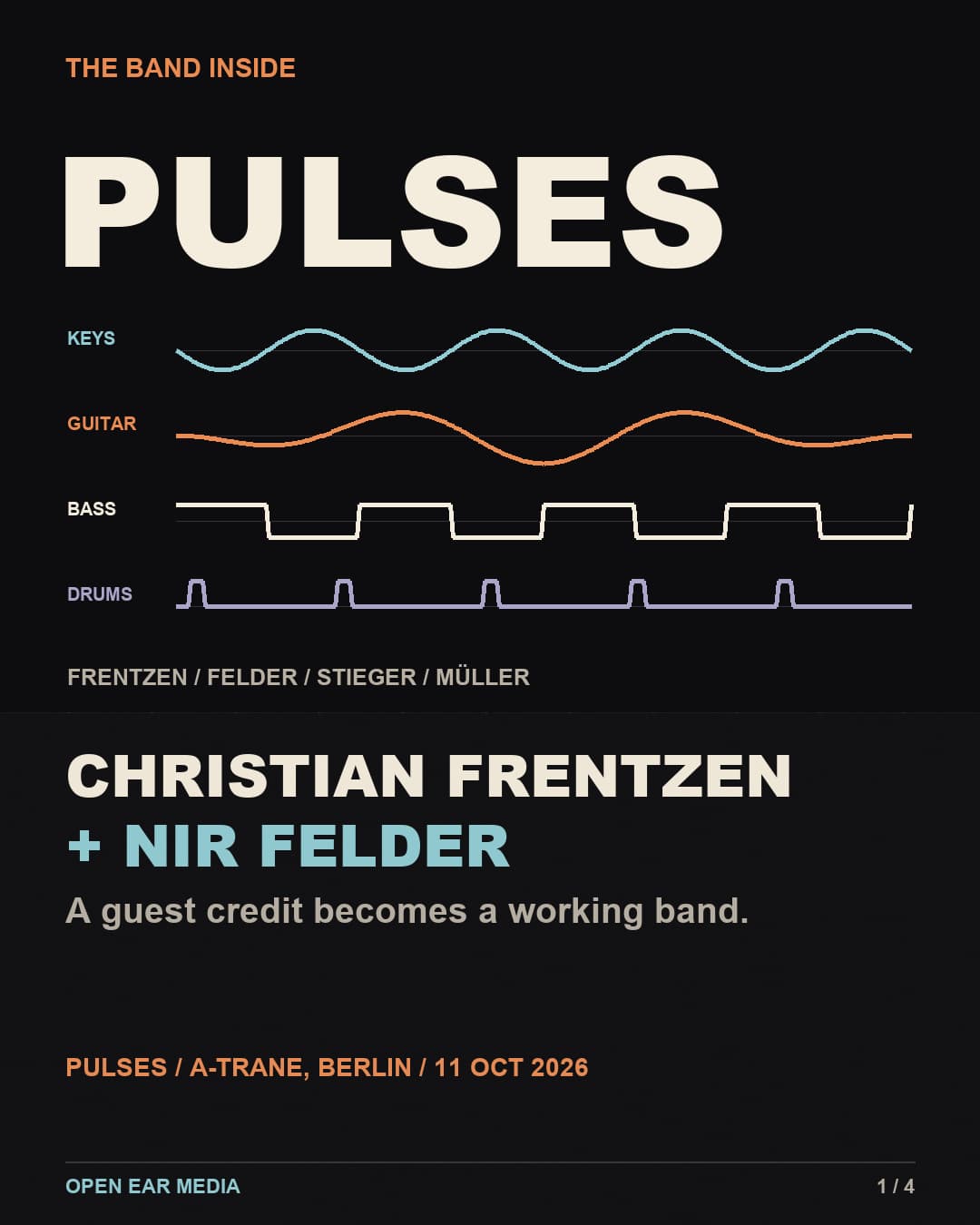
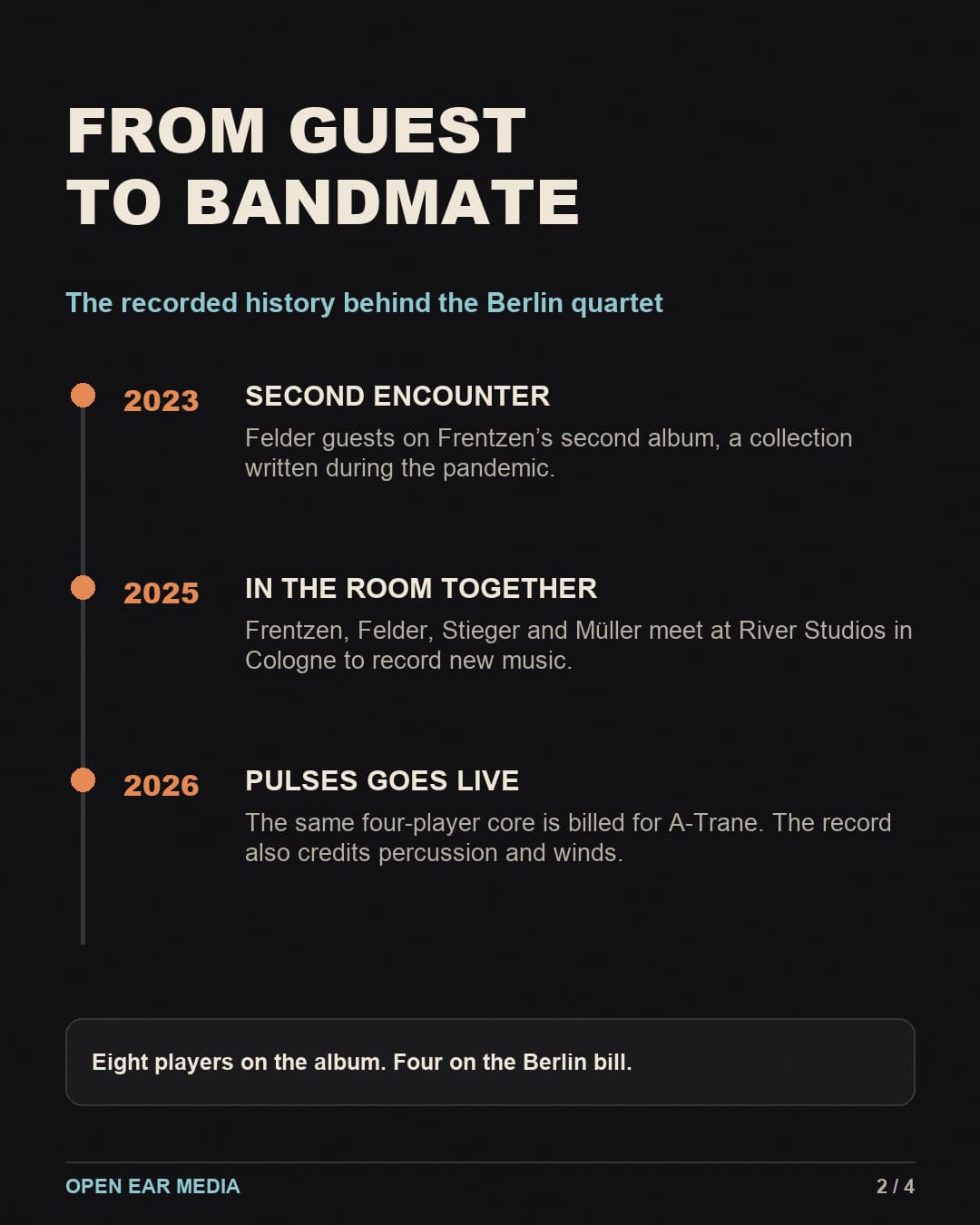
A concise visual guide for listeners, derived from the researched feature above rather than the other way around.
Research trail
Sources and further listening
Primary artist, presenter, label, and event sources lead this list. Reviews and discographic databases are used for listening context and detailed recording credits. Each source was checked on the date shown in the feature metadata.
- 1Pulses at A-Trane — October 11, 2026
A-Trane · official event
Supports: date and special Sunday hours, complete live lineup, venue address, ticket-section discrepancy.
- 2New album Pulses — the August 2025 sessions
Christian Frentzen · official artist
Supports: contact with Felder since 2022, River Studios sessions, quartet personnel, compositions written in summer 2025.
- 3Christian Frentzen — Info
Christian Frentzen · official artist
Supports: pianist and recording engineer, production and sample-library work, Second Encounter released in 2023.
- 4Second Encounter — artist’s recording account
Christian Frentzen · official artist
Supports: pandemic-era writing, instrumental sessions and overdubs, stylistic range, Felder and vocal guests.
- 5Pulses — official CD tracklist and personnel
Christian Frentzen · official artist
Supports: eight compositions, album-wide personnel, recording and production credits.
- 6Pulses — album and official listening page
Christian Frentzen · official artist
Supports: composition-centered album description, jazz pop and electronica context, artist-endorsed video embeds.
- 7Christian Frentzen feat. Nir Felder / In My Humble Opinion Live
Christian Frentzen · media
Supports: complete quartet performance, River Studios setting, video credits, upload date and duration.
- 8II — official release and instrumental credits
Nir Felder / Ropeadope · official label
Supports: July 10 2020 release, Felder’s instruments and production, Penman and Macbride personnel, Babko and Yowell contributions.
- 9Thomas Stieger — official biography
Thomas Stieger · official artist
Supports: bass composition and production, Choices in 2024, guest personnel, official Instagram account.
- 10Christian Frentzen — tour dates
Christian Frentzen · official artist
Supports: October 2026 routing, Berlin with Felder, Düsseldorf with Busch and Doffey.
- 11Christian Frentzen — official home and social links
Christian Frentzen · official artist
Supports: official Instagram and YouTube accounts, Pulses announced release date.
- 12A-Trane — contact and reservation information
A-Trane · official event
Supports: information-only phone policy, no telephone reservations.