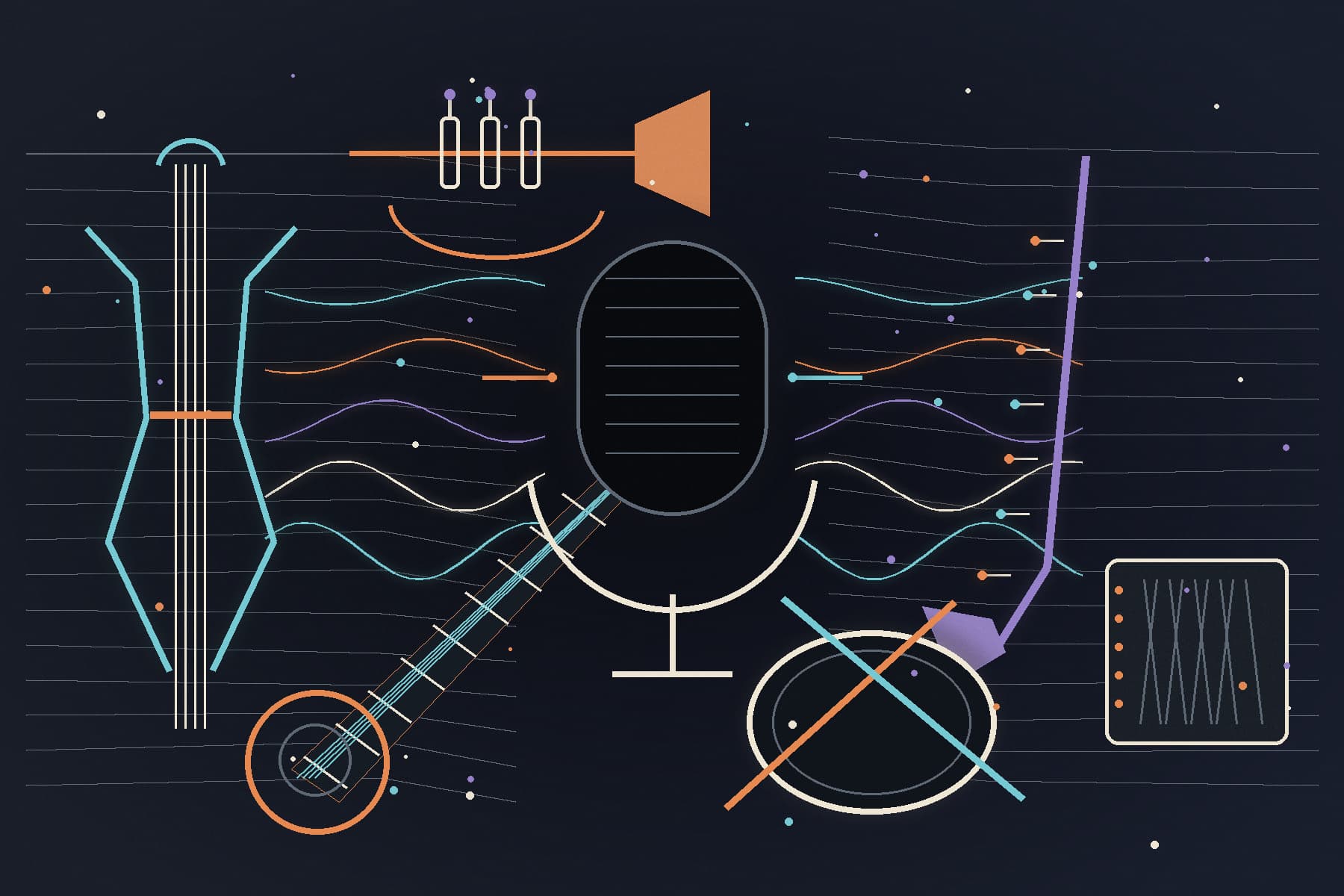
Chris Morrissey’s Sans Vox quintet
What remains when Chris Morrissey takes the words away
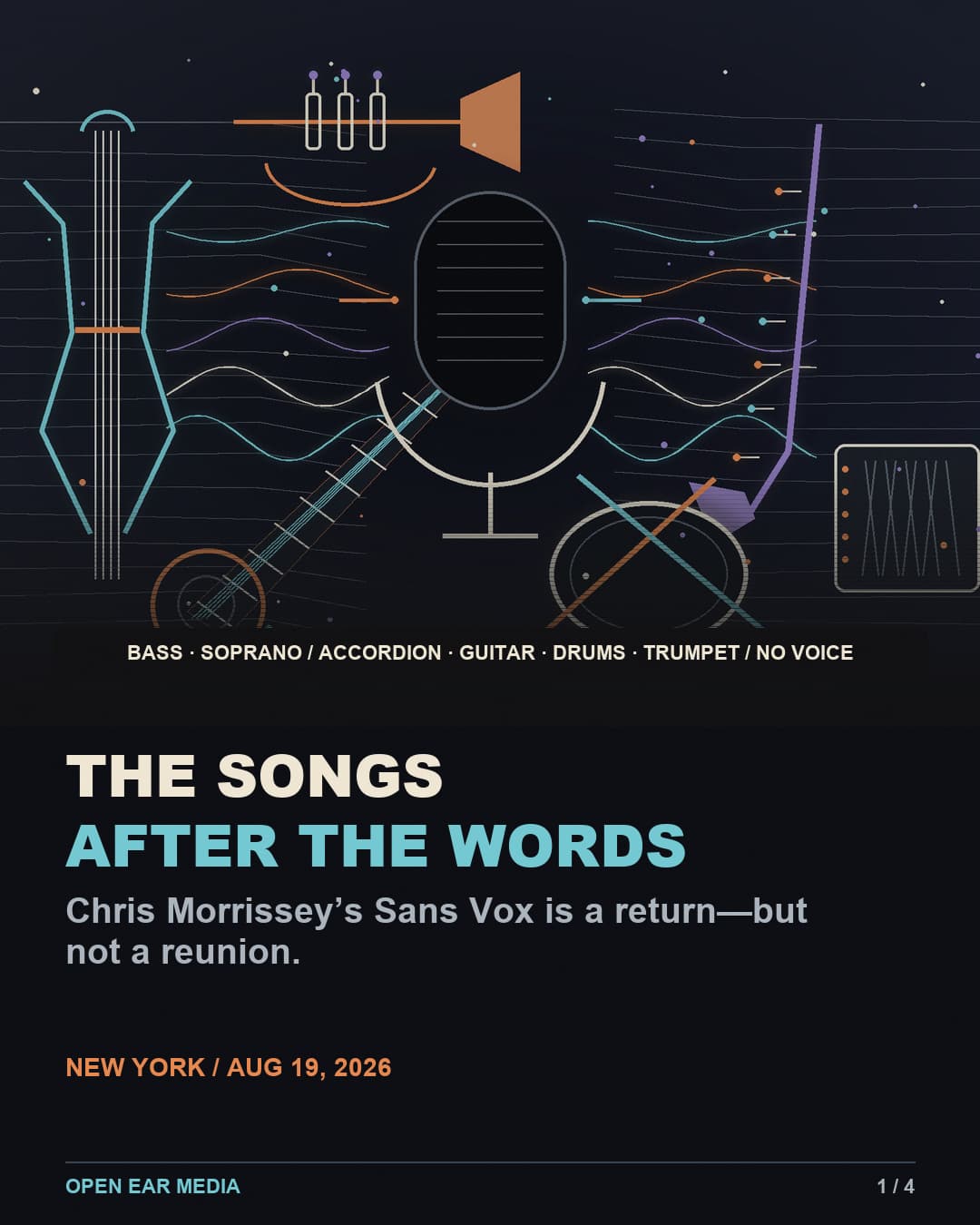
Sans Vox is not a revival of Chris Morrissey’s early quartets: Aurora Nealand, Steven Bernstein, Marvin Sewell and Dan Weiss reopen his instrumental book after years of voice-led records.
Chris Morrissey has spent the 2020s making the bass, the singing voice and the songwriter’s form coexist in one band. Sans Vox begins by separating them. The Jazz Gallery calls the new quintet a departure from Morrissey’s established role as frontman and singer, but also a return to the acoustic instrumental entry point of The Morning World and North Hero. The useful question is not whether he can still write without lyrics. It is what his writing has learned during the years in which lyrics were present. [1][2][3]
This is not an original-band reunion. Morrissey is the only musician carried over from either of those early records. Aurora Nealand brings soprano saxophone and accordion, Steven Bernstein trumpet, Marvin Sewell guitar and Dan Weiss drums—a palette with two horn voices, two possible sources of harmony, and no singer. The presenter promises “new and less new music” but publishes no titles, so the program remains open until the band plays it. [1][7][9]
That makes the August 19 date a test rather than a retrospective. Morrissey’s early quartet language supplies a point of departure; four musicians who did not make those records prevent it from becoming a replica. Listen for the distinction between melody and narration: a line can retain the contour and emotional economy of a song even when nobody tells us, in words, what it means. [1][7][11]
The apparent subtraction
Taking away the singer does not remove the songwriter
Morrissey’s current catalog makes the word “departure” meaningful. GroundUP Music released Infinite Source of Heat in March 2026 as his eighth bandleader album and fourth full-length for the label. Its eight songs use his longstanding group—Marco Bolfelli, Bill Campbell and Charlotte Greve—with guests Norah Jones, Mark Guiliana and Aoife O’Donovan. The label describes pieces written on guitars, pianos and in notebooks, then played repeatedly onstage. Voice is not an ornament added after the composition; it is one of the ways these songs were built and lived in. [3][2]
Impact Winter Formal marked an earlier turn in the same direction. Edition’s notes frame the 2021 record as Morrissey giving up on straddling jazz and alternative music as separate worlds. The credits place his bass and singing beside Philip Dizack’s trumpet, Ryan Ferreira’s guitar, Dan Rieser’s drums and Jon Cowherd’s piano, with a second lineup on “The Indigos.” Improvisation, song form and voice were deliberately made to share the same address. [4][5]
Sans Vox should therefore not be heard as an escape from songs. The event’s billing is literal: Morrissey is credited only on bass, and Nealand—herself a vocalist in other settings—is credited here on soprano saxophone and accordion. The constraint removes the most explicit carrier of language while leaving a composer whose earliest official biography described him as “changes first”: harmonic movement would inspire melody, and melody would determine form and rhythm. Instrumental music was already songwriting in his practice. [1][7][15]
I think I’m a ‘changes first’ type of composer.
The first chapter
The early quartets made song shapes without sung plots
The Morning World, released by Sunnyside in 2009, joined Morrissey and saxophonist Mike Lewis with drummer Dave King, pianists Peter Schimke and Bryan Nichols, and guest saxophonist Chris Thomson. The label heard Midwestern folk themes meeting modern jazz and emphasized supple, singable bass lines rather than displays of technique. That distinction matters now: the early book was not “wordless” because it lacked a singer. Its melodic directness already behaved like a set of songs. [7][8]
North Hero refined the idea four years later with a stable quartet: Morrissey on double bass, Mike Lewis on saxophone, Aaron Parks on piano and Mark Guiliana on drums, produced by Dave King. Sunnyside explicitly presented songwriting as the record’s center, arguing that jazz’s attention to soloists can obscure the composer. Contemporary reviews heard hard edges, folk simplicity, pop-rock rhythm and inviting melodies without suggesting that the improvising had been domesticated. [9][10][11][12]
Sans Vox changes every supporting chair and the instrumentation. Piano, the harmonic anchor on both early albums, is absent; guitar and accordion can supply chords but can also behave as lines, texture or breath. A second horn is added. The return is therefore to a compositional problem—how to make a memorable instrumental form—not to the old solution. The title tells us what has been removed. The lineup tells us how much else has changed. [1][8][10]
Two listening keys
Hear the instrumental origin, then hear what Sans Vox withholds
Begin with “The Morning World is Waiting,” the title track from the 2009 debut, heard here through Sunnyside’s official YouTube delivery. The album credits identify Morrissey on bass, Mike Lewis on saxophone, Dave King on drums and Peter Schimke on piano for this track. None except Morrissey appears on August 19, so this is evidence of the compositional entry point—not a preview of the new band’s sound or repertoire. [13][8][1]
Listen first to function. Sunnyside describes the piece’s atmosphere as film-noir inflected and the album’s bass lines as singable. Track when the bass acts as foundation and when its contour feels like another authored voice; notice how piano and saxophone can clarify a dark harmonic world without closing every space in it. Those are useful questions for Sans Vox, where guitar, accordion, soprano and trumpet can redistribute the same jobs in more combinations. [7][13][1]
Then watch the official 2024 live performance of “Impact Winter Formal” from Mercury Lounge. Morrissey sings while playing bass inside a band of drums, saxophone and two guitars, with Jeff Taylor sharing vocals. The downbeat is not the only organizing signal; words, bodies and instrumental attacks all mark the form. Sans Vox removes the clearest narrator from that system. Listen on August 19 for what assumes that responsibility: a recurring instrumental phrase, a bass entrance, a drum cycle, a horn cue—or the ensemble’s collective memory. [14][6][1]
The Morning World is Waiting
Official Sunnyside-supplied audio of the 2009 title track—the instrumental entry point Morrissey says Sans Vox recalls, heard with the original quartet rather than the 2026 lineup.
Watch on YouTube · Chris Morrissey - TopicChris Morrissey - Impact Winter Formal feat. Jeff Taylor (Live in New York City)
GroundUP Music’s official 2024 Mercury Lounge performance shows Morrissey’s recent voice-and-bass identity—the narrative layer Sans Vox deliberately sets aside.
Watch on YouTube · GroundUP Music NYCThe expanded front line
Aurora Nealand and Steven Bernstein bring histories that bend time
Nealand’s official biography locates her between sound art and multi-instrumental practice. Her Royal Roses draw on New Orleans early-jazz collective improvisation, but extend that lineage toward the AACM, collage and musique concrète; her other projects include the Monocle installation ensemble and John Hollenbeck’s GEORGE. The event’s soprano-saxophone-and-accordion credit compresses those possibilities into two very different tools: one can project a single high line, while the other can sustain harmony and move air like a portable ensemble. [15][1]
Her 2010 Live at Preservation Hall tribute to Sidney Bechet makes the historical connection concrete, with a program that includes “Petite Fleur,” “Blue Horizon” and “Si Tu Vois Ma Mère.” But treating Nealand only as an early-jazz specialist would miss her stated interest in everyday sound, staged work and experimental collaboration. In Sans Vox, a Bechet-informed soprano voice can arrive with an ear trained to hear tradition as material for new construction, not as a costume. [16][15]
Bernstein reaches a related freedom by a different route. His bands include Sexmob, Millennial Territory Orchestra and the Diaspora series; his arranging work ranges across jazz, popular song and film. In June 2026 he released ResoNation Trio, a deliberately chordless project with Scott Colley and Nasheet Waits, using valve trumpet and flugelhorn rather than his signature slide trumpet. Its stated aim is conversation in a sparse room. The Jazz Gallery bills “trumpet” without specifying which kind, so the safe expectation is not a particular horn but a player freshly engaged with how melody behaves when harmony is left open. [24][25][1]
Harmony without a piano
Marvin Sewell is not arriving to imitate a keyboard
Sewell’s route runs through Chicago blues, New York jazz and years of shaping music around singers. The Los Angeles Philharmonic traces his work from Von Freeman and Jack DeJohnette to a long composing and performing relationship with Cassandra Wilson; Peabody identifies him as a blues and jazz guitarist who has led his own group since 2001. That history makes him particularly apt for a wordless band led by a singer-songwriter: he knows how guitar can support a vocal center, and how it can become one when the singer is absent. [18][19]
His current work with Charles Lloyd offers a second clue. Blue Note’s notes for Figure in Blue describe an unconventional trio of Lloyd, Jason Moran and Sewell moving from ballads to raw Delta blues. Lloyd singles out Sewell’s bottleneck playing and “authentic voice,” while the label emphasizes patience, listening and ensemble empathy. Those qualities complicate the idea that guitar must replace the pianos on Morrissey’s early records chord for chord. [20][8][10]
The useful listening question is how much harmony Sewell chooses to state. Full voicings could make Morrissey’s forms explicit; a slide, a bent pitch or an isolated attack could leave their direction unresolved. Nealand’s accordion may share the harmonic load, allowing guitar to become color or counterline. Nothing in the event description tells us which arrangement will be used. The interest lies in hearing that decision made piece by piece. [1][20][15]
Time as form
Dan Weiss can make the drummer part of the composition’s grammar
Weiss’s official biography describes a language built from jazz, classical Indian rhythm, contemporary composition, West African music and metal. It identifies complex through-composed drum parts, non-Western rhythmic cycles and melodic shapes drawn from raga as compositional signatures. In other words, his role need not begin after melody and harmony have established the piece. Time can be one of the facts from which the piece is understood. [22]
Unclassified Affections, his 2025 quartet with Peter Evans, Patricia Brennan and Miles Okazaki, is especially relevant. Weiss wrote the music for the specific players; trumpet, vibraphone and guitar create contrapuntal and harmonic layers above rhythms described by the label as hypnotic, with room for improvisation and silence. Sans Vox is not that band, but Weiss arrives with recent evidence of making trumpet and guitar coexist inside forms where density can recede without the structure vanishing. [23][1]
Morrissey and Weiss form the only conventional rhythm-section pairing in Sans Vox, yet both are composers whose instruments can lead from below. Listen for whether bass and drums establish a stable floor or exchange fragments that force the front line to reveal the form. A memorable melody does not require a simple pulse; it requires a band that knows which part of the architecture must remain audible while the surface moves. [2][22][9]
Not a reunion
“Old and new friends” is an invitation, not a biography
The Jazz Gallery describes Sans Vox as “old and new friends playing new and less new music,” but does not identify which relationships are old or which compositions are returning. Public discographies do not justify turning that phrase into a tidy origin story. The defensible fact is the complete lineup and the new ensemble name. Anything more specific about first meetings, prior concerts or the August repertoire should wait for documentation from the musicians. [1][2][24][22]
That uncertainty is musically productive. On an older Morrissey piece, listen for what survives the transfer from piano quartet to five voices: perhaps the harmonic sequence, perhaps a bass line, perhaps only the shape of a melody. On new music, listen for whether the writing names the players’ differences or tries to reconcile them. Nealand and Bernstein can meet as a horn section or as independent narrators; Sewell and accordion can thicken harmony or leave it transparent; Weiss can make a transition feel composed before anyone states a theme. [1][7][9][15][25][23]
Most of all, listen for the missing lyric without pretending every melody conceals one. Morrissey’s recent records train an audience to follow his verbal point of view. Sans Vox asks whether pacing, register, repetition and ensemble response can supply an equally legible arc. The result does not have to sound like The Morning World, North Hero or Infinite Source of Heat to connect them. The connection can be the discipline of making a song’s emotional route clear while keeping its destination open. [1][3][7][9]
The room and the date
The Jazz Gallery is part of this return
Morrissey’s official biography says he has received commissions from The Jazz Gallery. The venue’s mission is built around exactly this kind of work: giving emerging and established musicians space to experiment, collaborate and develop a distinct voice. Founded in 1995 by Dale Fitzgerald, Lezlie Harrison and Roy Hargrove, the Gallery has commissioned new work since 2002. A new ensemble revisiting a bandleader’s own entry point belongs in that history of development rather than nostalgia. [2][26][1]
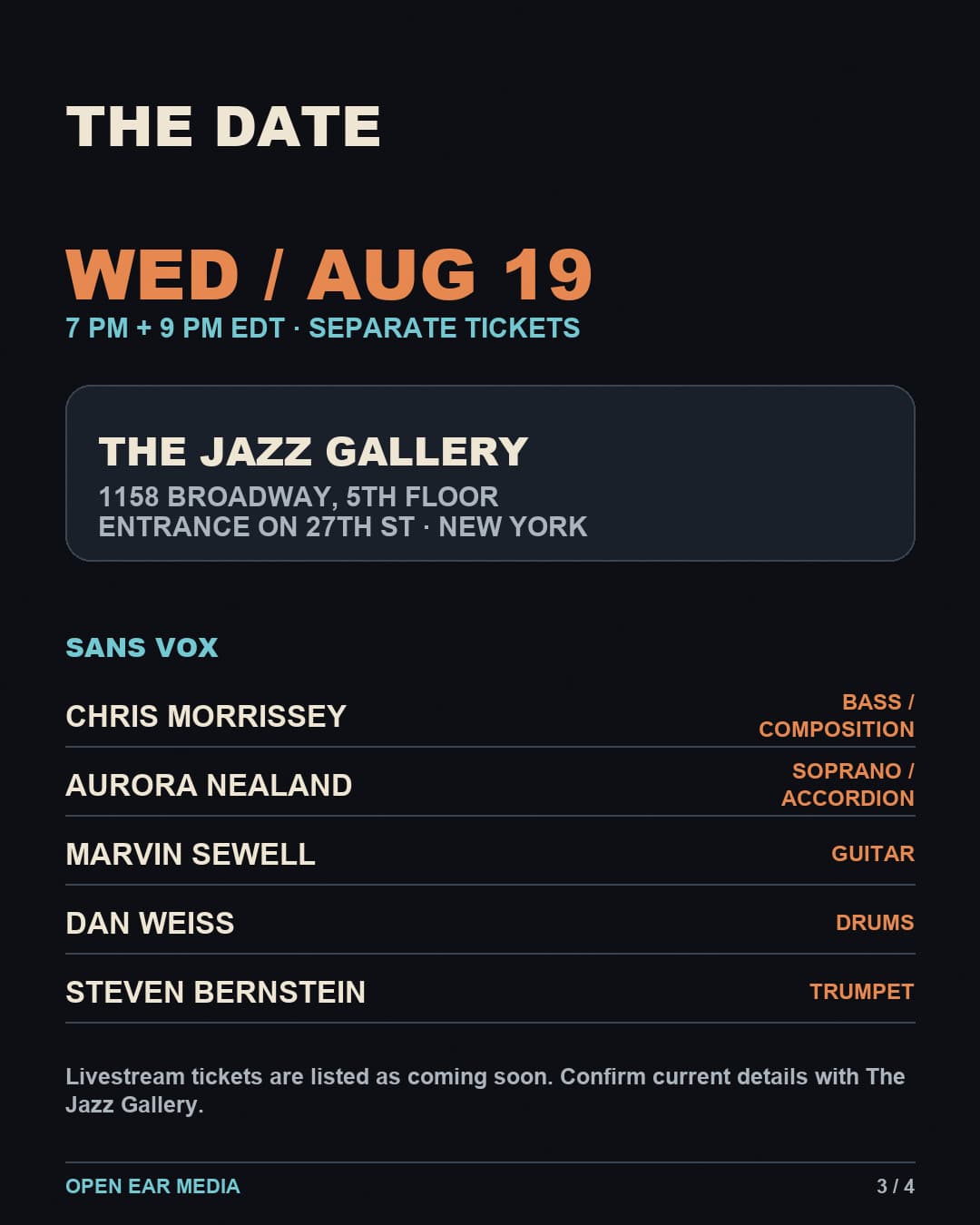
The performance is Wednesday, August 19, at 1158 Broadway, fifth floor, with the entrance on 27th Street. The Gallery lists 7 and 9 p.m. sets as separate ticket choices. It also displays livestream pricing but says livestream tickets are coming soon; until a working purchase link appears, a remote audience should not assume access. The event is scheduled, but ticket availability and program details can change, so the official page remains the source to check before making plans. [1][26]
After the date passes, the listening path remains useful: The Morning World for the instrumental premise, North Hero for its sharper quartet realization, Impact Winter Formal and Grey Like the Color for the fusion of singing and improvisation, and Infinite Source of Heat for Morrissey’s current songbook. Sans Vox sits between those shelves. It is a return only in the sense that an artist can reopen an old question after acquiring better questions to ask of it. [8][10][5][6][3]
The social edition
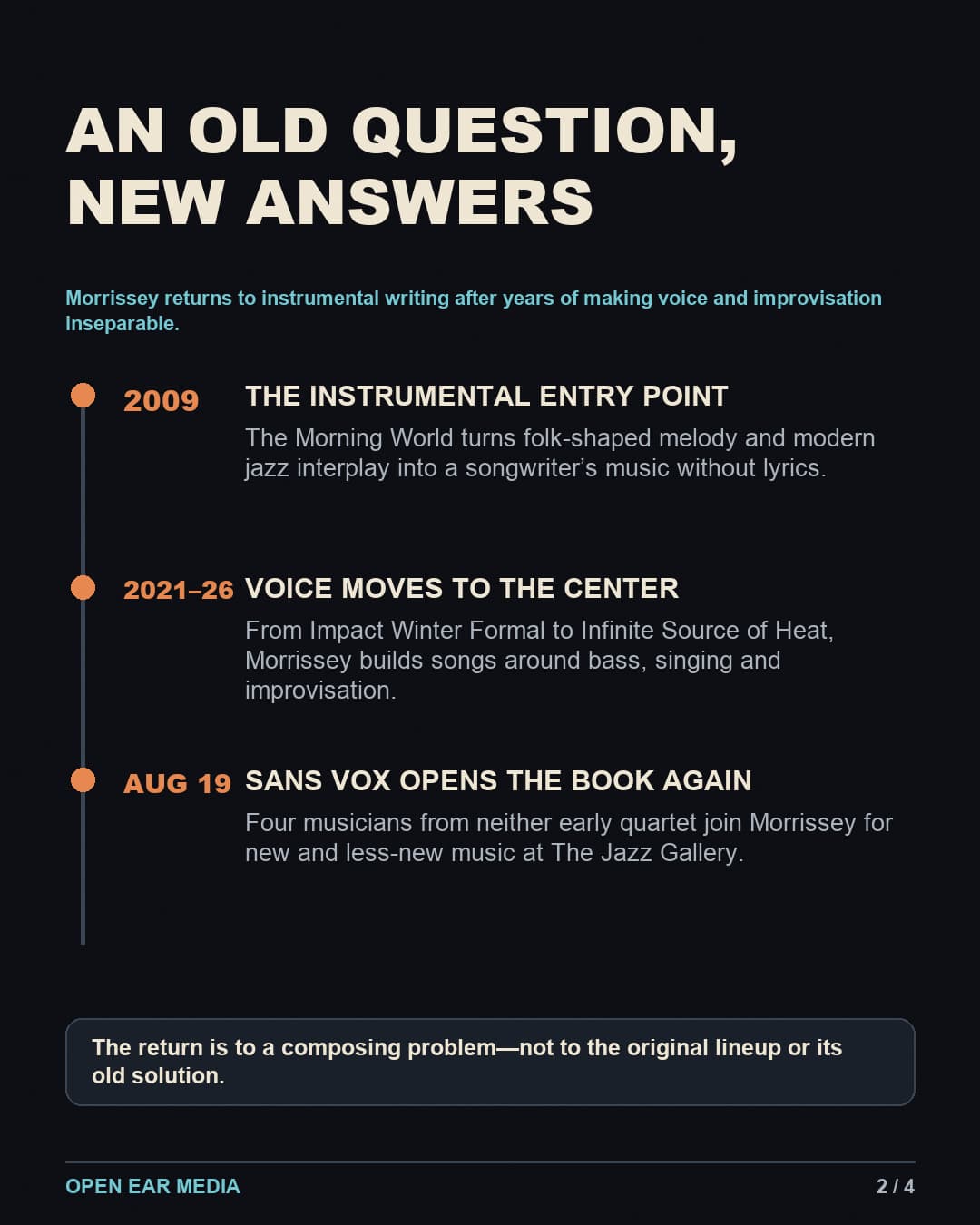
The story in four frames
A concise visual guide for listeners, derived from the researched feature above rather than the other way around.
Research trail
Sources and further listening
Primary artist, presenter, label, and event sources lead this list. Reviews and discographic databases are used for listening context and detailed recording credits. Each source was checked on the date shown in the feature metadata.
- 1Chris Morrissey Sans Vox Quintet
The Jazz Gallery · official event
Supports: date, set times, physical address, complete lineup, new-quintet description, ticket and livestream caveat.
- 2Chris Morrissey — official biography and discography
Chris Morrissey · official artist
Supports: artist identity, bandleader discography, sideman work, Jazz Gallery commissions, official Instagram.
- 3Infinite Source of Heat and Chris Morrissey artist page
GroundUP Music · official label
Supports: 2026 release date, current album credits, songwriting process, track list.
- 4Chris Morrissey | Impact Winter Formal
Edition Records · official label
Supports: 2021 release context, genre-blending statement, artist biography.
- 5Impact Winter Formal
Chris Morrissey / Edition Records · official label
Supports: release date, complete recording personnel, track list, voice-and-improvisation context.
- 6Grey Like The Color
GroundUP Music · official label
Supports: 2024 album credits, band personnel, official video context.
- 7Chris Morrissey artist page: The Morning World
Sunnyside Records · official label
Supports: debut context, personnel, composer’s changes-first process, track-level listening descriptions.
- 8The Morning World
Chris Morrissey / Sunnyside Records · official label
Supports: release date, track list, album and track personnel, recording credits.
- 9North Hero
Sunnyside Records · official label
Supports: quartet personnel, track list, songwriting-centered label context.
- 10North Hero
Chris Morrissey / Sunnyside Records · official label
Supports: release date, complete personnel, Dave King production credit, recording details.
- 11Bassist Chris Morrissey effortlessly straddles the worlds of jazz and indie pop
Chicago Reader · publication
Supports: North Hero critical context, folk and pop-rock elements, jazz and indie synthesis.
- 12Album review: Chris Morrissey’s inviting melodies lead North Hero
Los Angeles Times · publication
Supports: North Hero listening context, quartet roles, melodic character.
- 13The Morning World is Waiting
Chris Morrissey - Topic / Sunnyside · media
Supports: official audio, exact title, duration, release attribution, instrumental listening guide.
- 14Chris Morrissey - Impact Winter Formal feat. Jeff Taylor (Live in New York City)
GroundUP Music NYC · media
Supports: official live video, filming date and venue, complete performance personnel, duration.
- 15Aurora Nealand — official biography
Aurora Nealand · official artist
Supports: instruments, New Orleans base, Royal Roses approach, experimental projects and collaborators.
- 16Live at Preservation Hall: A Tribute to Sidney Bechet
Aurora Nealand · official artist
Supports: release date, Bechet tribute repertoire, early-jazz listening path.
- 17
- 18Marvin Sewell
Los Angeles Philharmonic · publication
Supports: Chicago and New York history, Cassandra Wilson collaboration, bandleader work.
- 19Marvin Sewell joins Peabody Jazz faculty
Peabody Magazine / Johns Hopkins University · publication
Supports: blues and jazz identity, faculty role, Marvin Sewell Group leadership.
- 20Charles Lloyd announces Figure in Blue featuring Jason Moran and Marvin Sewell
Blue Note Records · official label
Supports: current trio, bottleneck Delta-blues practice, ensemble listening context.
- 21
- 22Dan Weiss — official biography
Dan Weiss · official artist
Supports: drumming and composing identity, rhythmic languages, projects, official Instagram.
- 23Unclassified Affections
Dan Weiss / Pi Recordings · official label
Supports: 2025 release date, quartet personnel, musician-specific compositions, rhythmic and contrapuntal approach.
- 24Steven Bernstein — official biography and projects
Steven Bernstein · official artist
Supports: career history, bands, arranging practice, slide-trumpet identity, official social links.
- 25ResoNation Trio / Ultra Resonance
Steven Bernstein / Royal Potato Family · official label
Supports: 2026 release date, chordless-trio personnel, valve-trumpet instrumentation, improvisational method.
- 26About The Jazz Gallery
The Jazz Gallery · official event
Supports: venue mission, history, commissioning role, verified physical address.