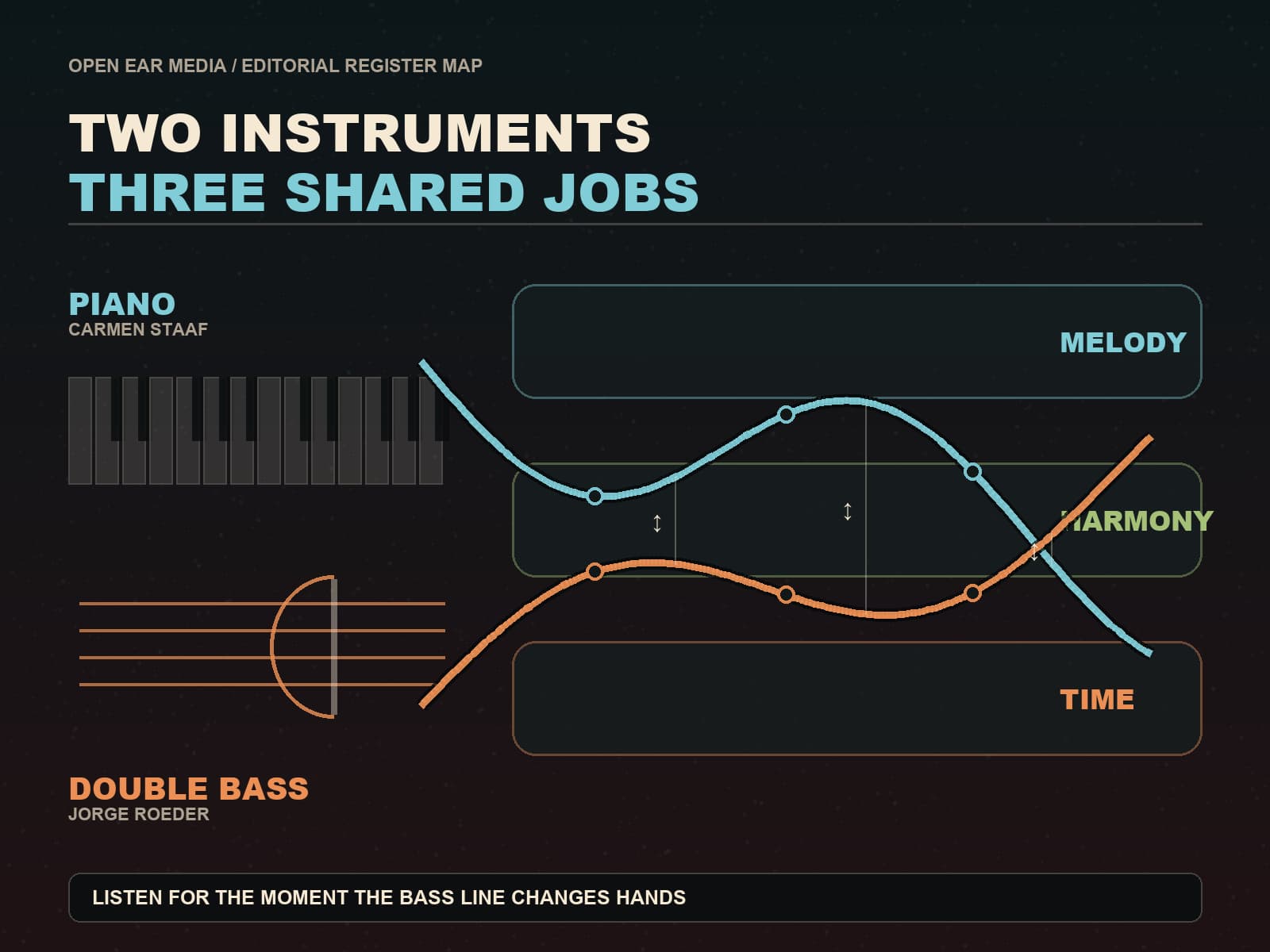
Two instruments, three shared jobs
Carmen Staaf and Jorge Roeder meet where the bass line changes hands
A piano-bass duo has two instruments capable of carrying melody, harmony and time. Across a five-date Japan run, Staaf and Roeder must decide who owns each function—and when ownership matters at all.
A piano-bass duo looks orderly on paper: piano supplies chords and melody; double bass supplies the bottom. Carmen Staaf and Jorge Roeder make that division impossible to trust. Staaf’s recent work treats duet as a laboratory where written history can become present-tense conversation. Roeder’s solo and duo records prove that the bass can carry song, counterpoint and pulse without waiting for another instrument to authorize the change. Put them together without drums or a horn, and every familiar job becomes negotiable. [10][11][13][15]
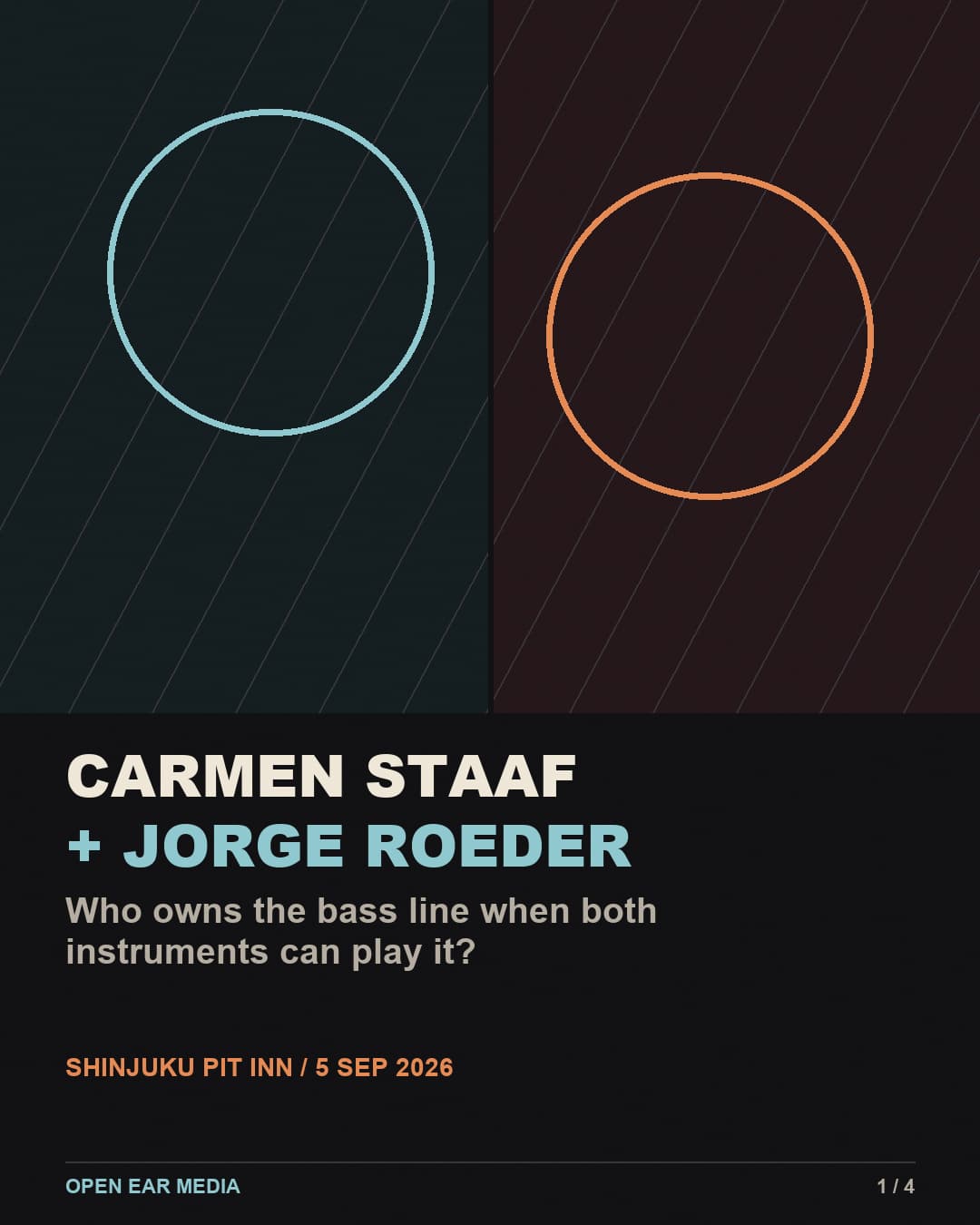
The September 5 set at Shinjuku Pit Inn is not an isolated booking. It sits inside a five-date Japan route—Shizuoka, two Tokyo clubs, Musashino and Kyoto—following a documented California duo concert in August and a January quartet date where Staaf and Roeder supported Toninho Horta with drummer Steven Crammer. The public sources do not call this their first tour or first-ever duet, and no shared album is announced. What they document is more useful: a partnership being tested repeatedly across very different rooms. [5][4][6][7]
Pit Inn is the close-focus chapter. The following afternoon’s civic-hall concert is already listed as sold out, while the club places listeners near the physical decisions that make this instrumentation compelling: whether Staaf’s left hand doubles or escapes Roeder, whether the bassist anchors a beat or phrases through it, and whether melody remains in one register long enough to belong to anyone. No repertoire is published. The case for the date comes from methods each musician has already made audible—not from a guessed set list. [1][8][10][13]
The partnership we can prove
A new duo chapter, without a fabricated origin story
Staaf’s calendar documents the pair at Palo Alto Art Center Auditorium on August 1, then lists five Japan engagements: Lifetime in Shizuoka on September 4, Pit Inn on September 5, Musashino Swing Hall on September 6, Le Club Jazz in Kyoto on September 7 and Body & Soul in Tokyo on September 10. Repetition changes the proposition. A single date could be an experiment; this route gives the duo successive rooms in which to keep, discard and reframe what they discover. [5][6][4]
There is also a documented ensemble prehistory, though it should not be inflated into a long-running duo biography. In January 2026, Staaf’s trio with Roeder and Crammer backed Brazilian guitarist-composer Toninho Horta at Cafe Ornithology. That performance placed piano and bass inside a larger harmonic and rhythmic frame. The current tour removes both the guest voice and the drummer, leaving the two musicians responsible for all transitions, tempo negotiations and changes in density. [7][1]
What remains undocumented is equally important. The reviewed public trail does not identify a Staaf-Roeder recording, announce a repertoire concept or make a career-wide “first” claim. The duo should therefore be heard as an active 2026 project rather than retrofitted with a mythology. Its story is the convergence of two mature approaches to reduced instrumentation—and the unusually concentrated sequence of performances now giving that convergence a working history. [5][4][1]
Carmen Staaf’s method
For Staaf, duet is where a musical argument becomes visible
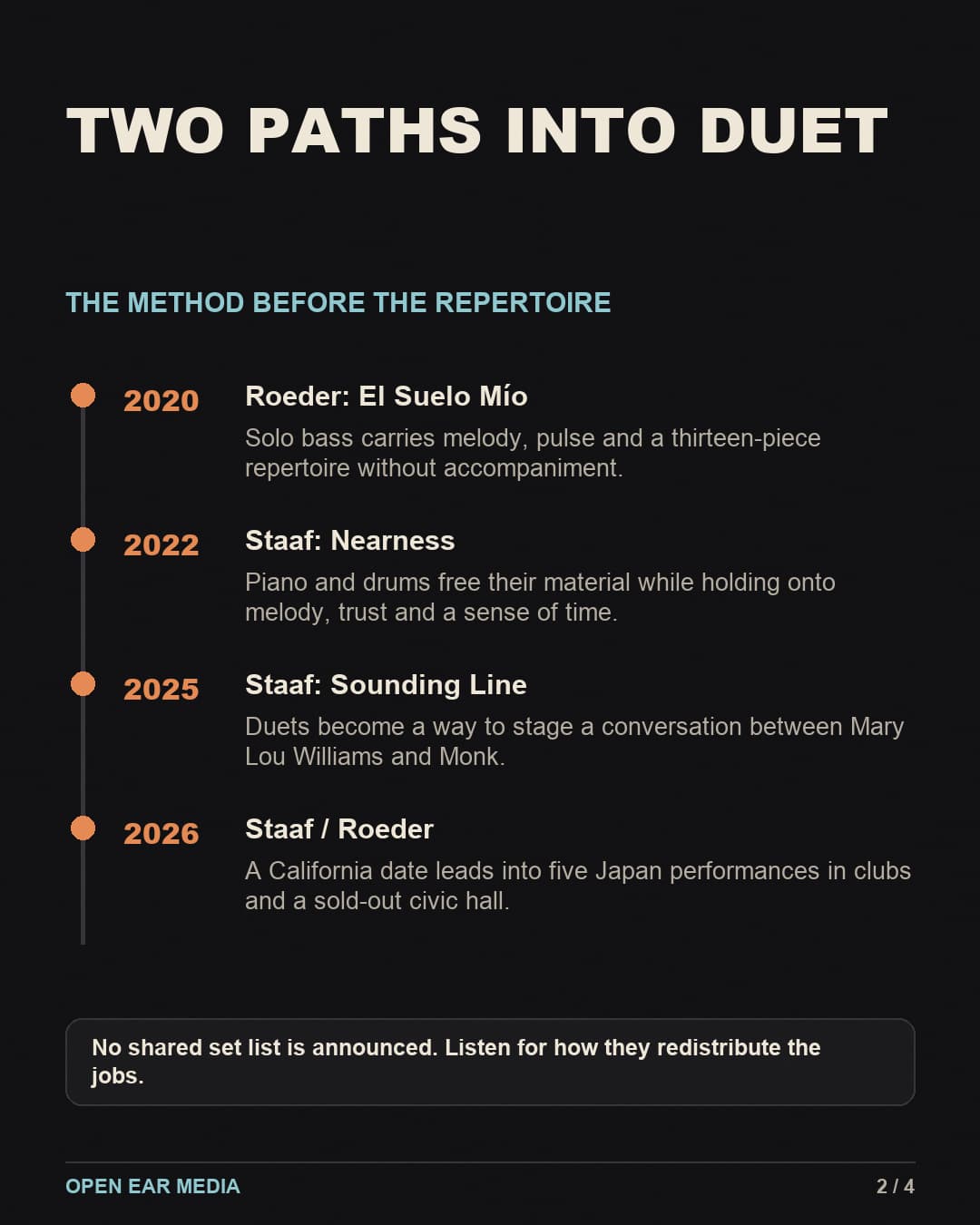
Nearness, Staaf’s 2022 piano-drums album with Allison Miller, grew from a relationship built through monthly “lab sessions” after the musicians met in 2015. Sunnyside’s notes describe a process of freeing material from structures that once defined it while retaining melody and time. The duo format mattered because it exposed their communication: no bassist or horn could mediate a transition, and improvised discoveries could become repertoire through repetition. [11]
Sounding Line, released in 2025, made duet a different kind of research tool. Staaf connected Mary Lou Williams and Thelonious Monk through shared harmonic and voicing ideas, then recorded pieces with individual partners including Ambrose Akinmusire, John Santos, Ben Goldberg and Dillon Vado. Her official essay says the best way to approximate a conversation between Williams and Monk was to perform their music in duos. The partner did not decorate a piano thesis; the partner made the historical conversation possible. [10][9]
Roeder changes the terms of that method. A trumpeter or clarinetist generally arrives as a second melodic voice; percussion arrives as an explicit rhythmic counterweight. Double bass can be either, neither or both. The Japan duo can make Staaf’s historical and compositional interests collide with an instrument that shares her left hand’s territory. Listen not just for what she plays, but for when she removes information because Roeder has already supplied it. [10][13][1]
Two official listening documents
Hear Staaf create a duet frame; hear Roeder fill one alone
Begin with Staaf’s recording of Mary Lou Williams’s “Scorpio,” issued by Sunnyside and published through her official topic channel. Her Sounding Line notes identify it as a duet with Akinmusire: a piano bass figure establishes the trip, then trumpet and piano negotiate blues color and contemporary boogie-woogie energy. The useful detail is structural. Staaf can make the piano’s low register function as a rhythm section, then alter its weight when a second improviser needs space. [12][10]
Then watch Roeder’s own video for “El Suelo Mío,” the title piece from his 2020 solo-bass debut. Here the bass cannot be described as accompaniment because there is nothing to accompany. Plucked attacks establish motion; register changes create formal contrast; resonance supplies harmony that a chordal instrument would ordinarily spell out. The album around it moves through originals, improvisations, Peruvian and Brazilian songs, a standard and Ornette Coleman, arguing that a single bass can hold repertoire rather than merely demonstrate technique. [14][13]
The two documents point toward Pit Inn without pretending to preview it. “Scorpio” shows Staaf deciding how much foundation to provide another voice. “El Suelo Mío” shows Roeder generating foundation and voice simultaneously. In their duo, each musician will encounter another player capable of doing the job that made the solo document coherent. The question becomes less “who supports whom?” than “which layer can disappear because the other musician has heard it?” [12][14][1]
Scorpio
Staaf’s Mary Lou Williams reading with Ambrose Akinmusire shows how her low-register piano can establish a duet’s foundation and then make room for another improvising voice.
Watch on YouTube · Carmen Staaf — Topic / SunnysideJorge Roeder | El Suelo Mío
Roeder’s artist-published solo performance makes the double bass responsible for pulse, melody, register and form before the Tokyo duo redistributes those jobs.
Watch on YouTube · Jorge Roeder / jeroedJorge Roeder’s method
Roeder’s bass language is already built for exposed conversation
El Suelo Mío is the clearest evidence that Roeder can make the double bass carry form alone, but his duet work shows how that independence becomes partnership. Coplas Escondidas, his 2023 album with vocalist Sofia Rei, draws on almost twenty years of intermittent collaboration and a Pan-American songbook in Spanish, Portuguese and English. Its notes resist simple categories—neither folklore nor avant-garde, straight-ahead nor “Latin jazz”—because improvisation is used to enter song traditions rather than flatten them. [15][13]
His 2025 SFJAZZ duet with Julian Lage supplies a second model. In “Double Southpaw,” guitar and bass work without drums after nearly two decades of Lage-Roeder collaboration. SFJAZZ describes Roeder’s range through Lima orchestral training, partnerships with Lage and Shai Maestro, and the solo debut. The important lesson for the Staaf pairing is not to expect Lage’s language. It is that Roeder knows how to keep a drummerless string dialogue mobile while refusing a permanently subordinate role. [16][13]
Staaf presents a different partner problem from voice or guitar. The piano can surround the bass with more notes than either of those instruments, and its tempered attack cannot bend or sustain like Roeder’s strings. That contrast makes touch and decay central. A piano chord begins to vanish immediately; a bowed or ringing bass note can outlive it. Listen for Roeder using duration to redraw Staaf’s harmony after she has stopped sounding, or using short attacks to leave her resonance unobstructed. [15][16][10]
Five dates, different rooms
The tour keeps changing the distance between player and listener
The route begins at Lifetime in Shizuoka, reaches Pit Inn, moves the next day to Musashino Swing Hall, continues to Le Club Jazz in Kyoto and returns to Tokyo at Body & Soul. Staaf’s calendar confirms all five, though some of its generic time fields disagree with venue-owned pages. The sequence mixes jazz clubs with a civic-hall concert; that matters because a duo’s dynamic range, unamplified detail and use of silence change meaning as the room gets larger or the audience gets farther away. [5][4][8]
Musashino’s official page lists the September 6 matinee as planned-ticket allocation ended—effectively the tour’s sold-out public-hall chapter. It also corrects Staaf’s calendar’s generic 8 p.m. display to a 2 p.m. start. Pit Inn is different: its event page still provides a reservation process and a much closer club setting. Rather than borrowing the next day’s demand as hype, use it as evidence that the duo will cross a sharp acoustic and social boundary in less than twenty-four hours. [8][1][5]
A repeated tour also allows repertoire to remain unsettled. A transition that feels too sparse in a hall may become intimate in a basement club; an arrangement that depends on physical piano detail may need stronger contour elsewhere. No official source says the five concerts use identical programs. The responsible expectation is not a fixed traveling set but a working duo learning how the same two instruments occupy each room. [5][1][8]
The physical date
Pit Inn puts every handoff under a microscope
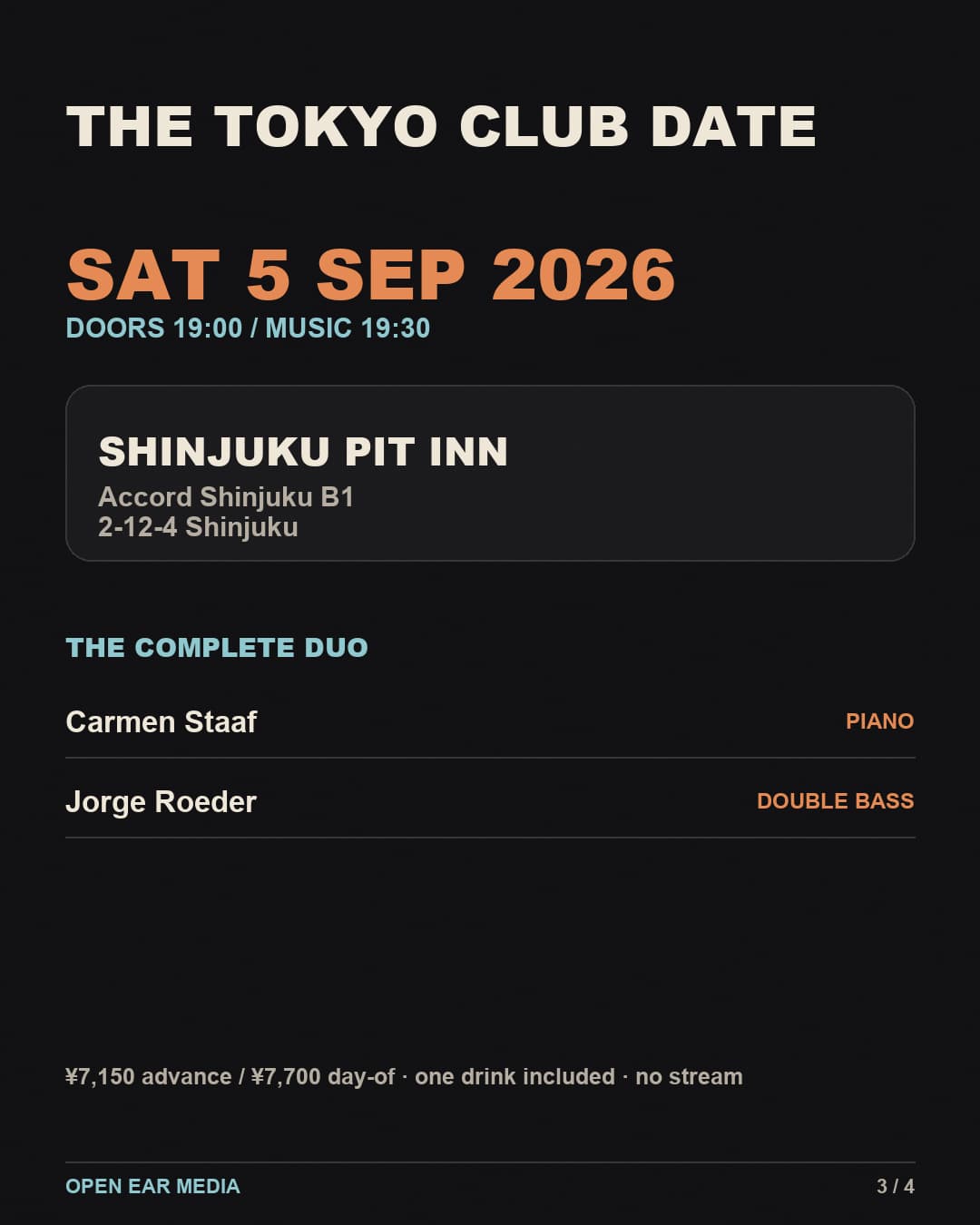
Pit Inn lists Saturday, September 5, with doors at 7 p.m. and music at 7:30. That venue-owned time supersedes the 8 p.m. placeholder on Staaf’s calendar. Admission is ¥7,150 in advance or ¥7,700 on the day, with one drink included. Reservations receive numbered priority admission, and the club asks reserved guests to purchase their tickets at reception before doors—beginning at 6 p.m. when possible—to reduce congestion. [1][2][4]
The room is in Accord Shinjuku B1 at 2-12-4 Shinjuku. The Japanese event page explicitly says there will be no stream, so this is not a date readers can assume will become an archive. Pit Inn’s current page still promotes the concert and reservation process, with no cancellation, postponement or sold-out notice observed at publication. Because those facts can change quickly, the club remains the final authority before travel. [2][3]
The basement-club scale suits the musical question. Piano mechanics, string attack, breath between phrases and the decay of low notes are not secondary details in a duo; they are orchestration. The listener’s task is simple to state and difficult to follow: notice every time the bass line changes hands, every time timekeeping becomes collective, and every time one musician’s silence supplies the clearest answer. [1][11][13]
Before and after
Prepare with methods, not an imaginary repertoire
A focused path begins with Staaf and Miller’s “Ask Me Now” on Nearness, then Staaf and Akinmusire’s “Scorpio” from Sounding Line. The first shows a mature duo freeing familiar material while retaining song and time; the second shows Staaf using low-register piano to frame a partner. Continue with Roeder’s “El Suelo Mío” and “Solo Juntos,” then hear Coplas Escondidas to follow his move from self-sufficient bass form into an equal dialogue with a singer. [11][10][13][15]
Nothing in that route guarantees a Pit Inn tune. Its purpose is to train the ear for four kinds of exposure: piano without bass, bass without piano, piano with a non-bass partner and bass with a non-piano partner. The Tokyo duo supplies the missing combination. If they play standards, originals or repertoire from either catalog, the same functional questions remain available beneath the titles. [1][10][13]
After the tour, the durable question will be whether this 2026 project becomes a recording or remains a sequence of rooms. The official sources make no promise. What already exists is a documented route and a convincing reason to listen: Staaf has made duet a method for exposing musical ideas, Roeder has made the bass independent enough to renegotiate every role, and Pit Inn offers the proximity to hear that negotiation happen. [5][10][13][1]
The social edition
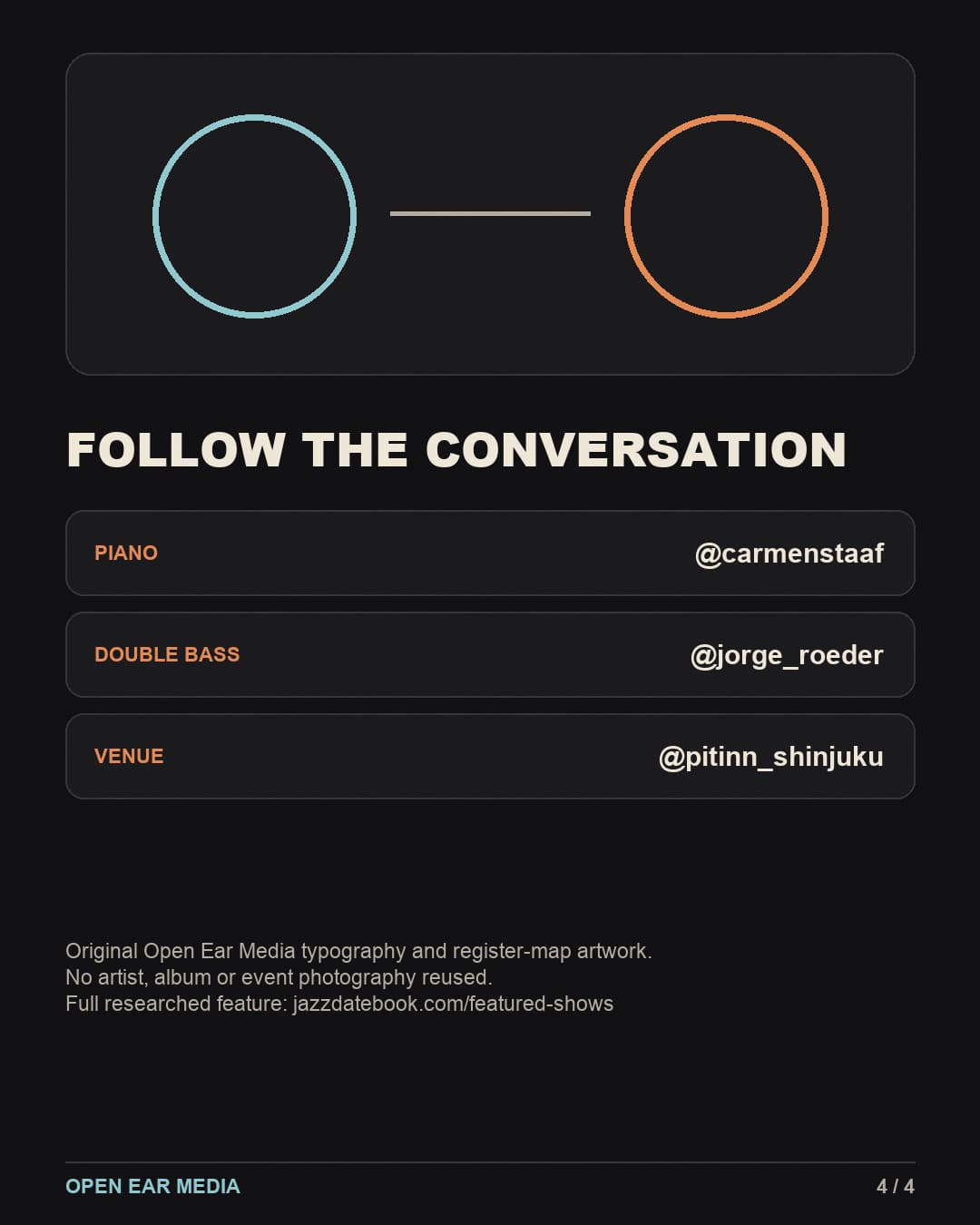
The story in four frames
A concise visual guide for listeners, derived from the researched feature above rather than the other way around.
Research trail
Sources and further listening
Primary artist, presenter, label, and event sources lead this list. Reviews and discographic databases are used for listening context and detailed recording credits. Each source was checked on the date shown in the feature metadata.
- 1Carmen Staaf & Jorge Roeder
Shinjuku Pit Inn · official event
Supports: September 5 date, 7 p.m. doors and 7:30 p.m. start, Carmen Staaf piano and Jorge Roeder bass lineup, advance and day-of prices, one-drink inclusion, reservation and numbered-entry procedure.
- 2Carmen Staaf & Jorge Roeder — September 5
Shinjuku Pit Inn · official event
Supports: current Japanese event listing, date, time, lineup and prices, advance reservation instructions, no-stream notice.
- 3Shinjuku Pit Inn
Shinjuku Pit Inn · official event
Supports: active featured-event promotion, venue address, general reservation deadline and admission procedure, venue contact information.
- 4Staaf/Roeder Duo at Pit Inn (Tokyo)
Carmen Staaf · official artist
Supports: artist confirmation of Pit Inn duo, Jorge Roeder billing, placement between Shizuoka and Musashino dates, artist-calendar time conflict documented privately.
- 5Carmen Staaf itinerary
Carmen Staaf · official artist
Supports: five-date September Japan route, Shizuoka, Pit Inn, Musashino, Kyoto and Body & Soul sequence, August Palo Alto duo date, January Toninho Horta ensemble date.
- 6Staaf/Roeder Duo at Palo Alto Art Center Auditorium
Carmen Staaf · official artist
Supports: August 1, 2026 duo performance, Palo Alto venue, Staaf and Roeder billing.
- 7Carmen Staaf Trio featuring Toninho Horta at Cafe Ornithology
Carmen Staaf · official artist
Supports: January 2026 Staaf and Roeder shared ensemble, Steven Crammer and Toninho Horta lineup, documented pre-duo performance context.
- 8Carmen Staaf & Jorge Roeder Jazz Duo Live
Musashino Cultural Foundation · official event
Supports: September 6 Musashino Swing Hall date, 2 p.m. official start, piano-bass lineup, planned ticket allocation ended notice, civic-hall tour context.
- 9Carmen Staaf biography
Carmen Staaf · official artist
Supports: pianist-composer identity, Dee Dee Bridgewater musical-director role, education and career context, Nearness, Sounding Line and other recording history.
- 10Sounding Line
Carmen Staaf / Sunnyside · official label
Supports: Mary Lou Williams and Thelonious Monk concept, duet-based recording method, complete selected partner context, Scorpio personnel and listening description, Staaf artistic statement.
- 11Nearness
Sunnyside Records · official label
Supports: Allison Miller and Carmen Staaf duo personnel, 2015 meeting and monthly lab sessions, freeing material while honoring melody and time, track list and official listening path, July 2022 release.
- 12Scorpio
Carmen Staaf — Topic / Sunnyside · media
Supports: official Sunnyside audio, Mary Lou Williams composition, Carmen Staaf artist credit, upload date and duration.
- 13El Suelo Mio
Jorge Roeder / T-Town Records · official label
Supports: 2020 solo-bass debut, thirteen-track repertoire, Peruvian, Brazilian, standard, Coleman and original material, melodic and rhythmic artist framing, official listening path and Instagram link.
- 14Jorge Roeder | El Suelo Mío
Jorge Roeder / jeroed · media
Supports: artist-published solo bass performance, title-track identity, upload date and duration, official artist YouTube channel.
- 15Coplas Escondidas
Sofia Rei & Jorge Roeder · official label
Supports: voice-bass duo format, nearly twenty-year Rei-Roeder collaboration, Pan-American song repertoire, improvisational approach and complete credits, 2023 release.
- 16Julian Lage & Jorge Roeder perform ‘Double Southpaw’
SFJAZZ · media
Supports: February 2025 drummerless guitar-bass duet, Lage and Roeder personnel, Roeder biography and collaboration context, official performance credits.
- 17Carmen Staaf (@carmenstaaf)
Carmen Staaf / Instagram · official social
Supports: current artist name and Instagram handle.
- 18Shinjuku Pit Inn (@pitinn_shinjuku)
Shinjuku Pit Inn / Instagram · official social
Supports: official venue handle.