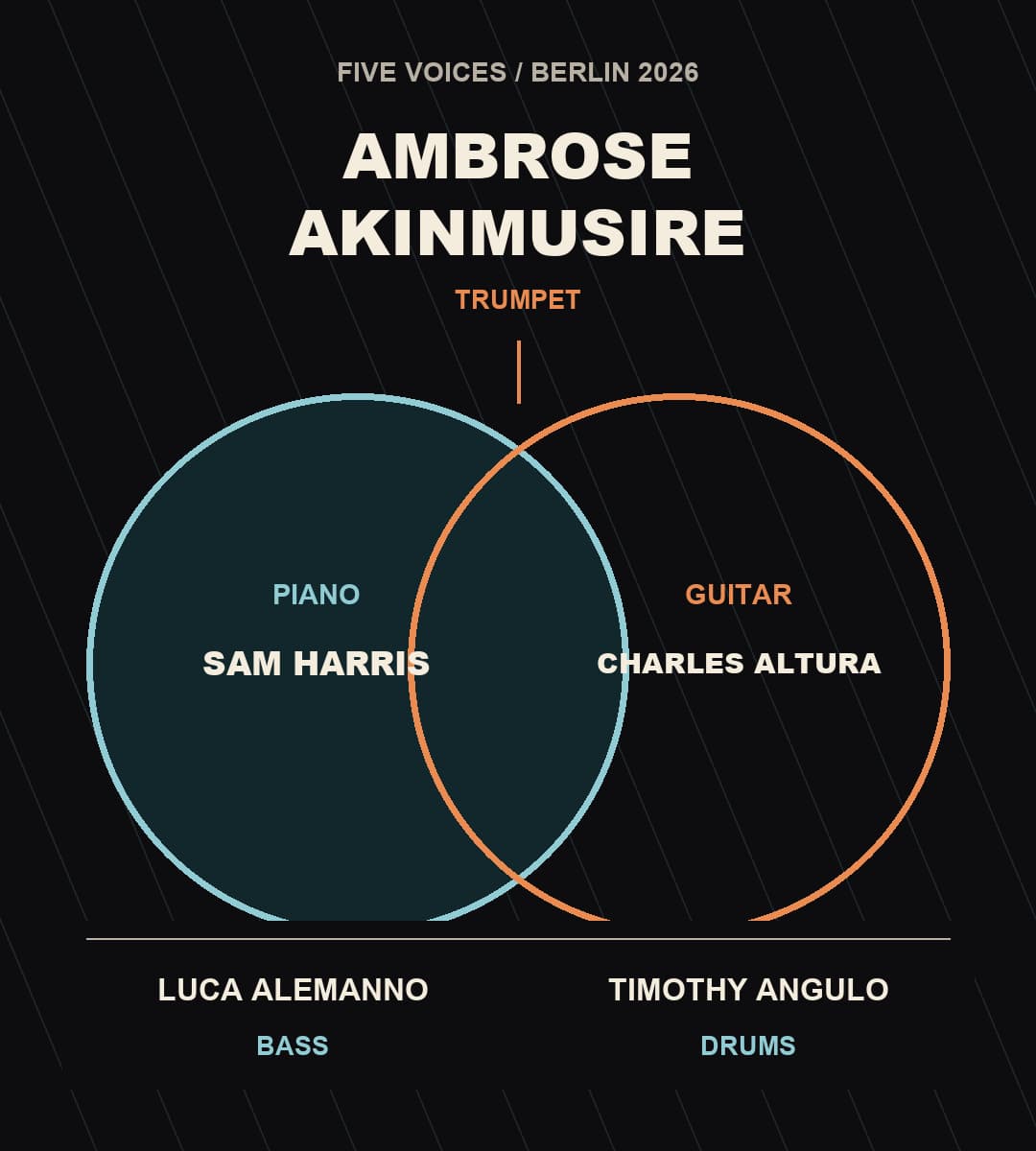
Five voices, one changing balance
Ambrose Akinmusire’s Berlin quintet: the history between piano and guitar
Sam Harris and Charles Altura connect a new five-piece balance to a 2014 recording, with Luca Alemanno and Timothy Angulo shaping what happens next.
A quintet can change its character without changing its size. In 2014, Ambrose Akinmusire’s working five-piece band placed tenor saxophone beside trumpet; his album the imagined savior is far easier to paint opened that group to guitarist Charles Altura, strings and voices. The Berlin quintet advertised for November 17, 2026 puts Altura inside the five-piece frame, alongside pianist Sam Harris, bassist Luca Alemanno and drummer Timothy Angulo. The interesting connection is not a promise to revisit that album. It is the presence of two musicians who helped Akinmusire enlarge his compositional world, now working in a different balance of instruments. [3][1]
Harris and Altura give this concert a history longer than its billing. Alemanno and Angulo make it something other than a reconstruction of the best-known Akinmusire quartet with Harish Raghavan and Justin Brown. At Zig Zag Hall, the useful question is how five particular musicians distribute melody, harmony and movement: when piano and guitar overlap, when they leave each other space, and how bass and drums can redirect the whole group. The presenter has announced the personnel, not a set list. That distinction leaves room for the part of a concert that cannot be written in advance. [1][13]
A recorded history
The 2014 connection was already about changing the frame
Blue Note’s contemporary account of the imagined savior is far easier to paint is unusually helpful here. It names Akinmusire’s working quintet as Walter Smith III, Harris, Raghavan and Brown, then describes Altura’s addition as a move toward a sextet. This matters because the Berlin band should not be mistaken for a reunion of the complete recording ensemble. Three participants in that larger project are present, but the saxophone chair is absent and the bass and drum chairs are different. The connection is real; the configuration is not the same. [3][1]
Akinmusire wrote twelve of the record’s thirteen tracks and produced it himself. Blue Note documents contributions from the OSSO String Quartet, flutist Elena Penderhughes and singers Becca Stevens, Theo Bleckmann and Cold Specks. These were not simply extra soloists placed in front of an unchanged band. The account describes characters and stories behind the compositions, and a process in which the guest singers developed lyrics from ideas he supplied. The album offers a useful precedent for hearing instrumentation as part of the writing, rather than decoration added after it. [3]
His comments about sustain sharpen that point. Discussing the string-and-flute piece “The Beauty of Dissolving Portraits,” Akinmusire identified Arvo Pärt as an influence and spoke about slowly adding and removing material. He also acknowledged how difficult that kind of sustain could be to achieve with a jazz quintet. It would be too much to claim that the Berlin instrumentation is an answer to that specific problem. But the earlier question gives listeners a productive way into the new arrangement: listen not only for what a player introduces, but for what continues sounding while someone else begins. [3][1]
Piano
Harris brings more than continuity
Harris’s relationship with Akinmusire crosses several kinds of ensemble. His official discography includes the imagined savior, A Rift in Decorum, Origami Harvest and on the tender spot of every calloused moment. The continuity is therefore not merely a pianist knowing a book of tunes. It includes work inside a small acoustic group and inside a project that placed piano and keyboards alongside strings and rap. For Berlin, that is a substantial history of adapting to Akinmusire’s changing compositional demands. [4][14]
Harris’s own music is a useful corrective to the idea of a pianist as a permanent supply of chords. His biography describes a practice drawing on blues and environmental music, and identifies HARMONY as a collection of ambient blues meditations. The official Bandcamp release credits Martin Nevin on bass and Craig Weinrib on drums, with all five pieces composed by Harris. Released in November 2018, it offers a separate listening path into the pianist’s priorities, rather than asking listeners to know him only through another leader’s records. [4][5]
That background suggests something concrete to follow in a band with guitar: who decides how much harmony is enough? Piano and guitar can both state chords, but they do not have to do so at the same time or with the same density. Listen for Harris acting as a second melodic voice, letting a texture remain sparse, or changing its weight with a short intervention. Those are listening questions, not a forecast of his performance. His own work makes them more revealing than simply counting how many solos he takes. [4][1]
Guitar
A guitar can alter the space around a trumpet
Altura’s participation in the 2014 record is documented by the label, which also identifies him as a fellow Northern Californian. Zig Zag’s current biography places that Akinmusire connection alongside work with Chick Corea, Terence Blanchard and Tigran Hamasyan. A résumé cannot tell us how someone will play a particular evening, but the earlier recording credit establishes that this is not a guitarist encountering Akinmusire’s music solely for the Berlin booking. There is an existing musical relationship behind the announcement. [3][1]
For a different view of Akinmusire’s interest in guitar, turn to Owl Song, made with Bill Frisell and drummer Herlin Riley. The artist’s own account describes a desire to create music oriented around open space, and praises Frisell’s ability to find the shape of a piece on first encounter. That trio is not the Berlin quintet, and Frisell’s approach should not be assigned to Altura. The useful connection is Akinmusire’s willingness to let the particular people and their instrumental balance determine the music’s possibilities. [7][1]
In Berlin, guitar and piano bring two different attacks and ways of allowing a note to decay. The question is not which one supplies the “real” harmony. It is how their sounds relate to the trumpet’s breath-shaped line, and whether a chord becomes a foundation, an interruption or a lingering trace. Comparing the expanded 2014 project with the deliberately spare Owl Song gives a listener two ends of a spectrum. Neither recording is a programme for November 17; together they help explain why another change of instrumentation is worth hearing. [3][7][1]
Bass and drums
Alemanno and Angulo change the conditions
The names on bass and drums deserve more than a final line in the announcement. Alemanno’s San Diego State University biography documents training in both classical double bass and jazz electric bass, followed by graduation from the Thelonious Monk Institute of Jazz Performance in 2018. His debut album, I Can See Home From Here, brought together a group including Miguel Zenón, Jon Hatamiya, Simon Moullier, Isaac Wilson and Jongkuk “JK” Kim. That is the background of a bandleader and musician accustomed to multiple instrumental colours, not merely a substitute bass chair. [8][9]
Angulo’s official performance archive supplies a particularly useful piece of history: it lists Akinmusire quartet engagements in September 2022 and February 2023. He therefore arrives with a documented relationship of his own. His biography traces his beginnings to Berkeley and names teachers including Milford Graves, Michael Carvin and Ndugu Chancler; it also describes his work with the experimental group L’Rain. The archive establishes prior collaboration without requiring a claim about when he first joined, or whether he has played every subsequent tour. [11]
Against the quartet on the 2020 album, the Berlin booking changes both rhythm-section personnel and the number of harmony-playing instruments. That combination matters. A bass line can anchor piano and guitar to the same direction, or open another route underneath them; a drum response can turn an apparent accompaniment into the centre of the exchange. Rather than treating Alemanno and Angulo as support for a trumpet-and-keyboard story, listen for moments when the other three must respond to them. The band’s balance is a five-way responsibility. [1][15][8][11]
Official listening
Start with the official film, not a predicted set list
The embedded film is “Ambrose Akinmusire - The Imagined Savior Is Far Easier To Paint (EPK),” published by AkinmusireVEVO on May 6, 2014. Blue Note links it from its own artist page, and the upload identifies Blue Note’s copyright. At nine minutes and twenty-one seconds, it is an official introduction to the recording project that connects Akinmusire, Harris and Altura. It is not footage of the 2026 quintet, and it should not be presented as a preview of the Berlin repertoire. [12][13][3]
Use the film alongside the label’s detailed album account, then continue to the recording itself. The notes identify “Richard (conduit)” as an extended performance recorded live at New York’s Jazz Standard, while the vocal and string pieces show other sides of the project. A helpful comparison is between music built around a live small-group exchange and music shaped by a particular voice or sustained texture. The personnel vary across the album; an album-level credit is not evidence that every musician appears on every track. [12][3]
There is a second, shorter route into the evening: follow the HARMONY link to hear Harris in his own trio, then read Akinmusire’s statement about Owl Song. One places the pianist’s compositional identity in the foreground; the other explains the trumpeter’s interest in open space and specific collaborators. These are different projects, deliberately kept distinct. They prepare the ear for decisions about density and duration without pretending that a listener needs to complete a discography before walking into the hall. [5][4][7]
Ambrose Akinmusire - The Imagined Savior Is Far Easier To Paint (EPK)
Blue Note’s official 2014 album film connects the feature to the recording project involving Akinmusire, Harris and Altura. This is historical album context, not footage of the Berlin quintet or a promise of its repertoire.
Watch on YouTube · AkinmusireVEVOThe larger stakes
The changing ensembles carry more than a sound
It would be misleading to reduce Akinmusire’s work to a sequence of instrumental experiments. Blue Note’s account of Origami Harvest describes a project about contrasts, involving Harris, drummer Marcus Gilmore, the Mivos Quartet and Kool A.D. Its social concerns are not separate from its formal ones: Akinmusire discusses the ways Black people are pressured to adapt to imposed expectations. The changes of texture belong to a larger inquiry into how a person lives within, or resists, a frame. [14]
The label’s discussion of on the tender spot of every calloused moment turns toward the blues, resilience and Akinmusire’s experience of returning to a changed Oakland. It names Harris, Raghavan and Brown as the quartet around him. None of that authorizes a claim about what the Berlin concert will address. It does explain why the catalogue rewards attention beyond virtuosity: a change in musical pressure may carry emotional or communal meaning, not simply announce the next solo. The strongest preparation is to keep both kinds of listening available. [15]
November 17 in Berlin
The hall, the hour and the open questions
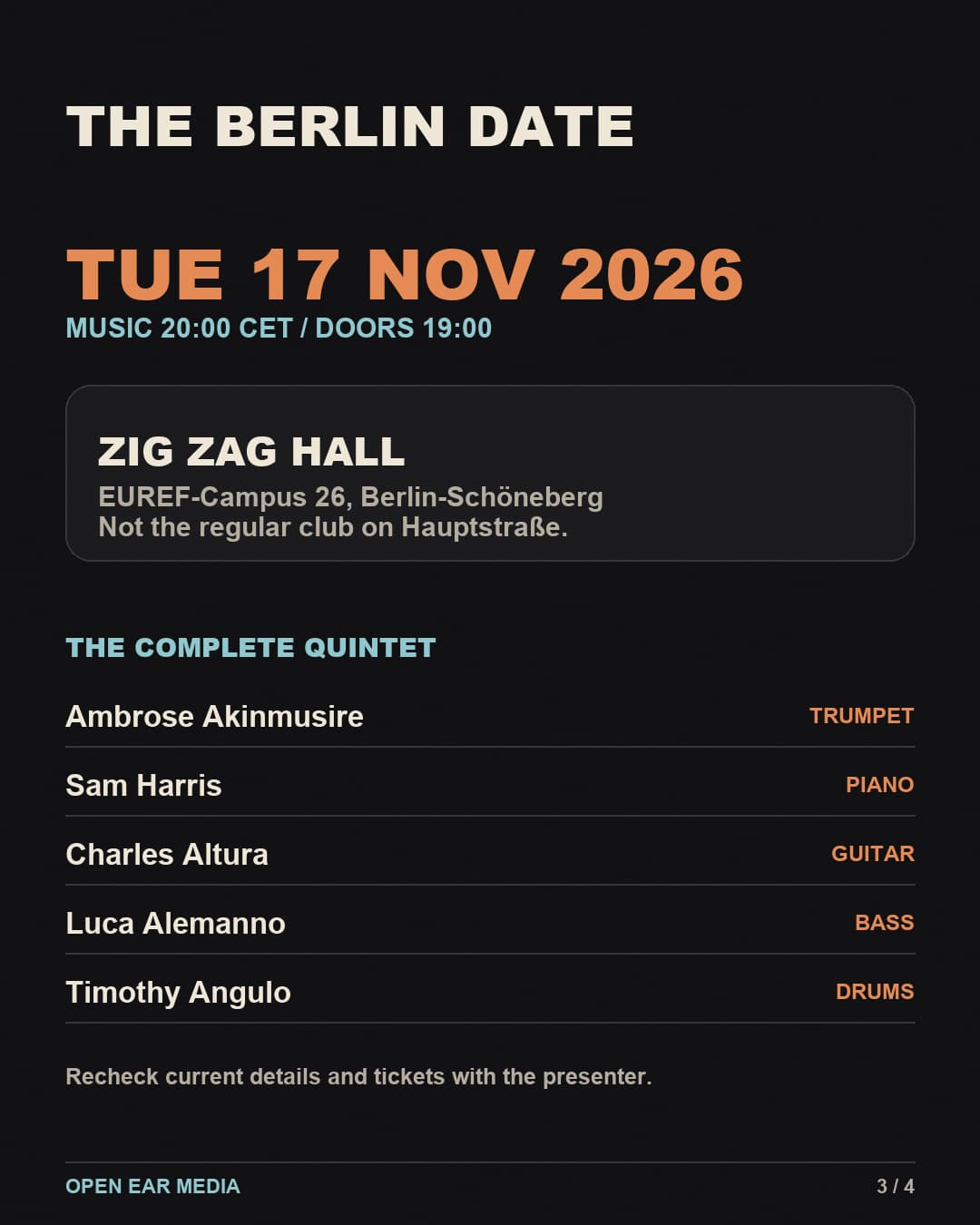
The performance is scheduled for Tuesday, November 17, 2026 at Zig Zag Hall. The presenter’s hall site gives the address as EUREF-Campus 26, 10829 Berlin-Schöneberg. This is not the regular Zig Zag Jazz Club address on Hauptstraße. The distinction is essential for this concert: the event is published on the club’s website, but its title identifies the Hall. The autumn programme’s separate hall address is the practical guide to where the advertised band is playing. [1][2]
Timing also needs a careful reading. The event’s calendar header begins at 19:00, but the body explicitly states a 20:00 start with admission from 19:00. We use 20:00 CET for the music and 19:00 for doors, rather than turning the calendar window into a performance time. The page advertises standard admission at €35 and says seats are allocated first come, first served. It links to Eventim Light, but ticket inventory and a final checkout total have not been verified. Recheck the presenter before travelling. [1]
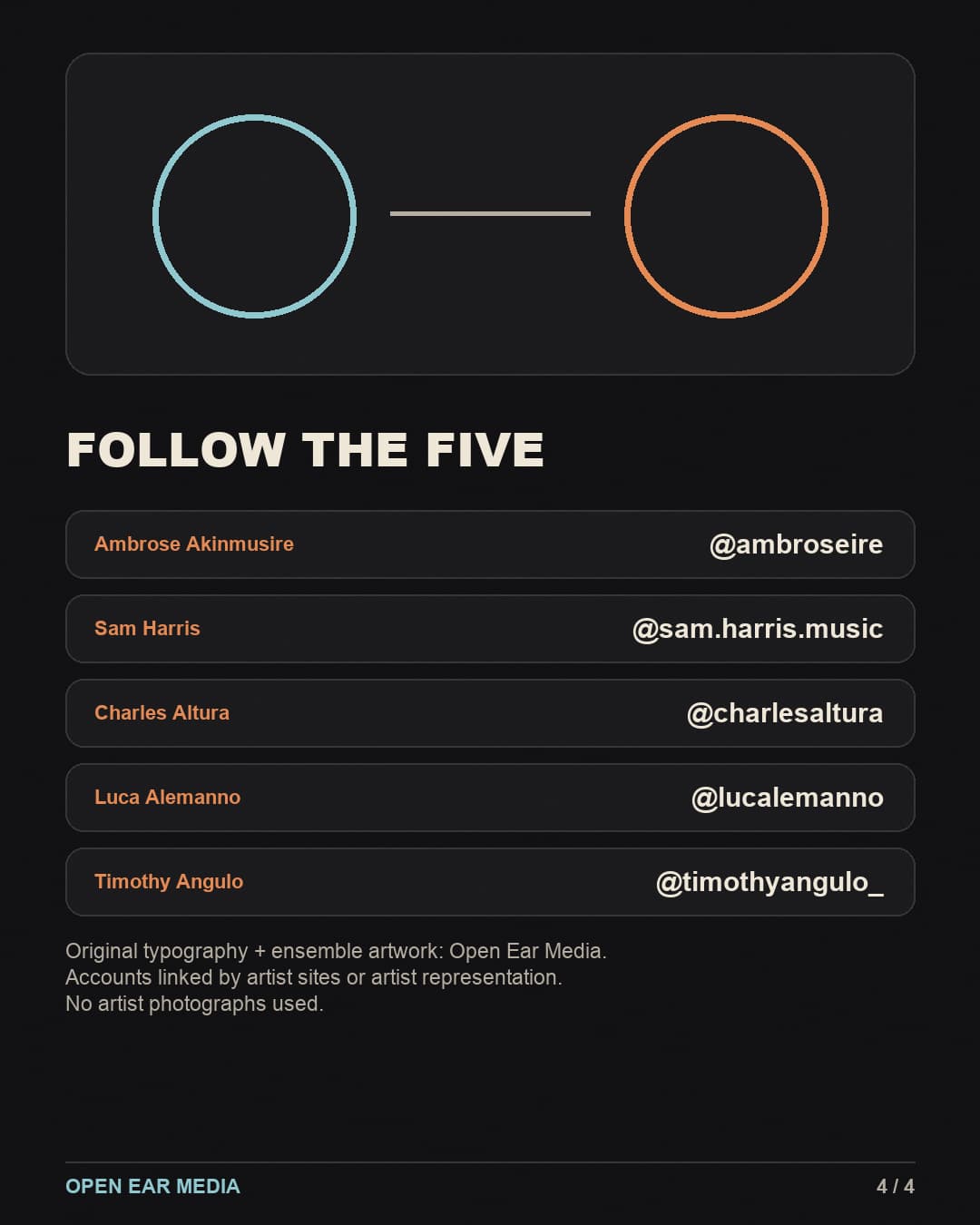
The complete advertised lineup is Akinmusire on trumpet, Harris on piano, Altura on guitar, Alemanno on bass and Angulo on drums. No repertoire or performance running time is promised here. What can be carried into the room is a more useful expectation: three participants in a documented earlier project, two rhythm-section voices with their own histories, and an instrumental balance that need not reproduce any one record. Listen for the point at which the band stops sounding like five individual credits and makes a decision together. [1][3][8][11]
The social edition
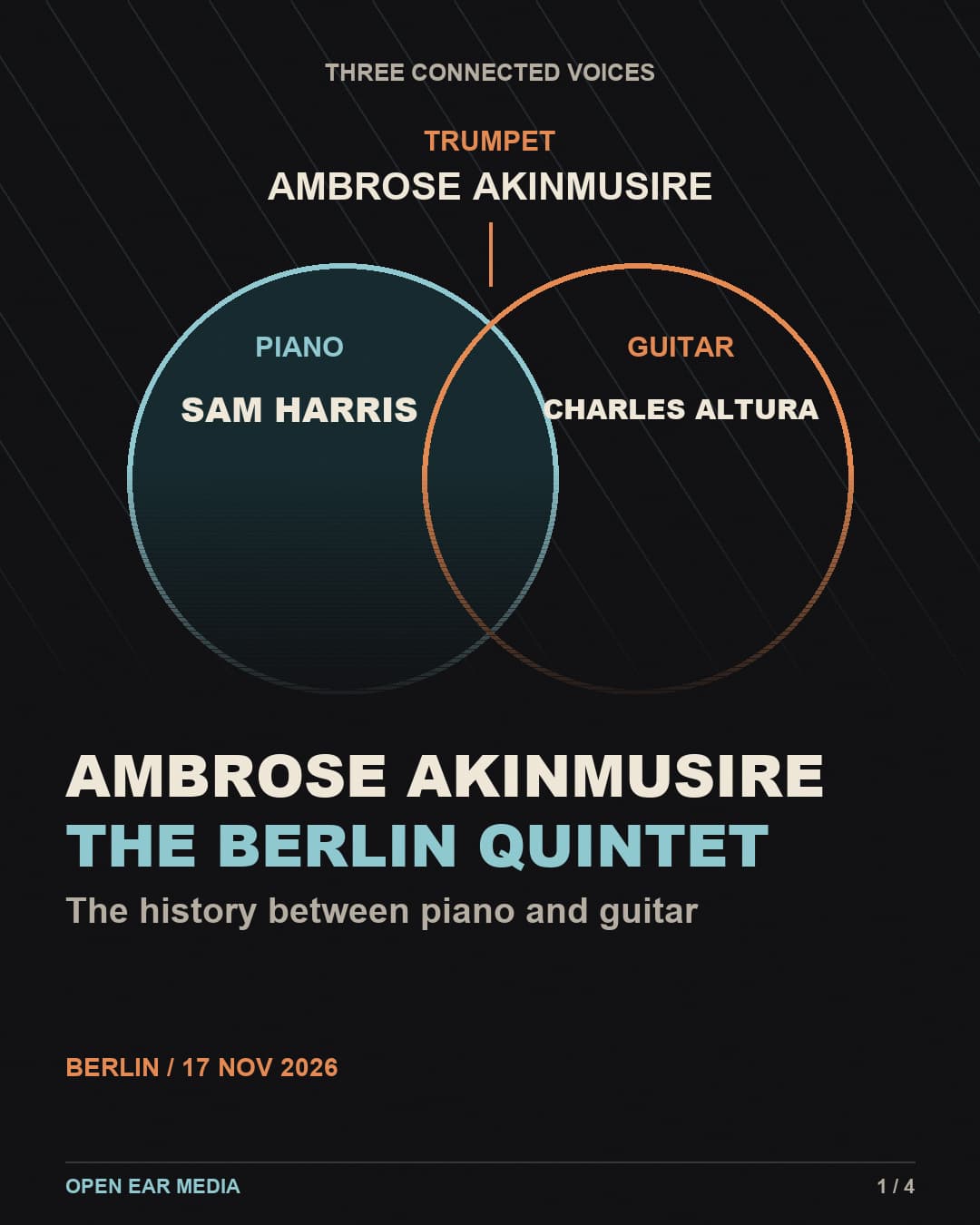
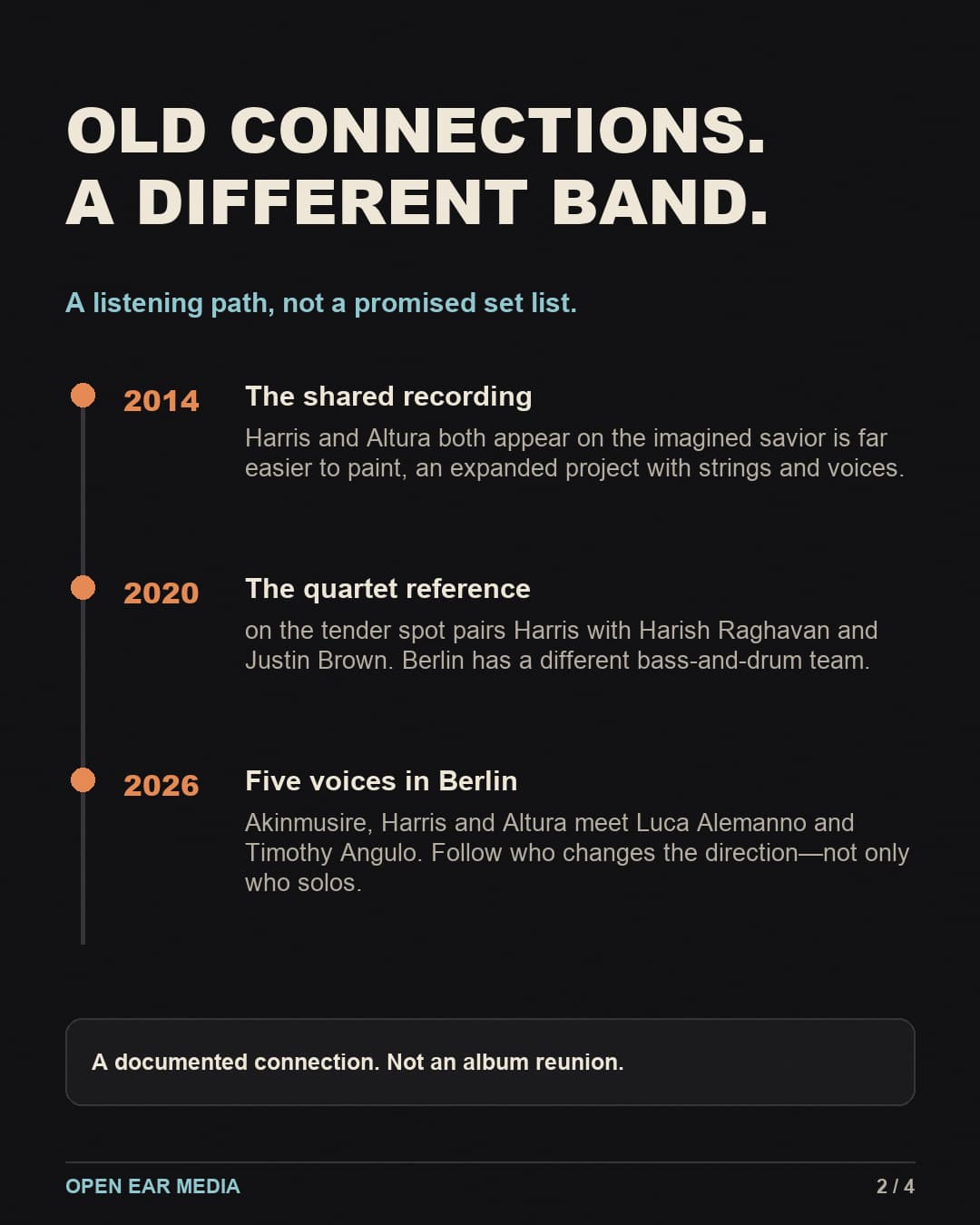
The story in four frames
A concise visual guide for listeners, derived from the researched feature above rather than the other way around.
Research trail
Sources and further listening
Primary artist, presenter, label, and event sources lead this list. Reviews and discographic databases are used for listening context and detailed recording credits. Each source was checked on the date shown in the feature metadata.
- 1ZIG ZAG HALL: Ambrose Akinmusire Quintet
Zig Zag Jazz Club · official event
Supports: November 17, 2026, complete quintet, 20:00 start and 19:00 doors, advertised price and seating policy.
- 2Zig Zag Hall 2026 — Fall Program Berlin
Zig Zag Hall · official event
Supports: physical hall address, distinction from the regular club.
- 3Ambrose Akinmusire Broadens His Palette
Blue Note Records · official label
Supports: 2014 recording personnel, Charles Altura joins the palette, compositional approach, string and vocal contributions.
- 4Sam Harris — biography and selected discography
Sam Harris · official artist
Supports: collaboration history, HARMONY and SOLO, official Instagram.
- 5HARMONY — credits and official listening
Sam Harris / Bandcamp · official artist
Supports: November 14, 2018 release, Martin Nevin and Craig Weinrib, five pieces and composer credits.
- 6Charles Altura — official website
Charles Altura · official artist
Supports: official artist identity and Instagram.
- 7Owl Song — artist statement
Ambrose Akinmusire · official artist
Supports: Bill Frisell and Herlin Riley, open-space approach, official artist Instagram.
- 8Luca Alemanno — faculty biography
San Diego State University School of Music and Dance · official artist
Supports: acoustic and electric bass training, 2018 Institute graduation, I Can See Home From Here personnel.
- 9Luca Alemanno — Biography
Luca Alemanno · official artist
Supports: official website, classical double bass and jazz electric bass education.
- 10Luca Alemanno — artist profile
New Age Productions · official artist
Supports: represented artist identity, official Instagram link.
- 11Timothy Angulo — biography and performance archive
Timothy Angulo · official artist
Supports: Berkeley origins, teachers, L’Rain collaboration, 2022–23 Akinmusire performances, official Instagram.
- 12Ambrose Akinmusire - The Imagined Savior Is Far Easier To Paint (EPK)
AkinmusireVEVO / Blue Note Records · media
Supports: official album film, title, channel, duration and upload date.
- 13Ambrose Akinmusire — artist catalogue and videos
Blue Note Records · official label
Supports: official EPK endorsement and channel identity, quartet personnel and release chronology.
- 14Ambrose Akinmusire: Origami Harvest
Blue Note Records · official label
Supports: 2018 contrasting ensembles, Sam Harris, Marcus Gilmore, Mivos Quartet and Kool A.D., social context.
- 15Ambrose Akinmusire: on the tender spot of every calloused moment
Blue Note Records · official label
Supports: 2020 quartet personnel, blues and resilience, Oakland and community context.