
Adi Meyerson’s Dark Matter quartet
What the quartet leaves unwritten
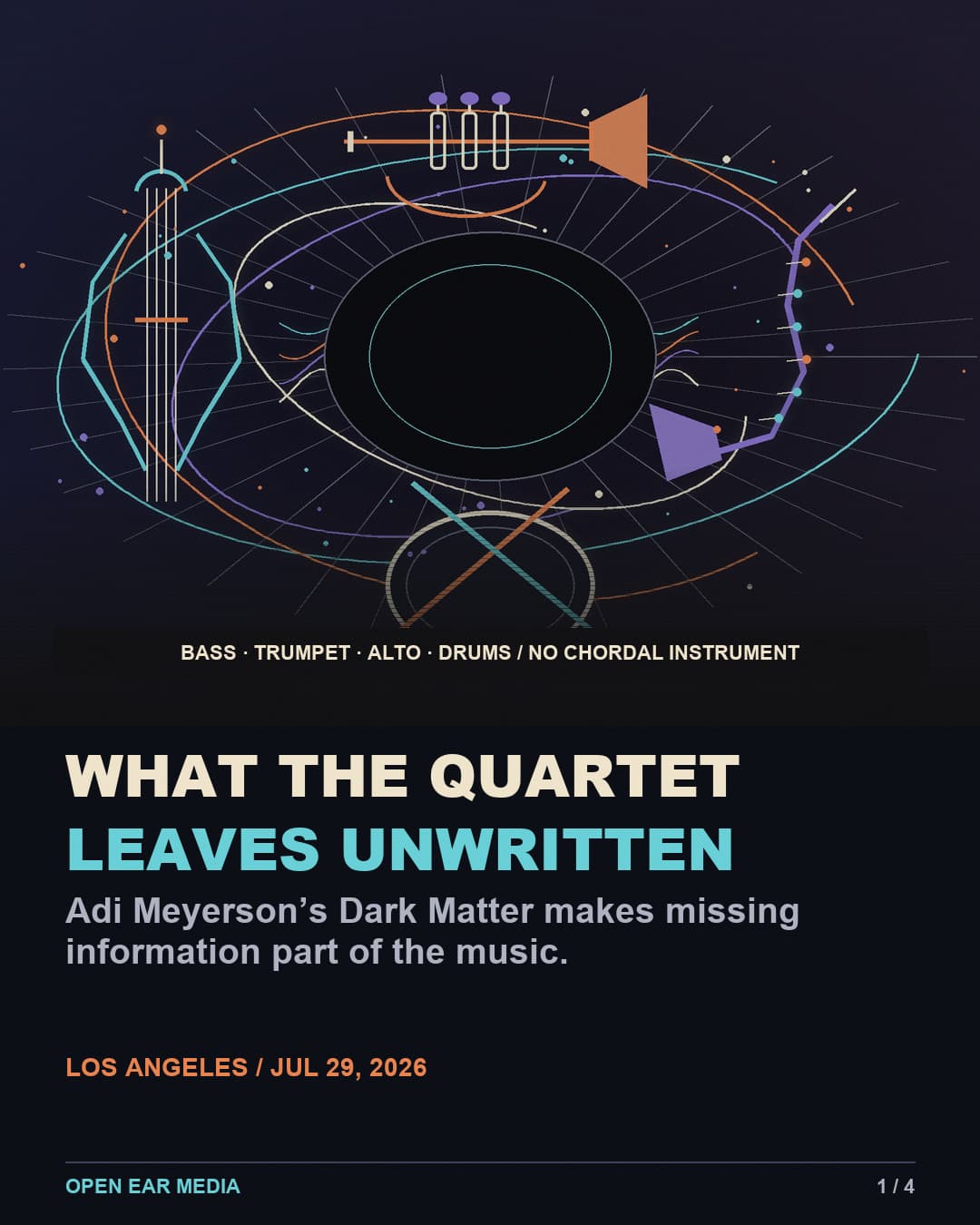
With no piano or guitar, Adi Meyerson, Nicole McCabe, Julien Knowles and Anthony Fung turn missing information into the working material of a quartet.
A grand piano occupies nearly half the frame in Adi Meyerson’s official 2024 Dark Matter videos from Sam First. Its lid is closed. The active band is trumpet, alto saxophone, acoustic bass and drums: four musicians working without a pianist or guitarist to declare every chord. That visual gets to the center of Meyerson’s project. Dark Matter is not music with something accidentally missing. It is music designed around the information a composer chooses not to supply. [4][5][7]
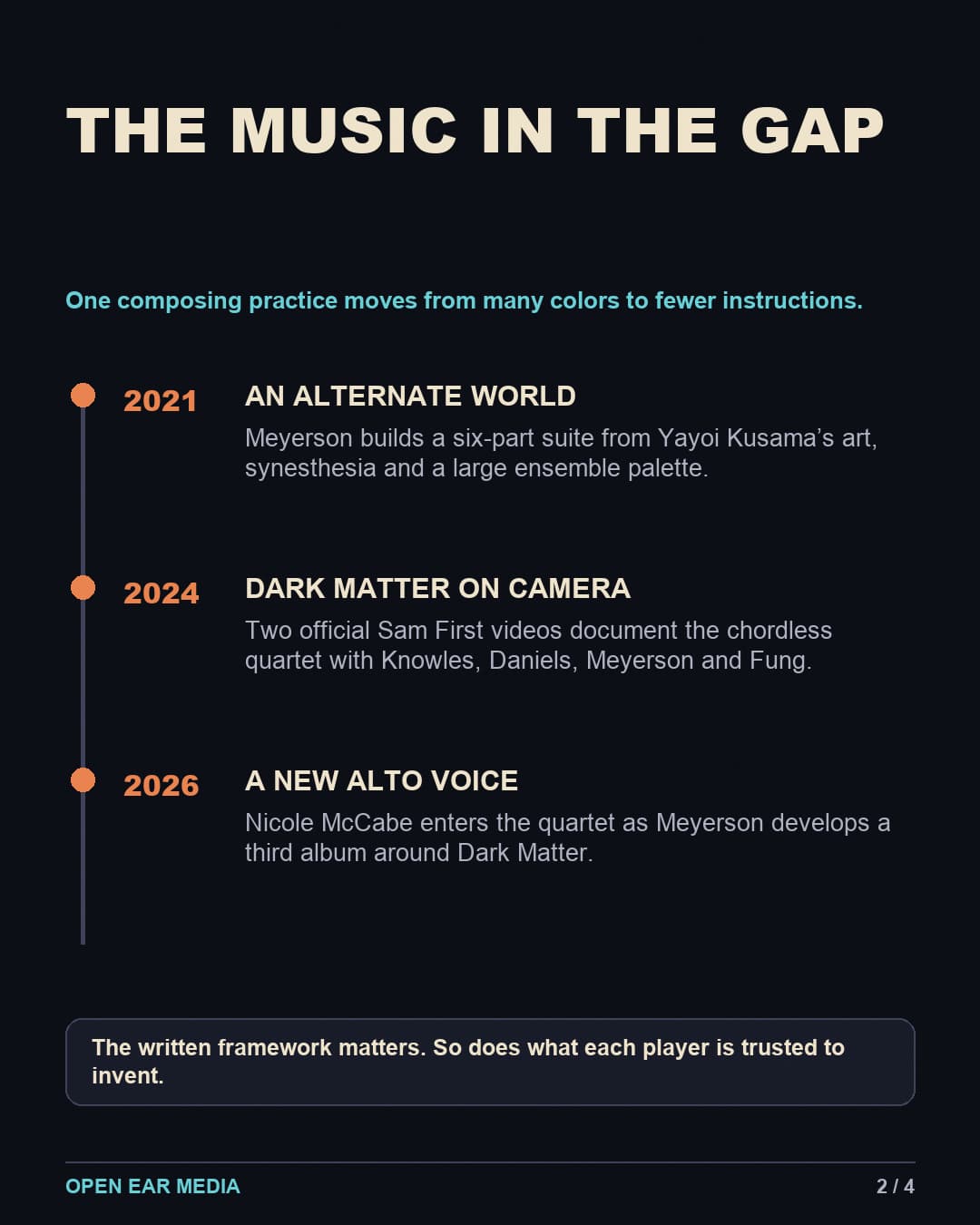
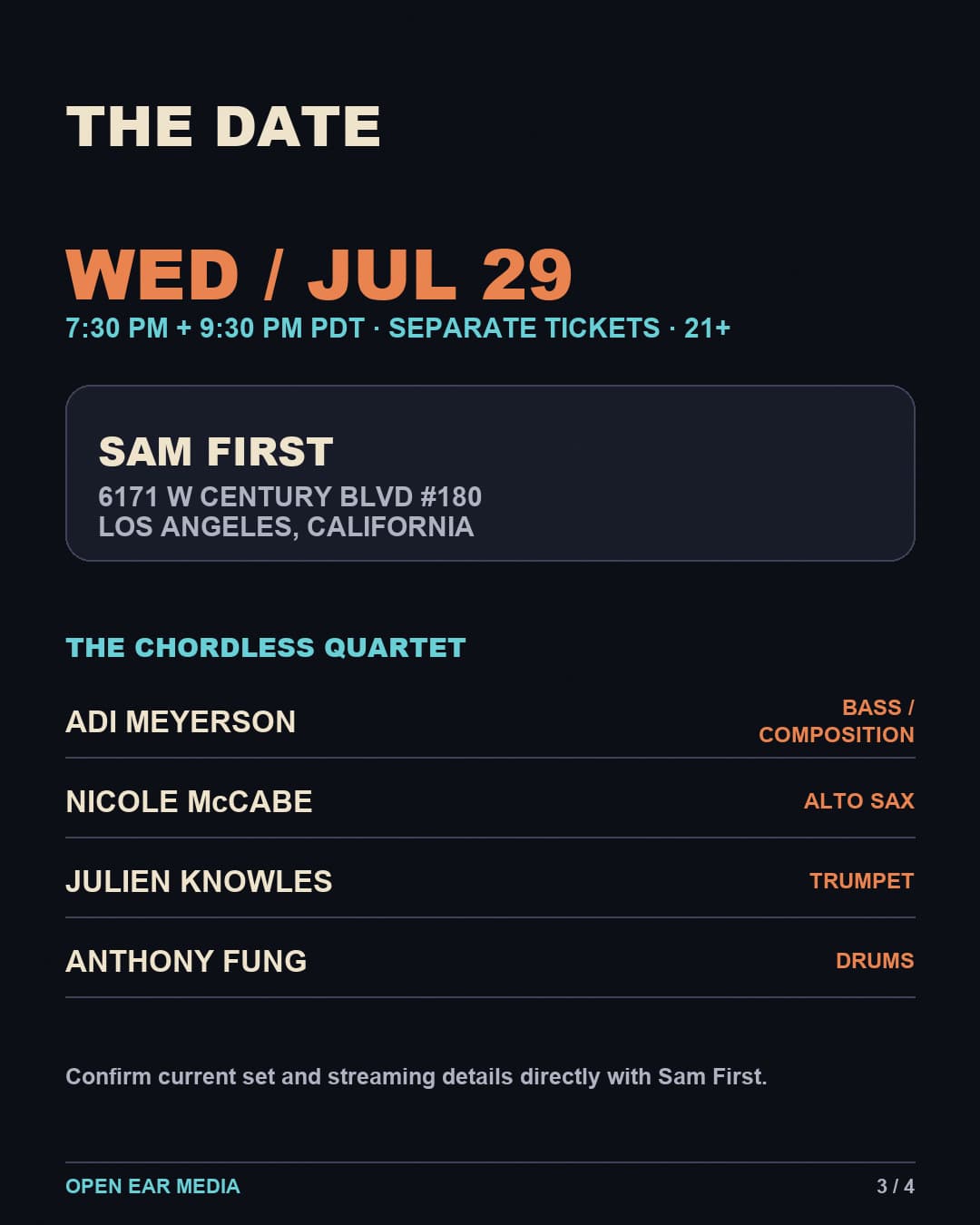
On July 29, Meyerson returns to the same Los Angeles room with drummer Anthony Fung and trumpeter Julien Knowles from that filmed quartet, while Nicole McCabe takes the alto chair previously held by Devin Daniels. Sam First describes the music as a balance between composition and improvisation, tension and release, silence and sound. The personnel change makes the premise newly audible: if the unwritten space truly belongs to the players, a new player must change what that space contains. [1][7][4]
This is also a project in motion rather than a tour behind a finished artifact. Meyerson’s current biography says she is recording her third album around Dark Matter, and Chamber Music America named the ensemble to its 2024 Performance Plus cohort with trumpeter Sean Jones as artist-educator. The Sam First date offers a view into the work before an album fixes its sequence, takes and personnel into a permanent form. [3][8]
The organizing idea
A chordless quartet makes absence functional
Meyerson calls Dark Matter a chordless acoustic quartet and describes a push and pull between freely improvised and more structured music. The crucial phrase in her official presentation is a focus on what is not written on the page. A conventional chordal instrument can spell out a progression, thicken a melody and establish a harmonic floor almost continuously. Remove it and those jobs do not disappear; they circulate among bass, horns, drums and the listener’s memory. [4][7][1]
The bass may state a root, trace a counterline or leave a note hanging without completing its implication. Alto and trumpet can define harmony through the interval between them, then separate into melodies that suggest different destinations. Fung can make pulse explicit, disturb it or reduce it to color. None of those possibilities predicts what the quartet will play on July 29. They explain why limited notation can increase responsibility: each musician must decide which missing fact the music needs and which one is better left absent. [1][5][6]
Meyerson’s stated goal is not abstraction for its own sake. She describes the music as a space-and-time travelogue that moves between lyricism and more abstract sound, offering calm reflection on the immediate moment through tension, exhalation, silence and cacophony. Those are not opposing genres. They are changes of pressure within one design, and the quartet’s identity lives in the route between them. [1][4]
a focus on what’s not written on the page
A developing book
Dark Matter has a history without becoming a fixed lineup
The public record begins at least as early as the February 2024 Sam First performance documented on Meyerson’s site and YouTube channel. That edition placed Julien Knowles and Devin Daniels in the horn line with Meyerson and Anthony Fung. The venue billed two sets, and Meyerson released official videos of the pieces “Time Waits For No One” and “Follow the Red Dot” from the night. This is unusually clear evidence of a project’s working language, not a promotional montage with anonymous personnel. [7][4][5][6]
Later in 2024, Chamber Music America selected Dark Matter for Performance Plus, a program pairing women and gender-minority jazz bandleaders with experienced artist-educators; Meyerson’s listed partner was Sean Jones. Her official biography now describes Dark Matter as the jazz quartet featured on a third album in progress. Together, those sources show sustained development—performance, outside mentorship and recording—without telling us that every edition must use identical personnel. [8][3]
The July 2026 lineup preserves three parts of the filmed Sam First ensemble and changes one. Nicole McCabe does not enter as a substitute whose task is to reproduce Daniels’s part. In a project premised on information created from information withheld, the alto player’s phrasing, register, articulation and tolerance for silence become compositional variables. Continuity gives the music a grammar; the changed voice tests whether that grammar remains alive. [1][7][4][11]
Watch the earlier quartet
The closed piano is the first listening cue
Start with “Time Waits For No One,” filmed at Sam First in February 2024. The camera keeps the room legible: two horns at the front, Meyerson and Fung behind them, and the club’s grand piano closed at the left edge. The official credits identify Knowles, Daniels, Meyerson and Fung. Three of those four musicians return in 2026, so the video documents the project’s architecture while stopping short of representing the current lineup. [5][7][1]
Listen first for harmonic implication rather than a missing chord symbol. When the horns move together, the distance between trumpet and alto can make a temporary sonority; when one drops out, bass motion and the remaining horn line carry more of the map. Then listen to the handoff between foreground and support. A bass figure can be structural without becoming an accompaniment pattern, and drum texture can alter the perceived weight of a phrase before tempo visibly changes. [5][4]
“Follow the Red Dot,” from the same night, is useful as a second angle because the personnel and room remain constant while the composition changes. Do not treat either performance as a forecast set list: Sam First has published no repertoire for July 29. Use them instead to learn the project’s questions—how a written anchor emerges, how long it remains binding, and what the quartet does when the next instruction is not obvious. [6][1][4]
Time Waits For No One - Dark Matter
Meyerson’s official video documents the February 2024 Dark Matter quartet at Sam First with Julien Knowles, Devin Daniels and Anthony Fung—three members of the current project plus the previous alto voice.
Watch on YouTube · Adi MeyersonFollow the Red Dot - Dark Matter Quartet Live
A second official composition from the same February 2024 Sam First session lets listeners compare how one chordless lineup negotiates a different written framework.
Watch on YouTube · Adi MeyersonThe bandleader’s route
Meyerson has been composing environments, not just tunes
Dark Matter’s travelogue language has a precedent in Meyerson’s second album, the six-part 2021 suite I Want to Sing My Heart Out in Praise of Life. In her Bandcamp notes, she traces the work to Yayoi Kusama’s art, the idea of an alternate universe built from love and compassion, and her own synesthesia: Kusama’s palette resembled colors Meyerson associates with pitches. The suite became an exploration of mental health, womanhood and identity during the pandemic. [9]
That album uses a broad palette—trumpet, flute, bass clarinet and saxophone, keyboards, drums, several vocalists and spoken word around Meyerson’s bass and compositions. Dark Matter reverses the production problem. Instead of assigning a large ensemble enough distinct color, it asks four acoustic players to make a complete environment from fewer fixed layers. The continuity is the invitation to inhabit a world; the new method is to leave more of that world unfinished until performance. [9][4][3]
Meyerson’s first album, Where We Stand, already framed uncertainty as both ambivalence and anticipation, with hard-bop reference points and an ensemble chosen for distinct individual sounds. The thread across these records is not a steady march away from tradition. It is a concern with how a band turns uncertainty into form. Dark Matter makes that concern unusually exposed because there is nowhere for an unresolved choice to hide inside a continuous chordal cushion. [10][4]
A new alto voice
Nicole McCabe brings her own methods for finding form in open space
McCabe’s recent catalog makes her more than a timbral change in the horn line. Her 2025 solo album A Song To Sing began with spontaneous work on synthesizer, piano, percussion and clarinet, then used processing, looping and layering as a route back to melody. The label notes describe a recording process that prized discomfort and spontaneity; when familiar alto-saxophone habits were unavailable, McCabe had to locate form through other actions. [13]
Her 2026 album Color Theory takes another route: eleven McCabe compositions recorded live with a core quartet, guests and producer Jason Moran. Its official notes emphasize groove, ensemble performance, solo looping and improvisation. The record is more arranged than Dark Matter’s public description suggests, but the relevant connection is methodological. McCabe has recent experience moving between fixed ensemble writing, electronic construction and exposed improvisation without treating those practices as separate identities. [12][11]
She also shares local bandstand history with Knowles. Sam First presented McCabe’s Color Theory release in February 2026 with Knowles on trumpet, Luca Mendoza on piano, Logan Kane on bass and Myles Martin on drums. Dark Matter removes that piano and changes the rhythm section, but the alto-trumpet pair arrives with a recent experience of shaping McCabe’s compositions in this exact room. Listen for what survives when the harmonic center is no longer continuously voiced. [14][1][12]
The returning voices
Julien Knowles and Anthony Fung already know how this system breathes
Knowles’s 2024 debut As Many, as One is built around a productive paradox: one artist can carry many influences, while an individual statement depends on a musical village. His notes also invoke the idea that body and mind can be both two and one. The album realizes that thinking through a quintet, occasional string quartet and compositions that balance individual identity with ensemble unity. NPR’s Nate Chinen heard a “controlled burn” and a gift for “unforced connection.” [16][15][17]
Those ideas are practical inside Dark Matter. Trumpet can oppose the alto, fuse with it, complete a bass implication or refuse all three roles. Knowles’s official biography emphasizes spontaneity and sensitivity, while his debut credits Devin Daniels throughout most of the album. The 2024 Dark Matter videos therefore capture an existing horn relationship; July 29 asks Knowles to retain the project’s memory while building a different one with McCabe. [15][16][5][1]
Fung is the other continuous partner in the public Sam First record. His bandleader catalog has repeatedly treated freedom as an organizing question, from 2022’s What Does It Mean to Be Free? to the 2026 guitar-trio album Common Language. The latter strips his core band to drums, guitar and bass, with guests on selected tracks. That is a different sound from Dark Matter, but it shows a drummer composing for lean instrumentation and taking responsibility for architecture rather than merely decorating someone else’s form. [18][19][7][1]
In a quartet without piano, Fung can clarify a section simply by changing density, attack or the amount of pulse he makes explicit. He can also leave the horns and bass to define an arrival without confirming it. The two official 2024 pieces are the safest guide to that relationship: they show him inside Meyerson’s book, in this room, with Knowles beside him. His role on July 29 is not inferred from a résumé; it is part of the project’s documented sound. [5][6][7]
The room matters
Sam First does not separate performance from documentation
Sam First describes itself as an intimate Los Angeles club within walking distance of LAX, presenting two sets Tuesday through Saturday. Its recording operation is not incidental: the room can function as a studio with a Yamaha grand, dedicated microphones, preamps and a multichannel digital system. Sam First Records says its purpose is to document concerts in the venue’s natural acoustics so listeners feel the moment of creation in the room. [20][21][22]
Dark Matter already belongs to that documentary ecology. The 2024 videos preserve the ensemble and show the physical distance among the players; the current event page carries a notice that Sam First records and livestreams performances. That matters for a music built from small adjustments. In a close room, a breath before a horn entrance, the decay of a bass note or a drummer’s move from cymbal to silence can register as structure rather than background detail. [7][5][1][22]
The current digital details require care. Sam First lists separately ticketed 7:30 and 9:30 p.m. sets and a 21+ policy, while Meyerson’s own calendar displays 7:00 p.m. Jazz DateBook follows the venue’s set selectors. The first-set stream description also exposes a YouTube link whose title is for a different July 31 performance, so we are not treating that link as a verified Dark Matter stream. The in-room date and lineup are well supported; streaming buyers should ask Sam First to confirm the correct destination. [1][2][23]
At downbeat
Listen for decisions before you listen for solos
First, track how harmony becomes temporarily legible. It may arrive as a bass note under a two-horn interval, as a melody whose contour implies its own changes, or as a unison that narrows several possibilities into one. When the sound opens again, notice whether the quartet has actually abandoned that harmony or simply stopped naming it. Chordless does not mean harmony-free; it means harmony can remain mobile. [4][5][6]
Second, hear McCabe as an author of the current version. The earlier videos teach the form of the question, not the answer she will give. Her recent music moves from live quartet writing to looping, woodwinds, voice and studio-built layers; her official biography stresses shifts between delicate melody and rhythmically charged improvisation. Listen for whether she fills the newly available space, sharpens it with short phrases or makes it feel larger by waiting. [11][13][12][1]
Finally, follow transitions. Meyerson defines Dark Matter through the pull between structure and freedom, lyricism and abstraction, silence and cacophony. The decisive moments may be the hinges: a written figure loosening, a pulse appearing without announcement, two horns discovering a shared endpoint, or the band declining to resolve. The quartet’s subject is not emptiness. It is what four musicians can build when no one has been given all the information in advance. [1][4][8]
The social edition
The story in four frames
A concise visual guide for listeners, derived from the researched feature above rather than the other way around.
Research trail
Sources and further listening
Primary artist, presenter, label, and event sources lead this list. Reviews and discographic databases are used for listening context and detailed recording credits. Each source was checked on the date shown in the feature metadata.
- 1Adi Meyerson & Dark Matter with Nicole McCabe, Julien Knowles & Anthony Fung
Sam First · official event
Supports: July 29, 2026 date, 7:30 and 9:30 set times, complete current lineup and roles, Sam First address, 21+ policy, separate tickets, project description, recording and livestream notice.
- 2Dark Matter Quartet — July 29, 2026
Adi Meyerson · official event
Supports: artist-confirmed date, Sam First, Los Angeles, artist calendar’s conflicting 7:00 p.m. display.
- 3Adi Meyerson biography
Adi Meyerson · official artist
Supports: official identity, bass, composition and education, two prior albums, third album in progress featuring Dark Matter, Performance Plus grant, official Instagram and YouTube.
- 4Dark Matter videos and project statement
Adi Meyerson · official artist
Supports: chordless ensemble description, composition and improvisation concept, unwritten-information concept, tension and release, February 2024 Sam First personnel, official videos.
- 5Time Waits For No One - Dark Matter
Adi Meyerson · media
Supports: official February 2024 Sam First performance, composition title, Julien Knowles, Devin Daniels, Adi Meyerson, Anthony Fung, video metadata, chordless instrumentation.
- 6Follow the Red Dot - Dark Matter Quartet Live
Adi Meyerson · media
Supports: official February 2024 Sam First performance, composition title, Julien Knowles, Devin Daniels, Adi Meyerson, Anthony Fung, video metadata, second listening example.
- 7Adi Meyerson’s Dark Matter with Julien Knowles, Devin Daniels & Anthony Fung
Sam First · official event
Supports: February 1, 2024 performance, complete prior lineup, chordless acoustic quartet description, two-set format, same physical room.
- 8CMA Announces the Recipients of its 2024 Performance Plus Grant Awards
Chamber Music America · publication
Supports: Dark Matter grant selection, Adi Meyerson as bandleader, Sean Jones as artist-educator, program context.
- 9I Want to Sing My Heart Out in Praise Of Life
Adi Meyerson · official label
Supports: 2021 release, six-part suite, Yayoi Kusama inspiration, synesthesia, mental-health and identity themes, complete instrumentation and personnel, artist statement.
- 10Where We Stand
Adi Meyerson · official label
Supports: debut album concept, hard-bop reference point, uncertainty and anticipation, ensemble identities, artist statement.
- 11Nicole McCabe official biography
Nicole McCabe · official artist
Supports: official identity, alto saxophone and composition, Los Angeles context, acoustic and electronic work, melodic and rhythmic range, official Instagram and YouTube.
- 12Color Theory
Nicole McCabe · official label
Supports: February 2026 release, eleven compositions, live quartet recording, solo looping, complete personnel, Jason Moran production, groove and texture concept.
- 13A Song To Sing
Nicole McCabe / Colorfield Records · official label
Supports: March 2025 release, spontaneous multi-instrument process, processing and looping, discomfort and spontaneity, space as a creative tool, complete personnel.
- 14Nicole McCabe Color Theory Album Release Show with Julien Knowles
Sam First · official event
Supports: February 21, 2026 performance, Nicole McCabe and Julien Knowles shared bandstand, complete lineup, Sam First room, Color Theory release context.
- 15Julien Knowles official biography
Julien Knowles · official artist
Supports: official identity, trumpet and composition, Los Angeles scene, improvisational priorities, Herbie Hancock Institute, As Many, as One, official Instagram and YouTube.
- 16As Many, as One
Julien Knowles / Biophilia Records · official label
Supports: April 2024 release, album concept, complete personnel, Devin Daniels collaboration, quintet and string quartet writing, Los Angeles recording.
- 17The Essential Jazz Discoveries of 2024
NPR · publication
Supports: critical assessment of As Many, as One, Julien Knowles and Devin Daniels relationship, composition and ensemble interpretation.
- 18Anthony Fung official biography and discography
Anthony Fung · official artist
Supports: official identity, drums and composition, Los Angeles base, leader discography, Herbie Hancock Institute, Chinese Immigration Suite, official Instagram.
- 19Common Language
Anthony Fung · official label
Supports: May 2026 release, guitar-trio core instrumentation, complete personnel, Anthony Fung compositions and production, Los Angeles recording.
- 20About Sam First
Sam First · publication
Supports: venue mission, intimate setting, LAX proximity, two-set schedule, official address, official Instagram.
- 21Sam First Studio
Sam First · publication
Supports: recording-studio operation, Yamaha grand piano, microphone and preamp inventory, digital recording system.
- 22Sam First Records
Sam First Records · official label
Supports: venue recording mission, concert documentation, natural acoustics, Los Angeles creative music scene.
- 23YouTube page currently linked from the first-set stream detail
Sam First · media
Supports: mismatched Peter Erskine July 31 title, reason the link is not presented as a verified Dark Matter livestream.